Two Yale Dropouts Are Undercutting a Multibillion-Dollar Prison-Phone Cartel, and They Just Took It to Pakistan
Ameelio gives away for free what Securus and ViaPath have charged families as much as $22.56 to get for fifteen minutes: the sound of a loved one's voice from behind bars.
By Carry and Conquer Publications
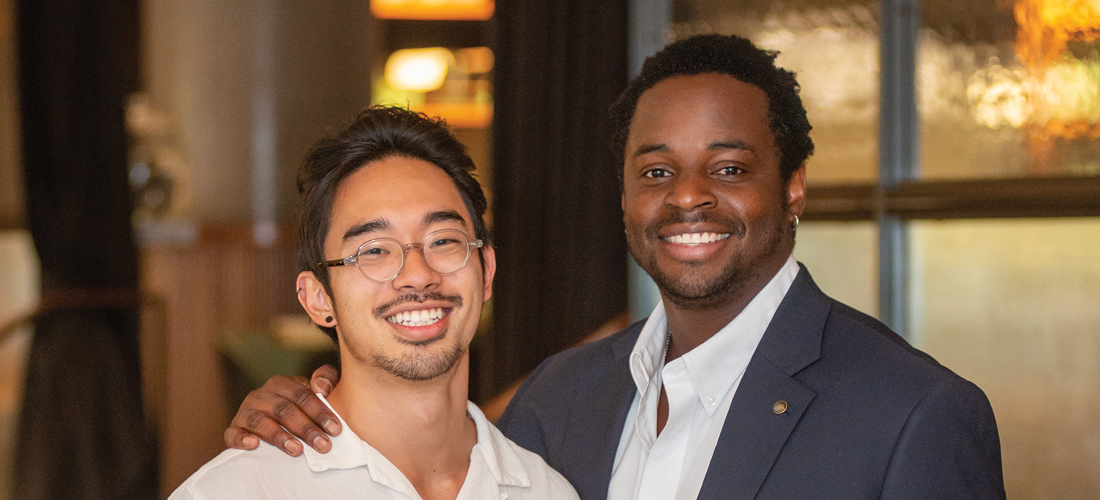
In 2019, Uzoma "Zo" Orchingwa was a first-year student at Yale Law School thinking about friends from his childhood in West Hartford, Connecticut, who had ended up incarcerated as teenagers. He also carried memories of the civic dysfunction he had witnessed growing up in Nigeria before his family moved to the United States. Those two threads converged into a conviction that the legal system alone could not fix what was broken in American incarceration. Technology might. Orchingwa found his technical co-founder over coffee in New Haven: Gabriel Saruhashi, then a Yale undergraduate who had interned as a software engineer at Facebook and turned down a return offer because he wanted to build something more meaningful than social media. Together they founded Ameelio, a name derived from the word "ameliorate," to make things better.
A Billion-Dollar Toll Booth on Family Contact
The industry Ameelio set out to challenge is a case study in captive-market pricing. When a state prison system or county jail signs with a telecom vendor, that vendor becomes the only legal way for incarcerated people to call home, and the vendor knows it. Two companies, Securus Technologies and ViaPath Technologies (formerly Global Tel-Link), have historically controlled an estimated 74 to 83 percent of the market. In 2018, Securus charged as much as $22.56 for a fifteen-minute phone call, while ViaPath charged up to $16.50. Contracts are typically awarded not to the lowest-cost provider but to whichever company offers correctional agencies the largest "site commission," a kickback funded entirely by the families paying the bill. Former FCC Commissioner Mignon Clyburn once called the arrangement the clearest case of market failure she had seen as a regulator.
Securus is a subsidiary of Aventiv Technologies, owned by the private equity firm Platinum Equity. The economics of that ownership structure are now under real strain. After the FCC voted in 2024 to slash interstate calling rate caps, Aventiv's bond value collapsed to 47 cents on the dollar, and S&P Global and Moody's both downgraded the company to junk status. Unable to refinance or find a buyer, Platinum Equity pushed Aventiv into an out-of-court, debt-for-equity restructuring in April 2025 that handed majority ownership to its lenders. Then the political winds shifted again: in October 2025, a Republican-controlled FCC voted 2-1 to roll back the rate caps it had approved a year earlier, allowing phone calls to cost up to eleven cents a minute and video calls up to twenty-three cents a minute in large facilities, several times what the 2024 order had set. Commissioner Anna Gomez, the lone Democrat, called the reversal an act of "shielding a broken system that inflates costs and rewards kickbacks." For a private, for-profit calling model, in other words, the ground keeps shifting depending on who holds the majority at the FCC. Ameelio's answer was never to wait for a regulator to fix the market. It was to make the market's price irrelevant by giving the service away.
Letters First, Then Video, Then a Cartel's Business Model
Ameelio's first product, launched in 2020 amid COVID-19 lockdowns that suspended in-person prison visits nationwide, was deliberately unglamorous: a mobile app that let families type a message, which Ameelio then printed and mailed as a physical letter, since paper mail remains the one format every prison accepts. Within a year the nonprofit had sent nearly two million letters and built a user base in the hundreds of thousands. That letter-writing tool, along with the earlier Ameelio Mail service, has since been sunset as the organization consolidated around its core communications suite.
The real assault on the industry came in June 2021, when Ameelio launched what it says was the nation's first no-cost prison video-calling platform. Saruhashi built the backend on open-source tools, mediasoup instead of Twilio, Kubernetes for orchestration, running the company's entire server footprint for roughly $100 a month. Orchingwa and Saruhashi paired that lean infrastructure with custom, ruggedized Android tablets that facilities could deploy in place of aging wall phones. The pitch to corrections departments was not charity. It was operational: fewer support calls for staff, an easier way to manage visitation scheduling, and, unlike the incumbents, no contractual requirement that facilities eliminate in-person visits once the technology arrived.
The organization now operates across a growing list of state prison systems, including Iowa, Colorado, Illinois, Indiana, Connecticut, and Washington, alongside a number of county jails. Iowa has become something close to a flagship account: the state has expanded from video calling to Ameelio's full suite, including e-messaging, voice calls, and attorney-client legal communications, all free, and Iowa Department of Corrections Director Beth Skinner has said the state's facilities have received video visits from families in 44 states and twelve countries.
An Investor List That Looks Nothing Like a Typical Nonprofit's
Ameelio's backers read like a Silicon Valley cap table rather than a foundation grant list. Jack Dorsey, Eric Schmidt, and Vinod Khosla have all supported the organization, alongside Zillow co-founder Rich Barton and his wife Sarah, former eBay CEO Devin Wenig and his wife Cindy, and Kevin Ryan, the former U.S. Attorney for the Northern District of California who succeeded Robert Mueller in that post before going on to a career in white-collar defense. True Ventures has provided grants, and Draper Richards Kaplan Foundation is also among the supporters. It is an unusual bench for a 501(c)(3): people who made their names or their fortunes in commerce and law enforcement, backing an organization explicitly built to make it impossible for a for-profit company to keep monetizing a captive population.
That mix reflects Orchingwa's own framing of the mission. Ameelio does not present itself as an act of charity toward incarcerated people so much as an indictment of an artificial industry. "These companies are basically earning billions by charging vulnerable people in our communities," Orchingwa has said. "These companies have created an artificial industry. If we succeed, an entire business model is undermined."
The Number That Turns a Nice Idea Into a Public-Safety Argument
Plenty of prison-reform ventures can point to a mission statement. Few can point to a rigorous, independent measurement of what happens inside a facility once the mission is implemented. Ameelio can. A difference-in-differences study of its rollout across Iowa's prison system found that easing communication access produced a 27 to 34 percent reduction in overall prison misconduct relative to the pre-treatment baseline, when facilities were logging roughly 139 misconduct incidents per week. The effect was concentrated exactly where policymakers would want it: violent misconduct fell 32 to 34 percent, and incidents involving violence or threats of violence dropped 55 to 62 percent. Notably, the researchers found no corresponding rise in communication misuse, such as coded messages or unauthorized contact, that skeptics might expect to accompany looser access. The paper has since been cited in state legislative proceedings, including workgroup materials before the Vermont Senate Institutions Committee in 2026.
That finding sits on top of earlier research from the Minnesota Department of Corrections, which found in 2020 that a single video visit reduced the hazard of reconviction by roughly 22 percent, and a broader body of criminology research linking sustained family contact to lower recidivism. Ameelio has partnered with a University of Chicago research team to formally study its impact across four dimensions: family financial relief, prison misconduct, recidivism, and reentry outcomes, treating its own operations as a live policy experiment rather than simply asserting an outcome.
Karachi: The First Deployment Outside the United States
In January 2024, Ameelio's model crossed a border for the first time. Working with the Sindh Prisons and Corrections Service and funded by the U.S. Embassy's Bureau of International Narcotics and Law Enforcement Affairs, Ameelio launched an online visitation-scheduling system at Central Prison and Correctional Facility Karachi, a maximum-security facility built in 1899 that now holds more than 4,800 prisoners, part of a system where two Karachi jails together house over half of Sindh province's entire incarcerated population. Sindh Inspector General of Prisons Syed Munawwar Ali called the launch a step toward transparency and improved security, in addition to convenience for families traveling from remote areas of the province. Unlike Ameelio's U.S. deployments, the Karachi facility currently supports voice calling only, not video, reflecting both the pilot's early stage and the different technical and security constraints of a foreign correctional system built more than a century before the company existed. It remains, as of this writing, Ameelio's only deployment outside the United States, a foothold rather than a full rollout, but a foothold in a prison system with no domestic Securus or ViaPath equivalent extracting a toll from families in the first place.
Betting a Business Model on Never Needing to Exist
Orchingwa has articulated a goal that would be almost unthinkable from a for-profit competitor: he wants Ameelio to not exist in fifteen years. The reasoning is structural. A for-profit prison telecom company benefits from a larger prison population and higher call volumes; growth and revenue are aligned. A nonprofit built to reduce recidivism and family financial strain has the opposite incentive, and Orchingwa has said explicitly that he fears Ameelio becoming just another prison contractor with its own institutional interest in the system's persistence. That tension, between wanting your product adopted everywhere and wanting the underlying problem to shrink, is one that most companies never have to sit with. Ameelio has built its entire premise around it.
The recognition has followed. Ameelio was named to TIME's 100 Most Influential Companies in 2023, in the same year the magazine noted the organization's tools serve more than 2 million incarcerated individuals and an estimated 27 million of their loved ones nationwide. In December 2021, the New York Times included Ameelio in its inaugural Good Tech Awards, a list explicitly built around technology used for public benefit rather than profit. Those honors sit alongside a more mundane but telling data point: independent app-store reviews put Ameelio's rating around 4.7 to 4.9 out of five stars, compared with the roughly two-star average that for-profit competitors have historically drawn from the same captive user base.
None of that guarantees Ameelio wins the argument it started. The FCC's about-face in late 2025 shows how quickly the regulatory tailwind that once seemed to be pushing the entire industry toward free or low-cost communication can reverse when the agency's composition changes. Aventiv's creditors, now its owners, still control a company serving more than 1,800 correctional agencies nationwide, and ViaPath remains standing as well. But every dollar a state legislature or a corrections department redirects from a per-minute contract to a free platform is a dollar the incumbents cannot recover, and every jurisdiction that watches its own misconduct numbers fall the way Iowa's did makes the argument for the next jurisdiction easier. Two students who met over coffee in New Haven set out to make an entire business model obsolete. Six years and one continent later, that business model is the one filing for debt relief, and the free alternative is the one expanding into new countries.