Tradwife Content Has Become a Publishing Bidding War, a Retail-Tourism Economy, and a Documented Radicalization Funnel All at Once
The same gingham dress is funding a fulfillment center, a Knopf advance, and a peer-reviewed footnote on white nationalist recruitment.
By Carry and Conquer Publications
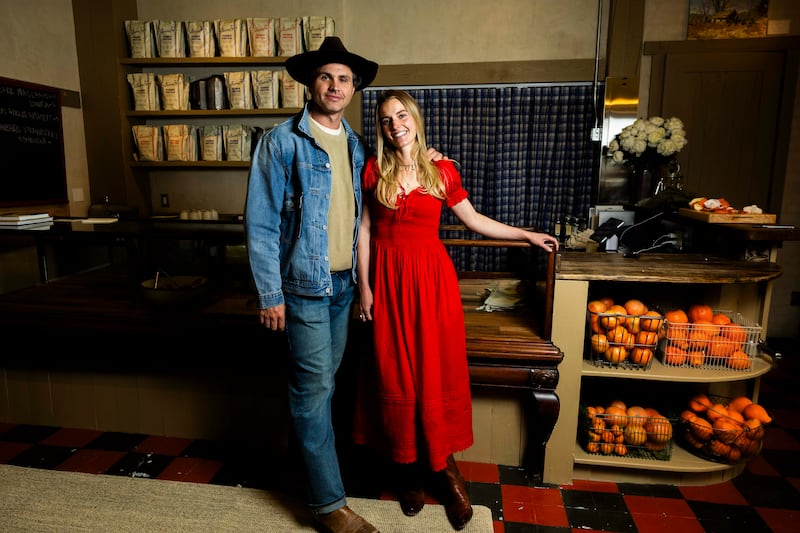
In April 2026, Hannah Neeleman walked through the doors of her own Midway, Utah retail store while, four thousand miles away, a Knopf imprint was shipping the first run of a novel that uses her aesthetic as its premise without using her name. Neeleman's Ballerina Farm account and Nara Smith's TikTok had each crossed 10 million followers. A debut novelist named Caro Claire Burke had just watched four film studios bid against each other for a book about a tradwife influencer who wakes up in 1855. And in a university research lab, a team studying TikTok's recommendation engine had already published a finding that should worry anyone treating this as a lifestyle trend: interacting with tradwife content quadrupled the misogynistic material served to a test account within five days. Three industries are now extracting value from the identical aesthetic, and almost none of them are extracting it from the same women.
The Farm That Became a Fulfillment Operation
Ballerina Farm did not start as a retail business. It started as an Instagram account documenting Hannah and Daniel Neeleman's life on 328 acres in Kamas, Utah, where Hannah, a Juilliard-trained ballet dancer, churns butter and bakes sourdough on camera while raising eight children. By 2026 that account, combined with the couple's presence on TikTok and YouTube, had pulled in more than 23 million followers across platforms.
The conversion from attention to commerce has been unusually literal. Ballerina Farm now operates a working dairy in Kamas, a farm stand at the same location, and a flagship retail store in Midway that opened in 2025 and immediately drew lines long enough that one local business owner compared the scene to Disney World. Company filings put Ballerina Farm's annual revenue at roughly $3.76 million with 21 to 50 employees across seven departments, a business built entirely on direct-to-consumer sales of products like Farmer Protein, bone broth hot cocoa, and sourdough starter kits, none of which existed as a commercial line before the Instagram following did. The store has become a tourism draw in its own right: Midway, a town of a few thousand people, now has competing influencer-run retail shops, and locals interviewed by The New York Times have noted the per-capita tradwife tourist count visibly rising. Daniel Neeleman is the son of David Neeleman, the billionaire founder of JetBlue and WestJet, a detail that complicates the "homesteading from scratch" framing the brand sells but rarely undermines it commercially.
Nara Smith, 24, has taken a parallel but distinct route. Married to model Lucky Blue Smith and based in Connecticut, Smith built her following, now over 17 million combined across platforms, on ASMR-style videos of making everything from scratch, down to the bread for a sandwich and the cereal for breakfast. Her path to monetization runs through traditional publishing rather than agritourism: HarperCollins will release her debut cookbook, "Homemade," on October 13, 2026, after Smith has already worked through brand partnerships with Reformation and Erewhon. Both women have publicly resisted the "tradwife" label itself, Smith telling Harper's Bazaar she finds the framing hard to "wrap her head around," even as their content is the reference point every academic paper and publishing pitch on the subject cites by name.
A Tradwife Who Wakes Up in 1855, and the Bidding War Behind Her
The aesthetic outgrew influencer marketing and became a literary microgenre fast enough to catch publishers off guard. By July 2025, a Goodreads user had created a "Tradwife Thrillers" list that grew to eleven books within months, and Dutton, HarperCollins, and Simon & Schuster all placed releases into the category for 2025 and 2026.
The clearest evidence of how much money is now chasing this premise is Caro Claire Burke's debut novel, "Yesteryear." The book follows Natalie Heller Mills, a tradwife influencer with 8 million followers who promotes pronatalism and traditional values from a farmhouse staffed with nannies and producers she keeps hidden from her audience, before waking up to find herself living in 1855, where the labor and danger she romanticized online has no production crew and no filter to soften it. Knopf won the publishing rights in a bidding war among 15 houses before the manuscript was finished. The film rights sold separately and even earlier: four studios competed in an auction that Amazon MGM won, landing a deal reported in the range of $450,000 against $2 million, with Anne Hathaway attached to star and produce through her Somewhere Pictures banner. Hathaway later supplied a cover blurb and is credited in the book's acknowledgments. By the time "Yesteryear" reached shelves on April 7, 2026, it had already ranked first on Goodreads' "breakout debut" list, debuted as a number one New York Times bestseller, and reviewers, including The Guardian's Rhiannon Lucy Cosslett, were directly comparing protagonist Natalie to Hannah Neeleman in print.
Burke is not alone in spotting the commercial opening. Journalist Jo Piazza has been previewing her own tradwife-adjacent thriller, "Everyone Is Lying to You," to subscribers months ahead of publication, openly hoping it tops bestseller lists on a premise built around the same aesthetic curdling into violence. Liane Child's "The Trad Wife's Secret" landed in the same publishing window. Publishers are not betting on tradwife influencers themselves becoming authors; they are betting that the unease their content generates in everyone else is worth a hardcover.
What the Algorithm Actually Serves People Who Watch This Content
While publishers and retailers were monetizing the aesthetic's surface, researchers were tracking what happens underneath it. The most direct evidence comes from a joint study by University College London, the University of Kent, and the Association of School and College Leaders, which built test TikTok accounts and modeled the platform's recommendation behavior. The researchers found a fourfold increase in misogynistic content served to a "For You" page over just five days on the platform. Principal investigator Dr. Kaitlyn Regehr of UCL described the mechanism in stark terms: the platform's algorithms target vulnerabilities like loneliness, then gamify extremist material so it reads to a young user as entertainment rather than ideology.
Media Matters ran a narrower, tradwife-specific version of the same experiment. Researchers identified seven TikTok accounts meeting a strict definition of tradwife influencer, each with at least 20,000 followers and content explicitly built around traditional gender roles, then liked and watched each account's ten most recent videos from a clean test account. Of the 327 videos TikTok subsequently served to that account's feed, nearly a third, 100 videos, contained conspiracy theories or apocalyptic fearmongering, much of it warning of an impending civil war or pushing medical misinformation.
A separate academic line of inquiry has looked specifically for the mechanism connecting wholesome domestic aesthetics to far-right recruitment: the so-called cottagecore-to-tradwife pipeline. A Northeastern University team led by Oliver Mel Allen collected more than 200,000 Tumblr posts tagged #cottagecore and coded roughly 2,500 of them for white supremacist content. Their finding complicates the radicalization narrative rather than confirming it outright: tradwife content made up only 1.1 percent of posts in the cottagecore tag, and just seven of those, 0.3 percent, contained anything codeable as white supremacist text or imagery, none of it rising to the level of explicit hate symbols or recruitment calls. What the researchers did find was a slower, harder-to-moderate shift: the hashtags attached to tradwife posts in cottagecore spaces moved, after 2021, from baking and gardening toward homesteading, biblical womanhood, and traditional gender roles, a pattern they categorized as ideological mainstreaming rather than explicit radicalization. The distinction matters for platform moderation, because content that mainstreams a worldview without ever triggering a hate-speech filter is, by design, nearly impossible to flag.
The Women the Coverage Skips
The widest gap in this story sits between who is being studied and who is being filmed. A survey led by researchers Rebecca Stotzer and Ashley Nelson analyzed TikTok content from 60 self-identified tradwives, deliberately selecting creators with small followings rather than the multi-million-follower figures who dominate press coverage. Their finding inverted the assumption baked into most reporting on the subject: most of the creators they studied were lower-income or middle-class, and nearly half were women of color. The motivations driving them toward a traditionalist lifestyle were rarely ideological in the way the algorithmic-pipeline research implies. Stotzer found women citing childcare costs they could not absorb on a dual income, safety concerns about returning to work, and religious belief, not white nationalism or pronatalist politics, as their stated reasons. "Many of the different routes that women took toward a tradlife were grounded in the observation that the demands placed on modern women are unrealistic and unreliable," Stotzer said, summarizing a pattern in which some creators blamed feminism itself for setting expectations they could not meet.
That finding sits awkwardly next to the radicalization research, not because the two studies contradict each other on the facts, but because they are describing almost entirely different populations under the same word. The UCL, Kent, and Media Matters research traces what TikTok's recommendation engine does to anyone, of any background, who engages with tradwife content as a category. The Stotzer and Nelson survey describes who is actually producing a large share of that content at the grassroots level, and that population looks nothing like Hannah Neeleman or Nara Smith, the two names every publishing pitch and magazine profile reaches for. Media coverage of the genre defaults to the wealthiest, whitest, most-followed examples because they are the ones generating retail revenue and film deals; academic coverage of the same genre increasingly finds that the typical practitioner is a lower-income woman of color logging childcare math, not ideology.
Some researchers studying the broader media response have started treating the coverage itself as part of the phenomenon. A qualitative study of 44 Dutch news articles published between January 2023 and December 2024 found that outlets routinely framed tradwife content as either a regressive throwback, a harmless fantasy, or evidence of female naivete, and argued that exactly this kind of dismissive framing inadvertently helps normalize the fringe ideologies embedded in the aesthetic by treating them as unserious rather than confronting them directly. A handful of commentators have gone further, arguing the entire press cycle amounts to a moral panic disproportionate to a trend that, by the Northeastern team's own count, produces explicit extremist content in roughly three out of every thousand posts a curious user might encounter.
Three Markets, One Aesthetic, No Shared Beneficiary
What makes this moment unusual is not that an influencer trend has commercial and political dimensions simultaneously; most do. It is that the three industries now extracting value from tradwife content, retail and tourism, publishing and film, and academic and platform-safety research, are operating on almost entirely separate evidentiary bases, drawing on different creators, and arriving at conclusions that do not obviously reconcile. Ballerina Farm's fulfillment center and Midway storefront prove the aesthetic converts directly into revenue for a specific, identifiable family. Knopf's fifteen-house bidding war and Amazon MGM's four-studio film auction prove publishers and studios believe the unease around that same aesthetic is worth millions, even when the resulting fiction explicitly indicts the lifestyle it profits from. UCL, Kent, and Media Matters prove the algorithmic delivery mechanism behind tradwife content measurably escalates toward misogynistic and conspiratorial material for anyone who engages with it. And Stotzer and Nelson prove that the actual demographic base producing this content at scale is poorer, more racially diverse, and more pragmatically motivated than any of the other two industries' raw material would suggest.
None of these four groups, the influencers, the publishers, the platform researchers, or the grassroots creators, are working from the same picture of who a tradwife actually is. The aesthetic is durable enough to fund a retail buildout in rural Utah, sell a debut novel to Knopf for enough money to draw fifteen competing bids, and trigger a measurable algorithmic shift toward extremist content, all at the same time, without any of those three outcomes requiring the others to be true. That is the part the trend pieces tend to miss: tradwife content is not one story being told three ways. It is three unconnected industries mining the same raw material and walking away with three different answers about what it actually is.