The Surgeon's Third Hand: How Moon Surgical Is Winning the Operating Room Without Replacing the Surgeon
A Paris-born startup is rewriting the economics of surgical robotics by betting that hospitals want a smarter assistant - not a more expensive boss.
By Carry and Conquer Publications
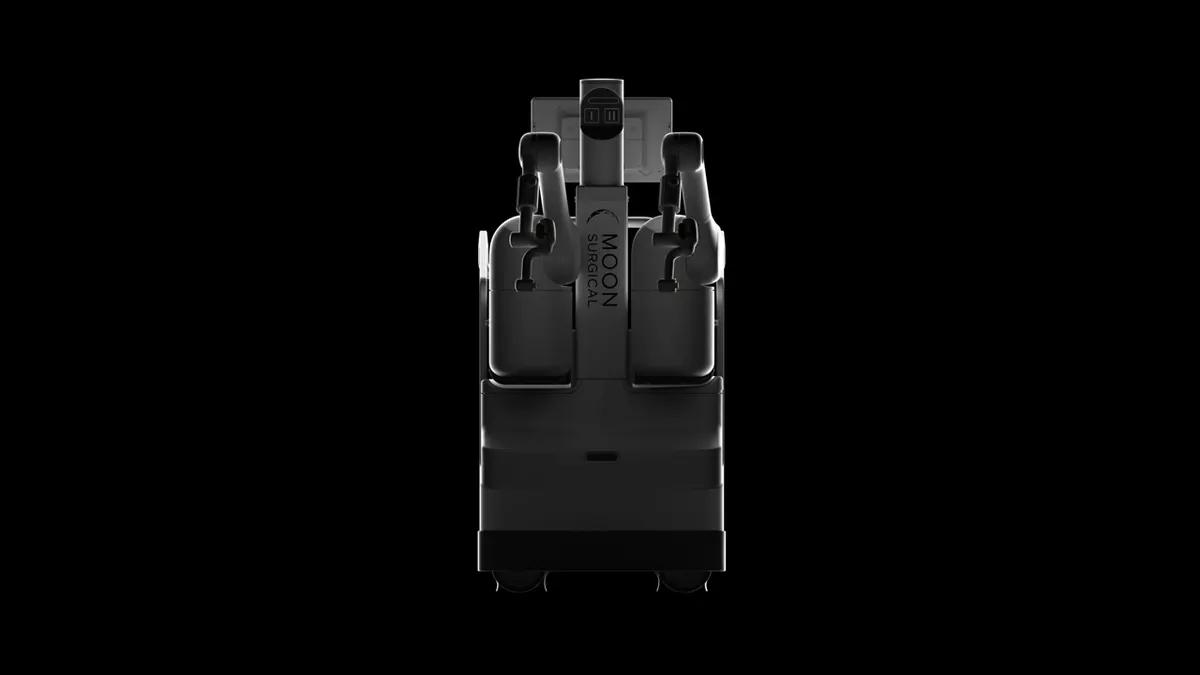
For two decades, surgical robotics has meant one thing: the da Vinci. Intuitive Surgical's towering multi-arm system, which sells for roughly $1.5 million per unit, transformed what was possible in the operating room and captured nearly 60% of the global robotic surgery market. But it also left a gap - the 19 million-plus annual soft tissue procedures that da Vinci's size, cost, and complexity could never reach. Moon Surgical, a French-American company founded in Paris in 2019, has spent five years engineering directly into that gap. Its Maestro system does not compete with da Vinci so much as it colonizes the territory da Vinci left behind: the vast majority of laparoscopic surgeries performed in ambulatory surgery centers, community hospitals, and outpatient departments that can't afford a $1.5 million robot and the dedicated staff required to run one.
A Surgeon's Idea, A VC's Execution
Moon Surgical did not begin in a corporate lab. Professor Brice Gayet, a world-renowned laparoscopic surgeon, founded the company in 2019 after spending a career watching surgical assistants struggle to hold instruments steady and maintain camera angles while a lead surgeon operated. Gayet's insight was simple but disruptive: what surgeons needed was not a robot that could replace them, but one that could give them a reliable third hand. The company was incubated by Sofinnova Partners' MD Start program in 2020, where Anne Osdoit - a biomedical engineer and VC partner - joined as CEO.
Osdoit is an unusual figure in medtech: she is simultaneously a venture capitalist and the operating CEO of one of her own portfolio companies. Her previous work at Mauna Kea Technologies, a Paris-based optical biopsy startup, included managing the company's 2011 IPO on the NYSE Euronext - the largest public listing in the medtech sector that year. At Moon Surgical, she has replicated that trajectory at speed. The company raised a $31.3 million Series A in June 2022 from GT Healthcare Capital and Johnson and Johnson Innovation, then followed with a $55.4 million round in May 2023 co-led by Sofinnova Partners and NVentures, Nvidia's venture capital arm, bringing total funding to $90 million. That second round also added Fred Moll - the founder of Intuitive Surgical itself - as independent chair of the board.
Moll's involvement was more than symbolic. He described Maestro as solving a problem the da Vinci system was never designed to address: the need for a surgeon to control three instruments simultaneously with only two hands. His backing lent the company both strategic credibility and a pointed implicit endorsement - the man who built the dominant robot in surgery was now betting on a fundamentally different concept.
What Maestro Actually Does
The Maestro system is a two-armed robotic assistant positioned beside the operating table. Unlike the da Vinci, which gives surgeons remote control of an elaborate multi-arm platform from a console, Maestro is co-manipulative - the surgeon positions its arms directly by hand, locks them in place, and then operates with those arms holding instruments, cameras, or tissue retractors as needed. It is compatible with nearly any standard laparoscopic tool already in the hospital's inventory, requiring no proprietary instruments and no dedicated operating room.
The business model reinforces the design philosophy. Rather than requiring hospitals to purchase a multi-million-dollar system outright, Moon Surgical offers a subscription model indexed to procedure volume - a monthly fee that covers the hardware, disposables, and service in one sum. Osdoit described this as specifically designed for the economics of ambulatory surgery centers and outpatient departments, where the capital commitment required by traditional robotic systems is often prohibitive. For institutions operating at deficit or facing chronic staff shortages, the pitch is practical: one fewer surgical technologist per case, no change to the surgeon's preferred laparoscopic technique, and a robotics footprint that fits in an ordinary OR.
The company received its first FDA clearance in December 2022 and its CE mark in September 2023. Commercial FDA clearance for the full Maestro system came in June 2024, enabling a limited U.S. market launch ahead of broader rollout in 2025.
2025: From Launch to Scale
The year 2025 functioned as Moon Surgical's proof point. By July, Maestro had been used in more than 1,600 procedures worldwide - 1,400 of them in the single preceding year - across 60 different types of minimally invasive surgery. The procedures span bariatric, gynecologic, urologic, and general soft-tissue surgery, demonstrating the system's range across specialties.
At Lee Health's Gulf Coast Medical Center in Fort Myers, Florida, the results came quickly. The hospital completed more than 100 procedures using Maestro, and in just the first 25 bariatric cases alone, it saved the equivalent of 8.3 full working days of surgical technologist time. The reduction of one surgical tech or advanced provider per case - without any compromise to clinical outcomes - was precisely the efficiency argument Moon Surgical had been making since inception. Juan Ibarra, M.D., robotic surgery program manager at Lee Health, described Maestro as a system that offered surgeons who prefer traditional laparoscopy a smart and reliable assistant without disrupting their established approach.
The AI Layer
In March 2025, Moon Surgical secured a second landmark FDA clearance - for ScoPilot, an AI-powered camera control feature built on Nvidia's Holoscan real-time sensing platform. ScoPilot enables the laparoscope attached to Maestro to follow a surgeon's instrument tip autonomously and in real time, so that the surgeon can direct camera positioning without ever removing their hands from the instruments they are operating. Kimberly Powell, vice president of healthcare at Nvidia, described it as the first FDA-cleared AI-driven surgical movement natively integrated into a commercial robotic platform powered by Holoscan. By enabling a single surgeon to effectively operate three instruments with two hands, ScoPilot is not a convenience feature - it is a redefinition of what solo surgical control means.
In July 2025, the FDA added connectivity clearance, enabling Maestro to operate with Wi-Fi and 5G, and approved a Predetermined Change Control Plan for ScoPilot - a rare regulatory pathway that allows Moon to deploy iterative software updates to the AI system faster than conventional clearance timelines would permit. By December 2025, Moon had added centralized cloud-based analytics via its Maestro Insights platform, powered by Nvidia GPU infrastructure, enabling hospital administrators to track procedure metrics, manage scheduling, and coordinate workflows across multiple sites. The system had treated more than 2,300 patients across the United States and Europe.
The Market Moon Is Hunting
Moon Surgical is not chasing Intuitive Surgical's existing installed base. Intuitive holds 58% of U.S. robotic surgical system market share and 86% of the accessories market, with a 12,000-unit global installed base and over $10 billion in 2025 revenue. Its da Vinci system is entrenched in academic medical centers and high-acuity hospital settings where size and cost are manageable. Moon's target is structurally different: the 19 million annual soft tissue procedures that are currently performed laparoscopically without any robotic assistance, in settings where da Vinci has never been economically viable.
Osdoit was direct about this framing in early interviews: the company is not a da Vinci competitor so much as a da Vinci complement, entering a market segment Intuitive has never meaningfully penetrated. With only 6% of soft tissue surgeries currently robot-assisted - almost exclusively via da Vinci - the potential addressable market for a modular, affordable system is enormous. The company's subscription model, its compatibility with existing laparoscopic instruments, and its scalability to ambulatory surgery centers make it structurally better suited to this market than any full-platform robotic system could be.
The competitive posture has attracted the attention of the medtech establishment. The hiring of Jonathan Conta - who spent 16 years at Intuitive overseeing marketing and product functions across both its multiport and single-port platforms - as chief marketing officer in June 2025 signals a transition from limited launch to full commercial scale. Jeff Driggs, named president of U.S. sales, came from ConMed's AirSeal platform and also held prior positions at Intuitive. These are not startup hires; they are moves by a company that has validated its technology and is now building the commercial infrastructure to scale it.
The Augmentation Thesis
The deeper argument behind Moon Surgical is not about laparoscopy. It is about the direction of technological progress in medicine. The dominant narrative in surgical technology has long centered on replacement - robots that could ultimately perform procedures autonomously, reducing the surgeon to a supervisor. Moon Surgical's Maestro embodies a different thesis: that the highest-value role for technology in the operating room is augmentation, not substitution.
That thesis has proven more palatable to hospitals under staffing pressure than robotic replacement ever would be. A system that reduces the need for one surgical technologist per case while preserving the surgeon's full control and familiar technique does not threaten clinical culture - it supports it. And a platform that evolves continuously via software updates, cloud analytics, and AI-powered features, without requiring hardware replacement, behaves less like a capital expenditure and more like a digital subscription - precisely the economic model that cash-constrained surgical departments can actually absorb.
Moon Surgical's rapid trajectory from a Paris incubator to treating 2,300 patients across two continents in five years suggests that the surgical robotics market is more nuanced than its headline players imply. The future of the operating room may not be dominated by ever-larger and more autonomous machines. It may be shaped by systems small enough to fit beside the table, smart enough to learn from every case, and modest enough to let the surgeon remain in charge.