The Startup That Wanted to Reinvent Cargo and Became an Arms Manufacturer Instead
How Destinus SA went from pitching DHL on Mach 5 hydrogen cargo flights to supplying Ukraine with cruise missiles and partnering with Rheinmetall.
By Carry and Conquer Publications
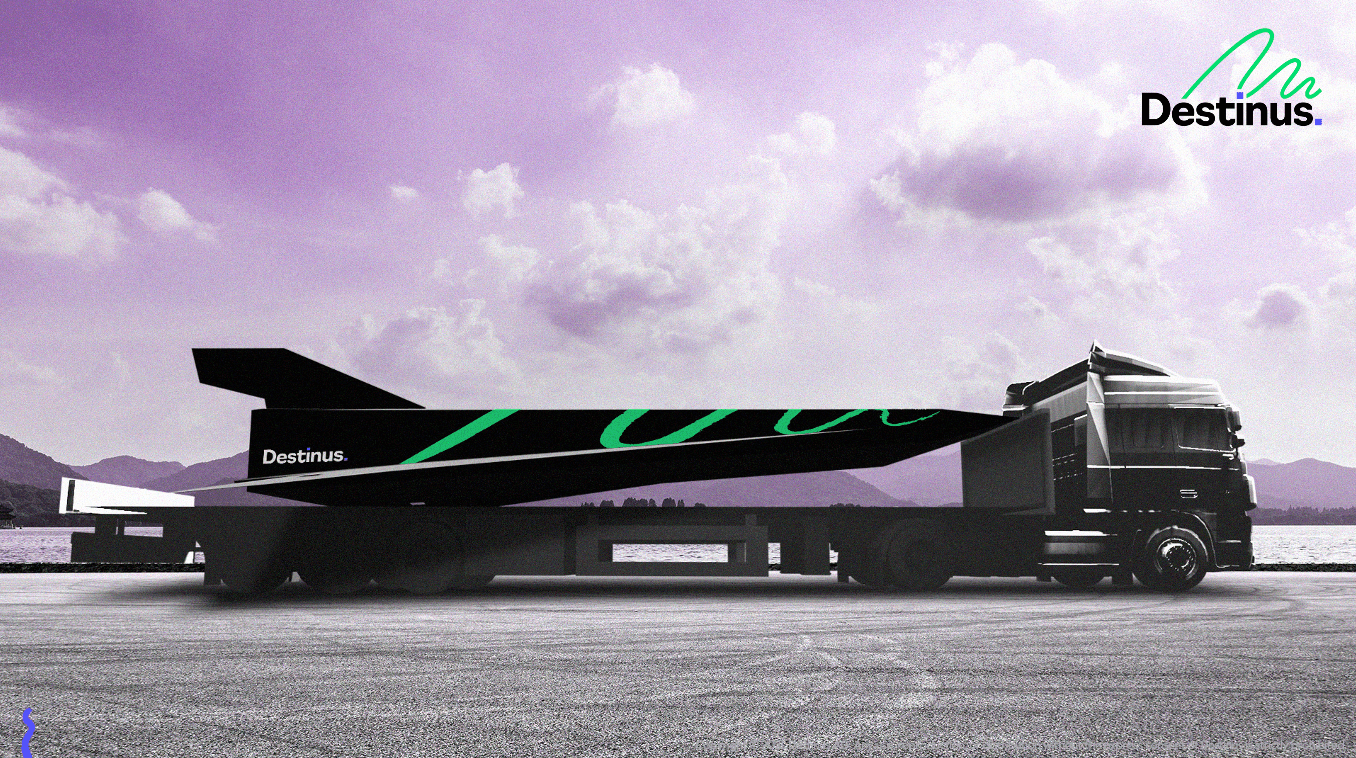
In early 2021, a Russian-born physicist named Mikhail Kokorich relocated to Payerne, a small Swiss town in the canton of Vaud, and registered a company with an ambition that bordered on the absurd. Destinus SA would build a hydrogen-powered aircraft capable of reaching Mach 5 and deliver cargo anywhere on Earth in under two hours. Not a concept paper. Not a PowerPoint. An actual flying machine, burning liquid hydrogen, pulling pharmaceutical shipments and semiconductor components across continents faster than a ballistic missile. Within eight months of founding, the company had already flown its first prototype. Four years later, the story of what Destinus became tells you more about the current state of European aerospace, dual-use technology, and geopolitical urgency than almost any other startup founded in the past decade.
The Vision: Collapsing Transcontinental Time
The core proposition of Destinus was deceptively simple: the world has a small category of cargo where speed justifies almost any premium. Pharmaceutical cold chains, semiconductor components rushed to a factory floor, aerospace parts needed to get a grounded aircraft back into service. These verticals collectively generate tens of billions in annual airfreight revenue, and they share a defining characteristic: a delay measured in hours costs more than the freight bill. Standard air cargo takes 48 to 72 hours door to door on transcontinental routes. Destinus proposed to collapse that to six hours or less, flying at the edge of the atmosphere at Mach 5.
Kokorich's pitch was built on a specific technology claim: hydrogen, the most energy-dense fuel available, would allow aircraft to fly at hypersonic speeds sustainably and with zero carbon dioxide emissions. Liquid hydrogen carries roughly three times the energy per kilogram of conventional Jet-A fuel, and its only exhaust is heat and water vapor. The engineering challenge was thermal management: at Mach 5, aerodynamic heating along the airframe reaches temperatures that would destroy conventional materials. Destinus's answer was an active cooling system that used hydrogen as a heat sink before injecting it into the combustion chamber, effectively turning the fuel into a thermal management medium before it became a propellant. The company filed patents on this system within its first year.
The aircraft architecture was what Destinus called a waverider: a hypersonic aeroshape that generates lift from the shockwave it creates rather than from conventional wing surfaces. The commercial freighter concept was unmanned, with a target payload capacity of one ton at first, scaling to 100 tons by 2029. Routes like Frankfurt to Hong Kong in under an hour, or Sydney to London in four hours, anchored the pitch materials. DHL was among the logistics companies reportedly engaged in early conversations about what hypersonic freight might mean for their premium express business.
Building at Speed: From Jungfrau to Destinus-3
The most striking thing about the early Destinus years was the pace. The first prototype, named Jungfrau, flew in November 2021 at an airport near Munich, just eight months after the company was incorporated. The test flight was subsonic, intended to validate the waverider aeroshape at low speeds during takeoff and landing, but it proved the team could move. A second prototype, Eiger, flew its maiden campaign in April 2022 and underwent a second campaign in October of the same year. The entire demonstrator program from conception to first flight took six months.
In early 2022, the company raised 26.8 million Swiss francs, roughly $29 million at the time, in a seed round that included Conny & Co, the Swiss investment firm of angel investor Cornelius Boersch, alongside Quiet Capital, One Way Ventures, Liquid2 Ventures, Cathexis Ventures, and ACE & Company. Boersch, who had backed Kokorich's previous ventures, described the development pace as "incomparable." The funding supported two parallel tracks: continued demonstrator flights and the development of hydrogen propulsion systems, including both gaseous and liquid hydrogen afterburner technology.
In June 2022, Destinus struck a partnership with ITP Aero, the Spanish engine manufacturer, to develop a hydrogen engine test bed with direct support from INTA, Spain's national aerospace research institute. The following February, the Spanish government awarded Destinus grants worth approximately 26.7 million euros across two projects to expand hydrogen propulsion capabilities and build a test facility near Madrid. Spain was explicitly trying to position itself as a leader in green hydrogen, and Destinus's work aligned neatly with that national industrial strategy.
At the Paris Air Show in June 2023, the company unveiled the Destinus-3. The prototype was ten meters long with a 3.5-meter wingspan, weighing approximately two tonnes. If successfully flown with its hydrogen afterburner, it would become the world's first liquid hydrogen-powered supersonic unmanned vehicle, targeting Mach 1.3. The Destinus-3 was publicly described as the bridge between the company's subsonic demonstrators and the commercial cargo aircraft it ultimately intended to certify. In October 2023, Destinus opened the Destinus H2 Park in Payerne, billed as Switzerland's first private testing site for hydrogen propulsion systems and only the third such facility in Europe.
By late 2024, the Destinus-3 had achieved Mach 1.3 in test flights. The engineering team was pressing toward supersonic hydrogen-powered flight, with hypersonic demonstration targeted for 2025.
The Pivot Nobody Saw Coming
What made Destinus genuinely distinctive was its explicit commercial-first positioning. While American competitors like Hermeus, the Atlanta-based hypersonic startup building the Quarterhorse, entered the market through Air Force contracts and pursued the commercial pitch later, Destinus opened with logistics. It signed a letter of intent with Brazilian air charter platform Flapper to introduce express cargo routes between Latin America and Europe. It built an advisory board stacked with European political figures: Philipp Rosler, former German Vice Chancellor and Economics Minister, became chairman. Michel Friedling, the first French Air Force general to head France's Space Command, joined the strategic committee. Oleksandr Danyliuk, former Finance Minister of Ukraine, joined as Senior Vice President of Defense in January 2023.
That last appointment was telling. Danyliuk's arrival in a defense role at a commercial aerospace startup reflected an early awareness at Destinus that dual-use technology served two masters. The company's hydrogen propulsion and waverider aerodynamics had obvious military relevance. European defense agencies took notice. And as Russia's full-scale invasion of Ukraine entered its second year, a new market appeared.
Destinus began developing and supplying drones to Ukrainian forces. The Ruta missile, a cruise-missile-drone hybrid with a range of 300 kilometers, entered Ukrainian service by late 2024. President Volodymyr Zelensky confirmed its operational use publicly in October 2025. A successor, Ruta Block 2, was unveiled in early 2026 with a range exceeding 450 kilometers, a 250-kilogram warhead, AI-guided multimode navigation, and stealth geometry. The company was producing more than 2,000 cruise missile systems per year across European facilities.
Acquisitions, Relocation, and the Rheinmetall Deal
The company's shape changed faster between 2024 and 2026 than it had in its first three years. Destinus acquired Dutch drone maker Aerialtronics in March 2025, absorbing its IP, technology assets, and engineering team following Aerialtronics' bankruptcy proceedings. In August 2025, it agreed to acquire Swiss AI aviation company Daedalean for CHF 180 million, adding autonomous flight certification software to its portfolio. The two acquisitions built out the AI and avionics layer that makes autonomous strike systems operationally viable at scale.
In November 2024, Destinus moved its headquarters from Switzerland to the Netherlands. Swiss export law on weapons had become a structural problem. The Dutch regulatory environment was more permissive for defense technology exports. The company's valuation reached CHF 650 million by the end of 2024, with a stated target of CHF 1 billion. Revenue surged from $18 million in 2023 to an estimated $70 million in 2024, a 280 percent year-over-year increase driven primarily by defense contracts, against a European aerospace sector average growth rate of roughly 12 percent over the same period.
In April 2026, Destinus and Rheinmetall announced a joint venture to be called Rheinmetall Destinus Strike Systems, targeting cruise missile and ballistic rocket artillery production at industrial scale. Rheinmetall holds 51 percent; Destinus retains 49. The venture is expected to launch in the second half of 2026, pending regulatory approval, and will be based in Unterluss, Lower Saxony. Kokorich framed the rationale precisely: Europe's constraint is not demand but industrial capacity. The two companies estimated the near-term market opportunity at hundreds of millions of euros annually.
The company that set out to deliver DHL pharmaceuticals at Mach 5 was now one of Rheinmetall's manufacturing partners.
Kokorich: A Portrait in Relentless Reinvention
Understanding Destinus requires understanding its founder. Mikhail Kokorich was trained in physics at Novosibirsk State University and built his first fortune in Russia through retail: he founded Chudodom, a domestic merchandise chain, merged it with a competitor in 2009 to form the largest such chain in Eastern Europe, acquired Technosila, one of Russia's largest electronics retailers, and sold his stakes to pivot into aerospace. In 2011, he founded Dauria Aerospace, Russia's first private space company, with headquarters in Munich. He moved to the United States in 2014 and later founded Momentus, a satellite transportation company that raised $143 million privately and went public on Nasdaq via SPAC in 2021.
The Momentus chapter ended badly by any conventional measure. The Department of Defense raised concerns about Kokorich's Russian citizenship and his access to sensitive space technology. Federal agents raided Momentus's offices in 2019. His asylum application was denied. He was forced to resign as CEO and divest his shares. The SEC sued him in 2021, alleging he had misled investors about the state of Momentus's propulsion technology and concealed the depth of the government's national security concerns. In November 2024, a federal court entered a final consent judgment: a $2 million civil penalty and a five-year bar from serving as an officer or director of a public company.
None of this stopped him from building Destinus. He moved to Switzerland in early 2021, founded the company in March, flew the first prototype in November, and raised $29 million in February 2022. At the end of 2024, he formally renounced his Russian citizenship, posting the letter to the Russian embassy on LinkedIn. His stated reason: fundamental disagreement with Russia's invasion of Ukraine and the policies of the Putin government. By 2026, his personal profile on Destinus's website described him not as a hypersonic aviation pioneer but as the founder of "a European defence industrial company developing and manufacturing scalable strike and air defence systems."
What the Pivot Reveals About Capital and the Dual-Use Era
Destinus's trajectory is not unique, but it is unusually transparent. The story of a commercial aerospace startup becoming a European defense manufacturer within five years reflects a broader structural shift in the continent's security calculus. European defense budgets rose 30 percent between 2021 and 2024, reaching 326 billion euros annually. The EU committed a further 800 billion euros in rearmament spending through the ReArm Europe initiative. Demand for scalable, affordable strike systems, the kind Ukraine has consumed by the thousands, created a market that simply did not exist in 2021.
Destinus was positioned to serve it because the engineering base was genuinely dual-use. Hydrogen propulsion expertise, advanced aerodynamics, precision guidance, autonomous flight control: these are not separate disciplines from what a cruise missile requires. The Ruta's lineage is visible in the same waverider geometry and propulsion philosophy that powered the company's original cargo aircraft designs.
For private equity and growth investors, the lesson is structural. The most defensible aerospace investments of the next decade will likely sit in companies that serve both commercial and defense applications simultaneously, because government contracts stabilize the balance sheet while the commercial opportunity provides long-term upside. Destinus has proven this model works in practice. Defense contracts funded the propulsion and guidance research. That research produced systems relevant to both freight and warfare. The company arrived at both markets not sequentially, but simultaneously.
The original hypersonic cargo vision has not disappeared. The Swiss engineering team continues propulsion and electronics development in Payerne. The Destinus-3's supersonic campaigns are ongoing. The Destinus S commercial passenger aircraft, targeting Mach 5 cruising with 25 passengers, remains listed among the company's planned vehicles. But the company that Kokorich describes publicly today is a European defense industrial platform, not a logistics disruptor.
The pharmaceutical shipments can wait. Europe cannot.