The Rubik's WOWCube: A $299 Handheld Console Nobody Knew They Needed, With 24 Screens and No Buttons
How a 12-year-old's question in 2016 became the world's first twist-controlled handheld gaming platform.
By Carry and Conquer Publications
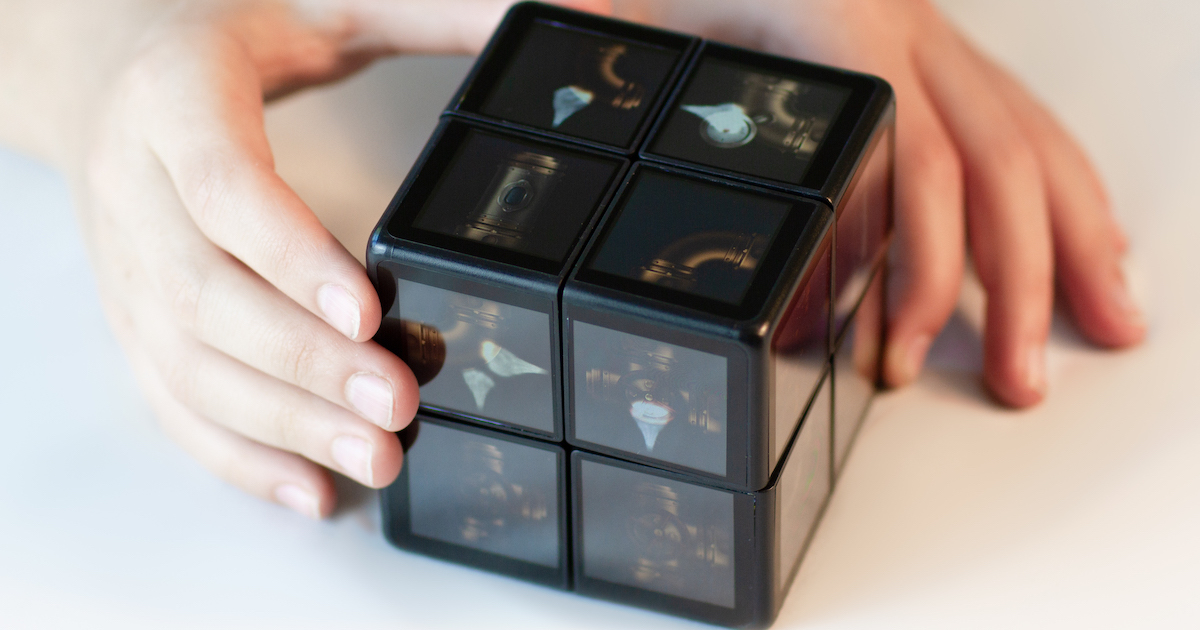
The oldest insight in game design is that the best interfaces disappear. A joystick becomes invisible when you are fully absorbed in flight; a controller fades when the game is good enough. The Rubik's WOWCube takes that logic to its radical conclusion: it eliminates the controller entirely and makes the device itself the interface. No buttons. No joystick. No d-pad. The cube twists, tilts, shakes, and taps, and so does the game running across all 24 of its IPS LCD screens simultaneously. It is a consumer product you can buy today for $299, and it represents something genuinely rare: a new category of physical computing that did not exist before someone built it.
A 12-Year-Old's Question That Took Nine Years to Answer
The origin of the WOWCube is one of those stories that sounds apocryphal until you verify it. In the fall of 2016, a 12-year-old boy named Savva Osipov asked his father Ilya a simple question: what if a Rubik's Cube had screens instead of colored stickers, so that game characters could run from face to face as you twisted it? Ilya Osipov was not a toy designer. He was a computer scientist, a serial entrepreneur, and a holder of roughly 30 patents, including mechanical puzzle designs. He had sold one of Russia's largest regional news portals, NN.RU, to the Hearst Corporation. When his son posed the question, he spent a few days thinking about it, called a patent lawyer, confirmed no one had built it, and started prototyping.
By spring 2017, the first physical version existed: an Arduino-based cube, 3D-printed in-house, connected to small screens. It was rough. But when Ilya programmed a simple version of Digger and watched the character walk from screen to screen across the faces of the cube as he twisted it, the concept proved itself. The pair publicly presented the prototype in June 2017 at the CALL scientific conference at UC Berkeley, then at Maker Faire in Santa Clara in 2018. Cubios, Inc. was formally registered on April 11, 2017.
What Ilya had underestimated was the engineering problem at the center of the idea. Making a cube that rotates mechanically like a Rubik's Cube is straightforward. Making one that rotates while maintaining continuous electrical and data connections between eight independent computing modules is not. A single centralized processor cannot work: when you twist the cube, the topology of the network changes. The relative positions of the eight modules shift. The software needs to know where every face is at all times, recalculate the mapping matrices in real time, and keep the game state coherent across eight separate CPUs simultaneously. Ilya has described writing the first C++ program for the prototype as literally disorienting: the mental model required to track screen positions across rotating axes is non-trivial even for experienced engineers.
144 Neodymium Balls and a Distributed Architecture
The physical solution Cubios developed is the most technically interesting part of the WOWCube. Each of the eight modules contains its own processor, battery, screens, and motion sensors. They communicate through 144 neodymium magnetic ball connectors embedded at the contact points between modules: 96 of these connections actively carry data and low-voltage power while the cube is in any configuration. The connectors are self-orienting and unisex, inspired by Apple's MagSafe but redesigned without the male-to-female constraint, so any module face can mate with any adjacent face regardless of orientation. When two modules come into contact, their magnetic balls bind, sealing the connection and restoring data flow instantly.
The operating system, built on FreeRTOS, maintains topological integrity across all eight processors at once. As the user twists a layer of the cube, the OS detects the changed configuration through sensor data, recalculates which screens are now adjacent to which, and updates the game state accordingly. A character running across the surface of the cube does not stutter or disappear during a twist; the OS knows where the character is in absolute space, not just relative to a particular module, so the illusion of a unified 24-screen playing field remains unbroken. The SDK Cubios provides to third-party developers abstracts this complexity: developers work with a unified spatial model and let the platform handle the distributed rendering.
The result is a device that weighs roughly 400 grams, measures 76 by 76 by 76 millimeters, and runs six approved patents covering the connector system alone. Manufacturing is handled by Shenzhen Mineiwing Electronics Co., and the hardware includes a microphone, speakers, Bluetooth connectivity for the companion smartphone app, and a battery in the 3,600 mAh range.
What Happens When Spin Master Calls
By 2021, Cubios had raised $4.5 million from investors including Aleksandr Agapitov, founder of gaming commerce platform Xsolla. Distributors in 18 countries had expressed interest. Time magazine named the WOWCube among its 100 Best Inventions of 2021. The Edison Award and a CES Innovation Award honoree citation followed. Preorders exceeded 155,000 units by August 2021. For a startup with a genuinely novel hardware concept, the traction was real.
The inflection point came in 2024. Spin Master, the Canadian toy and entertainment company that had acquired the Rubik's brand in 2021 for an undisclosed sum, approached Cubios about a licensing and marketing partnership. Spin Master operates 29 offices in nearly 20 countries, employs more than 2,500 people globally, and runs digital game properties including Toca Boca, which counts 70 million monthly active users. The deal gave Cubios access to the Rubik's visual identity: the colors, the characters, the brand recognition that the cube's inventor Erno Rubik spent decades building. In exchange, Cubios pays royalties on hardware and software sales. Max Filin, who had joined as CEO in the years prior to help commercialize the platform, described the arrangement to GamesBeat as "a little bit more than a licensing agreement."
The rebranded Rubik's WOWCube launched in October 2025 at New York Comic Con, where the booth drew crowds of visitors who expressed disbelief that a childhood icon had become a handheld gaming system. Pre-orders had opened at $299 over the summer, targeting the holiday season. Newsweek ran a hands-on feature in early 2026 calling it a "bridge between analog puzzles and digital play." Forbes characterized it as "part console, part puzzle, and all chaos."
Twenty-Four Screens and the Problem of Software
The game library at launch illustrates both the ambition and the constraint. Cubios partnered with ZeptoLab to bring Cut the Rope to the platform: players tilt and twist the cube to move candy toward Om Nom, cutting virtual ropes that wrap around the cube's geometry. In 2024, Cubios and Japanese publisher Taito Corporation announced Space Invaders Cubed, in which players tilt the device to control a spaceship and rotate layers to align with enemy rows before firing. The puzzle game 2048 and several arcade and educational titles round out the catalog, which Cubios lists at over 100 games through its WowClub subscription pass.
The SDK is open to third-party developers, which is the long bet Cubios is placing. The argument is that the WOWCube's input language, because it maps directly to physical space rather than abstracted button inputs, unlocks game genres that do not exist on any other platform. A puzzle that requires you to isolate one face while keeping another stable. A physics simulation where gravity is relative to how you hold the device. An educational app where solving the spatial arrangement of screens is part of the lesson itself. STEM.org has authenticated the device, and early classroom interest suggests the educational positioning has some traction.
The skeptical read, articulated most directly by PC Gamer's Andy Moore in November 2025, is that the WOWCube offers fewer grid cells than a standard 3x3 Rubik's Cube, costs as much as a Nintendo Switch, and is asking consumers to adopt an entirely new control vocabulary for a library that cannot yet compete with established mobile or console ecosystems. Hackaday's Maya Posch wrote that the device "raises many questions about what market it's really targeting." Some hands-on reviewers flagged uneven software quality and accessory issues with the dock station at launch.
The Case for a Category That Doesn't Exist Yet
The standard critique of novel hardware is that the platform requires a software ecosystem that only arrives after critical mass, and critical mass only arrives after a software ecosystem. The WOWCube does not escape this problem. But the critique misses what makes the device structurally interesting from a product design standpoint.
Every major input paradigm in consumer electronics was once a category that did not exist. The touchscreen was a curiosity until the iPhone; the motion controller was an academic concept until the Wii. What those devices shared was a control language native to human intuition: touching a screen, moving your body. The WOWCube's control language is twisting, a physical vocabulary that humans have practiced with puzzle objects for half a century. Rubik's Cube sold over 500 million units. The muscle memory for rotating layers of a cube is embedded in an entire generation of consumers.
Cubios is betting that this embedded intuition is a distribution channel. That when a player picks up a WOWCube and twists it for the first time, they are not learning a new interface; they are discovering that the interface they already know works differently than they expected. The character running across the cube's surface as they twist is not a demo. It is a proof of principle: that the physics of a fifty-year-old toy were always, in some sense, pointing toward this. Whether $299 and a holiday 2025 launch is the right moment to prove that principle is a different question. What is not in question is that Savva Osipov asked a good one when he was twelve.