The Man Who Engines SpaceX Now Wants to Move Everything in Space
How SpaceX's founding propulsion engineer built a $1.8 billion in-space mobility company after 18 years designing the world's most reliable rocket engines.
By Carry and Conquer Publications
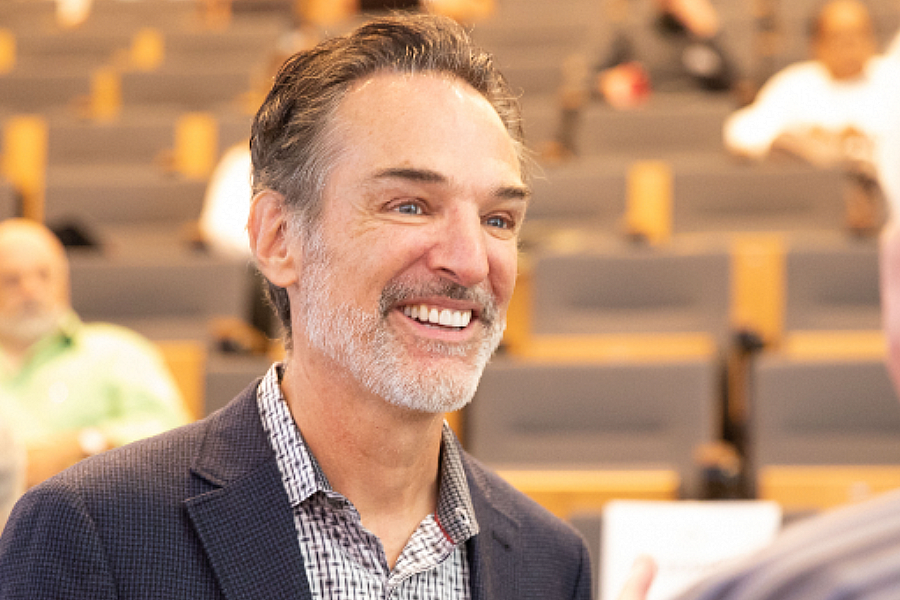
Tom Mueller grew up the son of a logger in St. Maries, Idaho, a timber town of 2,500 people, and he has never stopped building things that push further than anyone expects them to go.
From Lumber to Liquid Rockets
Mueller's origin story reads like it belongs in a different century. His father drove log trucks and fully expected his son to follow. Mueller worked four summers as a logger to pay for college, then enrolled in mechanical engineering at the University of Idaho. When he graduated in 1985, he turned down job offers in Boise and drove to California - not because he had a job, but because that was where the rockets were. He crashed on his mother-in-law's couch in North Hollywood and attended a job fair. Three offers came back. He picked the one that had anything to do with aerospace.
For 15 years, Mueller worked at TRW Inc., the sprawling aerospace and defense conglomerate. He rose to lead the propulsion and combustion products department, where he oversaw development of the TR-106, a 650,000-pound-thrust hydrogen engine that stands among the most powerful ever built in the United States. But TRW was vast and slow-moving - a place, as Mueller later put it, where his ideas got diluted. So he started building rockets in his garage as a hobby, then moved his project to a friend's warehouse. The engine he built there weighed 80 pounds and produced 13,000 pounds of thrust. It was the largest amateur liquid-fuel rocket engine ever constructed.
In early 2002, a mutual friend introduced Mueller to a recently rich internet entrepreneur named Elon Musk. Musk had one question for him: "Can you build something bigger?" Mueller said yes. A few meetings later, he signed on as SpaceX's first employee. As Mueller noted years later at Loyola Marymount University, where he completed his master's degree in 1992, "What he wanted to hear was some optimism. And the answer that no one could give was, yes, I think I could."
The Merlin Years
What Mueller built at SpaceX over the next 18 years became the foundation of commercial spaceflight. As Vice President of Propulsion Engineering and later Propulsion CTO, he oversaw the development of the Merlin engine family that powers the Falcon 9 - the most reliable rocket engine in history with more than 400 successful flights. He developed the Kestrel engine for Falcon 1, the first privately-funded liquid-fueled rocket to reach orbit. He built the Draco thrusters that guide the Dragon spacecraft and the SuperDraco engines used in its abort system. His department propelled the Falcon 9 to become the world's most active launch vehicle, flying more than 130 missions in 2024 alone.
Mueller was also part of the architecture of Starship. When Musk asked him early on what propellant the vehicle should use to get 100 tons to Mars, Mueller argued for methane over hydrogen - a decision that shaped the Raptor engine program and remains central to SpaceX's Mars ambitions today.
He retired from SpaceX on November 30, 2020. "I retired from SpaceX today! Thank you Elon Musk, it was quite a ride!" he wrote on X. Musk replied: "Thanks for everything you did to help build SpaceX! Some of the best memories ever."
Mueller lasted about six months in retirement.
The Gap Nobody Had Solved
"Within about six or eight months, I started another company because I got bored," Mueller said at an LMU keynote in 2024. That company was Impulse Space, founded in September 2021, based in Redondo Beach, California.
The logic behind it was precise. SpaceX and the wave of commercial launch companies that followed had solved the hardest part of the problem: getting mass to low Earth orbit cheaply. Rideshare missions on a Falcon 9 had become routine. But once a satellite reached orbit, it was largely stuck. Most payloads land on a standard rideshare orbit and stay there - they have no propulsion of their own. The satellites needed for geostationary operations, national security missions, and deep space exploration require getting to orbits that are far above the drop-off point. Electric propulsion can make that trip, but it takes four to nine months, during which the satellite is exposed to radiation and generating no revenue. A chemical tug can complete the same transfer in under a day.
"The genesis of Impulse is really to pick up where SpaceX and others left off," said Eric Romo, Impulse's COO and President. "Getting to space is solved and now we need to figure out how to move things through space efficiently."
Mueller assembled a team of SpaceX veterans. Kevin Miller, who spent 14 years working on the Merlin and Raptor engines, leads propulsion. Barry Matsumori, former head of sales at SpaceX and CEO of BridgeComm, served as early COO. General John W. Raymond, the first Chief of Space Operations for the United States Space Force, joined the board of directors. The team took the first Mira vehicle from a clean sheet of paper to a spacecraft in orbit in just 14 months.
Mira, Helios, and the Fleet in Between
Impulse's first product is Mira, a high-thrust, highly maneuverable orbital transfer vehicle roughly the size of a dishwasher. It weighs approximately 300 kilograms when loaded with propellant, uses Saiph bipropellant thrusters burning nitrous oxide and ethane, and can perform precise orbital adjustments across LEO, medium Earth orbit, and GEO. The company launched Mira's first mission in November 2023 on SpaceX's Transporter-9 rideshare flight. Mueller called that debut "probably the most successful orbital transfer vehicle debut in history." By the time the Series C closed in 2025, Impulse had flown three Mira missions.
The second vehicle, Helios, is more ambitious. Announced in January 2024, Helios is a high-energy kick stage powered by the Deneb engine - a 15,000-pound-thrust staged combustion cycle engine burning liquid oxygen and methane. A single Helios can push up to four tons from LEO directly to geostationary orbit in under a day, bypassing the months-long slow climb that electric propulsion requires. First flight is targeted for late 2026. In May 2025, satellite operator SES signed a multi-launch agreement to use Helios to lift its four-ton satellites from LEO to GEO starting in 2027.
The two vehicles work together by design. Mueller described Helios as a long-haul truck that carries bulk cargo across great distances, while Mira handles the precise last-mile delivery. Together they are meant to serve every orbit between LEO and Mars.
$525 Million and a Billion-Dollar Bet
Impulse's fundraising trajectory reflects the growing conviction that in-space mobility is the next infrastructure layer of the space economy. A $20 million seed round led by Founders Fund in 2022 was followed by a $45 million Series A in 2023 led by RTX Ventures, then a $150 million Series B in October 2024 again led by Founders Fund. In June 2025, Impulse raised $300 million in a Series C led by Linse Capital - one of the largest venture rounds in space industry history - bringing total capital to $525 million and placing the company's valuation at $1.8 billion.
"Impulse is tackling one of the most technically demanding challenges in aerospace with a speed and precision we rarely see," said Bastiaan Janmaat, Managing Partner at Linse Capital. Other investors in the Series C include DFJ Growth, Valor Equity Partners, Lux Capital, Airbus Ventures, DCVC, Spring Tide, and First Principles Group.
The capital backdrop comes with a clear thesis: analysts project the broader space economy to grow from $630 billion in 2023 to $1.8 trillion by 2035. Mueller estimates the serviceable market for in-space orbital transfer alone at roughly $8 billion by the end of the decade. With over 30 signed contracts valued at nearly $200 million in backlog - including an NRO BALISTA contract and SBIR Phase III contracts with the United States Space Force - Impulse has commercial and government validation running in parallel.
Mars and the Long Game
Mueller is not building a satellite logistics company. He is building what he calls the supply chain for the solar system.
Impulse has partnered with Relativity Space, the 3D-printed rocket startup, to attempt the first commercial robotic Mars landing mission. Impulse is building the cruise vehicle, entry capsule, and Mars lander; Relativity will provide launch on its Terran R rocket. The mission, originally planned for 2024 and then revised to 2026, now carries a target date of 2029 after both companies pushed back timelines. The vision is repeatable missions at every 2.2-year launch window - a regular cargo service to another planet.
Impulse is also pursuing the Moon. In October 2025, Mueller published a blog post laying out a plan to deliver 0.5 to 13 tons of lunar payload using a lander mated to a Helios kick stage, with first missions targeting 2028. The payload gap Mueller identified - between small landers capable of 130 to 625 kilograms and massive crew-capable vehicles like Starship - represents a niche that neither Blue Origin nor NASA's commercial partners have cleanly addressed.
The company's GEO rideshare program, branded Caravan, is set for a 2026 debut. Caravan 1, a dedicated Falcon 9 mission carrying multiple Helios-assisted payloads to geostationary orbit, is already fully booked.
The SpaceX Alumni Phenomenon
Impulse Space is part of a broader wave of companies seeded by SpaceX departures. By one Forbes analysis, SpaceX alumni have founded 141 startups collectively valued at $10.6 billion. What those founders bring is something that cannot be easily replicated: the experience of having built the most cost-effective, reliable rocket propulsion systems in history on a startup budget and timeline. Mueller drew directly on that culture at Impulse - iterative development, vertical integration, a preference for hiring doers over credentialed specialists.
Mueller himself has called Musk "the best mentor I've ever had" for teaching him how to drive a team, absorb information fast, and force engineering problems to convergence. The philosophy extends to how Impulse builds its engines. All three vehicles in the fleet share the same propellant families and common avionics, letting test data, tooling, and certification work accumulate across the product line.
For an engineer who started as a logger's son in Idaho, turned his father's welding equipment into a rocket engine at age 12, and built the world's largest amateur liquid-fuel rocket in a friend's warehouse at 43, the $1.8 billion valuation is almost beside the point. Mueller has said the metric that matters is simpler than that: "I think the true space age is starting now." Impulse Space is the bet that he is right.