The Man Who Designs Yachts That Fly: Inside Lazzarini's Plectrum, the 75-Knot Hydrogen Superyacht
A Rome-based designer is pushing the absolute frontier of what a yacht can be, and the Plectrum is his most technically extreme vision yet.
By Carry and Conquer Publications
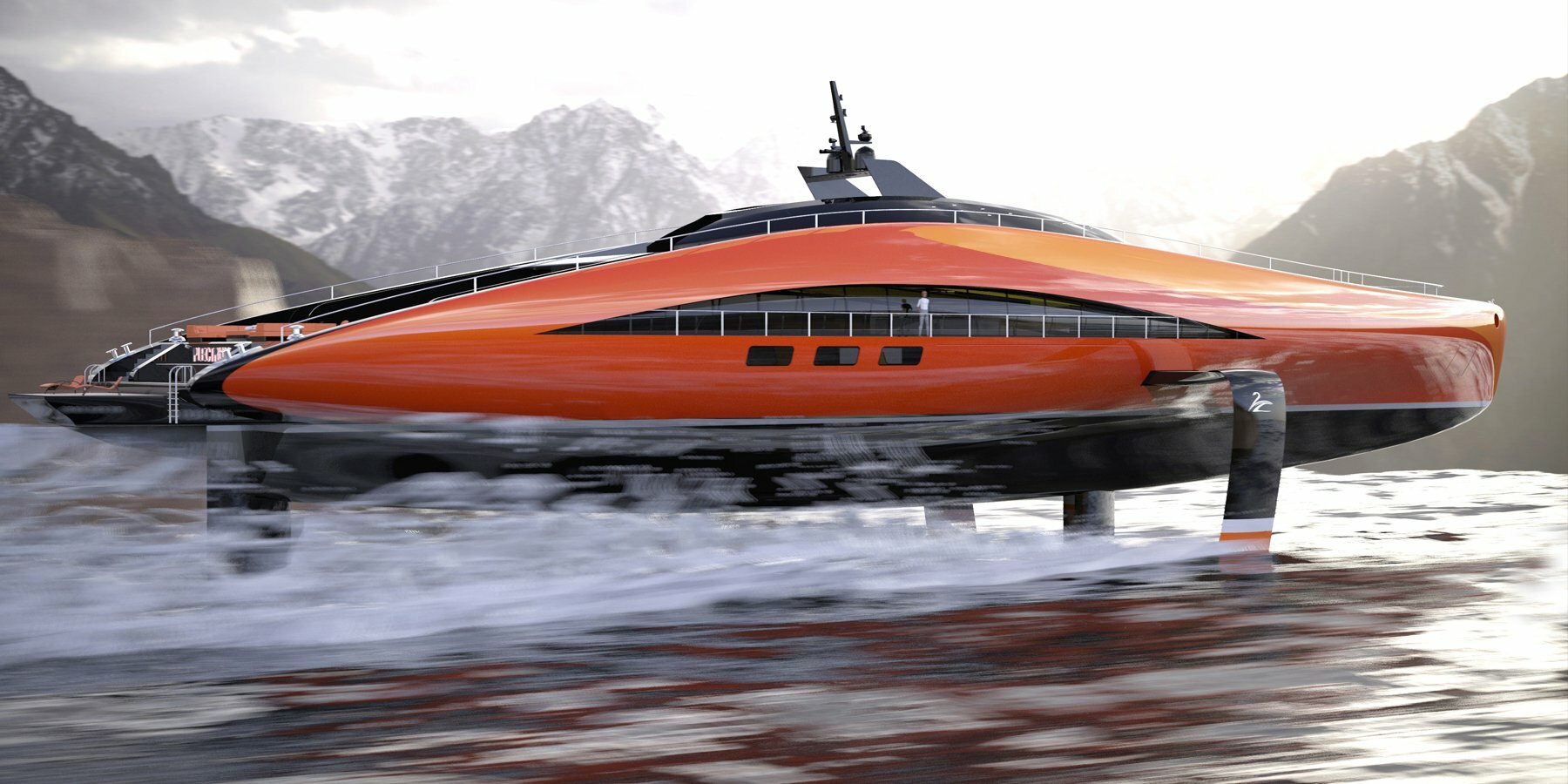
There is a moment in the Plectrum concept video where the yacht simply lifts off. Not in a metaphorical sense. The 243-foot carbon fiber hull rises clear of the ocean surface, suspended on its hydrofoil wings, and accelerates across open water at 75 knots, roughly 86 miles per hour. At that speed, on a vessel the length of a small office building, powered entirely by hydrogen, with no keel dragging through the sea below. The Plectrum is not a toy of the imagination. It is the most technically coherent extreme vessel concept ever seriously proposed, the product of a decade of escalating ambition from a Roman designer most of the world has never heard of.
Who Is Pierpaolo Lazzarini
Pierpaolo Lazzarini was born in Rome in 1982, studied fine arts in Viterbo, then completed a Master's in Car Design and Mobility at Milan's Domus Academy in 2008. He spent several years in the automotive industry before founding Lazzarini Design Studio in Rome in 2010, a boutique operation that provides, in his words, "startup projects ready to be launched on the market." His first significant creation, the Jet Capsule, launched publicly at the 2013 Monaco Yacht Show. The concept was simple and radical: a fully enclosed, pod-shaped watercraft, looking like something from a 1980s science fiction film, designed to be what Lazzarini called "a smart car for the sea." The Jet Capsule worked. Over the past decade, units have been delivered to clients in the United States, Spain, China, and the Middle East. Its commercial success gave Lazzarini global visibility and the revenue base to develop far more ambitious concepts.
The studio operates under the mantra "rooted in the future but inspired by the past." It is an apt description of Lazzarini's method. His designs draw from history, from racing sailboats, from historic airships, from cold war-era naval engineering, then recast those references through the materials and performance possibilities of the present. The result is a body of work that sits in a peculiar and valuable space: technically coherent enough to be taken seriously, visually extreme enough to capture global attention. Lazzarini has become, quietly, the most important yacht concept designer that almost no one outside the marine world knows by name.
The Plectrum Brief
Unveiled in January 2023, the Plectrum is the peak of that arc. The vessel is 74 meters, or 243 feet, long, constructed entirely from dry carbon fiber composite. Hull, decks, structural members: all carbon. The weight reduction achievable through full carbon construction is what makes the performance numbers possible; there is no other material through which a 74-meter hull could be made light enough to hydrofoil at the speeds Lazzarini specifies.
Propulsion comes from three hydrogen fuel cell motors, each rated at 5,000 horsepower, for a combined output of 15,000 horsepower. To calibrate that figure: the average ocean-going superyacht in the 60 to 80 meter range runs on diesel-electric systems producing somewhere between 3,000 and 6,000 horsepower total. The Plectrum carries two and a half times the power output of a top-tier conventional superyacht on a hull built to minimize the very mass that power must move. The result, on paper, is a top speed of 75 knots, with hydrofoil takeoff beginning at 15 knots.
The hydrofoil system is adjustable. When berthed or at anchor, the foil beam retracts to 15 meters. At speed, it extends to 20 meters, adding 2.5 meters of foil arm on each side of the central hull platform. This variable geometry serves two purposes: it keeps the vessel dockable in standard superyacht berths, and it maximizes lift and stability at full speed.
The AC75 Bloodline
Hull design on the Plectrum derives directly from the AC75, the foiling monohull class developed for the 2021 and 2024 America's Cup matches. The AC75 is a 23-meter racing sailboat that lifts its entire hull off the water on ballasted hydrofoils, reaching speeds above 50 knots under sail alone. During the 2024 Louis Vuitton Cup Final, INEOS Britannia was recorded at 55.5 knots, a figure that, just a decade ago, would have been considered physically implausible for any sailing monohull.
The specific inspiration for the Plectrum hull is the Luna Rossa Prada Pirelli challenger, the Italian entry that competed in both the 2021 and 2024 cups. Luna Rossa's AC75 is characterized by clean monohull lines, an aggressive forward hull profile, and foil geometry developed in partnership with Prada, the Italian fashion house that has backed the Challenger since 2000. Lazzarini took the fundamental hull logic of that racing architecture, the deep-V forward sections, the buoyancy distribution, the structural loads that foiling imposes, and scaled it by a factor of approximately three to produce the Plectrum.
The AC75 analogy is not merely aesthetic. Foiling physics at superyacht scale has never been attempted. A 74-meter hydrofoiling hull imposes structural loads that no existing marine engineering has validated. Lazzarini's point is that the AC75 proves the foiling monohull concept works at speed, and that carbon fiber composite construction is capable of sustaining those forces. The Plectrum is an extrapolation of a proven design principle, not a departure from it.
What Is Inside
Four decks of accommodation occupy the carbon hull. The owner's suite sits at the upper level, with large format glazing and views over the foil geometry aft. Six guest cabins occupy the mid decks. At the forward bow, housed in what Lazzarini calls a "retractable" structure, is a helicopter hangar: the helicopter is stored in the bow itself, not on an exposed deck helipad. Twin tender garages deploy through side-opening hatches amidships, a configuration borrowed from fast patrol vessel design. At the stern, a separate garage accommodates a car.
The beach club occupies the aft main deck, with a pool that can be covered. Fold-out terraces extend the deck area at anchor. The overall interior brief is conventional superyacht luxury in extraordinary packaging: the same categories of accommodation a 70-meter conventional yacht would offer, compressed into a hull designed to travel at twice the speed.
The price estimate is 80 million euros, approximately 86 million dollars at current exchange rates. For context, a conventional 70 to 74 meter superyacht from a major builder such as Lurssen, Feadship, or Oceanco typically ranges from 70 to 120 million euros depending on specification. The Plectrum's price, if buildable, would sit at the lower-middle of that range while delivering a vessel with no aerodynamic or speed peer in the class.
The Technology Gap, and Why It Matters Anyway
Lazzarini is candid about the Plectrum's primary limitation. The hydrogen fuel cell motors specified, three units producing 5,000 horsepower each from hydrogen, do not yet exist at production scale. The highest-output hydrogen fuel cell marine propulsion systems currently available produce a fraction of that power per unit. Scaling hydrogen fuel cells to the power density the Plectrum requires is an unsolved engineering problem.
This is not, in Lazzarini's framing, an argument against the Plectrum. It is a technology target. The studio notes that in 1964, the United States Navy laid down the USS Plainview, a 320-foot naval hydrofoil ship capable of sustained high-speed operation on foils. The engineering to build the Plectrum's hull, its hydrofoil geometry, and its carbon composite structure all exists today. What remains ahead is the propulsion technology. Lazzarini's position is that the Plectrum defines what is worth building toward: a design brief that is technically coherent in all but one dimension, waiting for materials science and fuel cell engineering to close the gap.
That framing is what separates Lazzarini's work from pure speculative rendering. He does not propose the Plectrum as fantasy. He proposes it as a specification, a record of exactly what a hydrogen-powered, 74-meter hydrofoil superyacht would look like, how it would be configured, and what it would cost, so that when the propulsion technology arrives, the design brief already exists.
The Wider Universe
The Plectrum is not an isolated project. Lazzarini's concept portfolio constitutes, taken together, a systematic attempt to redefine every category of extreme luxury vessel. In 2022, the studio unveiled the Air Yacht, a 262-foot hull suspended between two enormous helium-filled airship envelopes, a flying superyacht in the literal sense. In March 2024, the Colossea followed: a 699-foot megayacht designed as a floating docking station for a detachable 347-foot airship, the blimp itself a modernized tribute to the Norge, the Italian-built airship that completed the first verified expedition over the North Pole in May 1926. Inside one of the Colossea renderings, a banner trailing from the airship reads simply: "Elon, get in touch."
There is also the Pangeos, a 1,800-foot terayacht shaped like a sea turtle, designed to function as a floating city for 60,000 guests, roughly twice the footprint of the Colosseum. Each project escalates the ambition of the last. Each draws from specific historical or technical precedents. The Colossea references the Norge. The Plectrum references the AC75 and the USS Plainview. The Air Yacht references the golden age of rigid airship transport. Lazzarini is not making things up. He is finding the most extreme real-world performance precedents and asking what happens when you combine them with contemporary materials and a superyacht brief.
A Design Studio as Engineering Manifesto
There is a legitimate question about whether concept-only design studios provide durable value. The yachting world is full of beautiful renderings that never become hulls. Lazzarini's answer to that question is the Jet Capsule: a futuristic concept that entered production, sold internationally for over a decade, and generated a commercial business on the strength of an idea that initially looked unbuildable.
The Plectrum will not be commissioned next year. The hydrogen propulsion gap is real and meaningful. But Lazzarini Design Studio is not a studio that only generates images. The Jet Capsule line, now in its Hyper-Sport variant and priced from around 300,000 dollars, has been delivered to clients across four continents. The studio has real engineering capability, a track record of translating concept to production, and a design philosophy disciplined enough to ground even its most extreme proposals in historical and technical precedent.
The Plectrum stands as the fullest expression of what that philosophy can produce when it is given a 74-meter canvas and no constraint except physics. A 243-foot carbon superyacht designed to lift off the ocean at 86 miles per hour on hydrogen power is the kind of design brief that does not arrive often. Lazzarini has written it down, rendered it, priced it, and published it. The rest is an engineering problem.