The Light That Builds: How Computed Axial Lithography Is Rewriting the Rules of Manufacturing
A printing technology that illuminates objects into existence in under two minutes, with no layers, no support structures, and the ability to build around objects that already exist.
By Carry and Conquer Publications
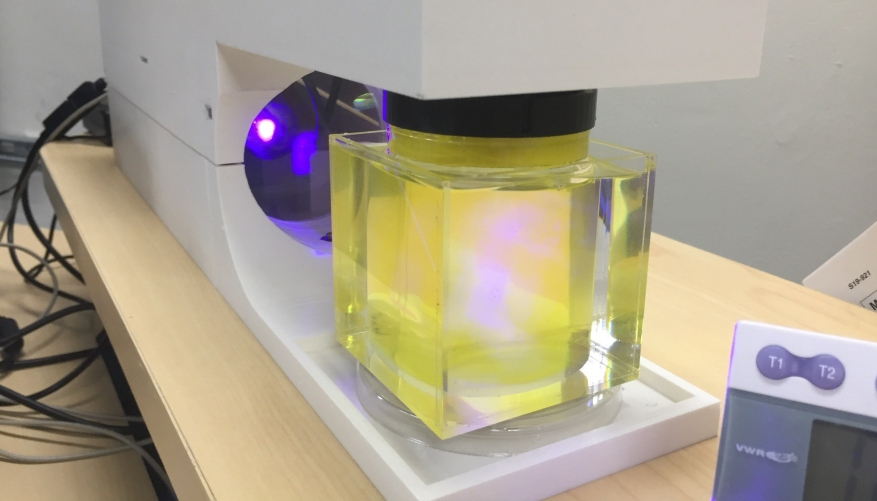
In the fall of 2016, two graduate students at UC Berkeley were brainstorming a class project for a computational imaging course. Brett Kelly, then splitting time between Berkeley and Lawrence Livermore National Laboratory, and Indrasen Bhattacharya had a problem: the volumetric 3D printing approaches that already existed could only produce simple geometries. What they needed was a method that could handle arbitrary, complex shapes all at once, without the layer-by-layer constraints that had defined additive manufacturing since Charles Hull invented stereolithography in the 1980s. The solution they sketched out borrowed from an unlikely source: the CT scanner. They called it Computed Axial Lithography.
How a CT Scanner Became a Printer
The core insight of CAL is an elegant reversal of medical imaging logic. In a computed tomography scan, a machine fires X-rays through a patient's body from multiple angles and reconstructs a 3D image from the resulting data. CAL runs this process in reverse. Instead of X-rays reading a body, a standard digital projector beams computed light patterns into a rotating cylinder of photosensitive resin. As the vial turns, each angular position receives a precisely calculated 2D projection. The cumulative light dose, accumulated across all those angles, exceeds a polymerization threshold at every point corresponding to the desired object, and only at those points. The resin solidifies simultaneously throughout the volume, and the complete object materializes at once.
"In conventional layered additive manufacturing, the layers that are printed are the same as the layers that go into your design file," Bhattacharya explained at the time of the Science publication. "However, in this case we are projecting images that travel through the entire volume and when they are all combined, you get a 3D volume that looks like what you need to print. There is no printing without the computation."
The team, also including Hossein Heidari at Berkeley and Maxim Shusteff and Christopher Spadaccini at Lawrence Livermore, published results in Science on January 31, 2019. The paper described how the system projected 1,440 different image frames, four per degree of rotation, into the resin as it turned. Print times ran between 30 seconds and two minutes. Objects emerged with smooth, layer-free surfaces and no stair-step artifacts. The team named their machine "the Replicator," after the Star Trek device that materializes objects on demand.
The Overprinting Capability That Changes Everything
Of all CAL's properties, the most commercially transformative may be what the Berkeley team calls overprinting: the ability to print a 3D structure around and directly encapsulating a solid object that already exists in the resin. The earliest demonstration was blunt and memorable. Researchers placed a metal screwdriver shaft into the photosensitive resin and printed a custom polymer handle directly onto it. No mold. No assembly. No post-processing. The handle materialized around the shaft in seconds.
This capability exists because of how CAL handles light occlusion. In a layer-by-layer printer, an opaque insert blocks the light path and ruins the print. In CAL, the shadow cast by a prepositioned object at any given angle is compensated for by projections arriving from all other angles. The insert's shadow is, in effect, mathematically canceled out. Cornell University researchers published results in Advanced Materials in 2024 demonstrating this property for soft robotics: a GelMA hydrogel actuator with an embedded endoskeletal structure was printed in a single CAL process, the soft gel forming around a rigid internal frame in one step. Traditional fabrication of the same structure required molding the silicone body separately and then inserting the endoskeleton by hand.
The implications for embedded electronics are significant. The same principle that allows printing around a screwdriver shaft allows printing around a microchip, a circuit board, a sensor array, or an antenna. A device housing can be printed directly around its electronic components, eliminating assembly steps, reducing tolerance stack-up, and enabling geometries that would be impossible to assemble conventionally.
Material Expansion and the Micro-CAL Breakthrough
The 2019 demonstration used standard photopolymer resins. The past several years have extended the material palette substantially. In April 2022, Taylor's group published results in Science showing that CAL could be adapted to print in fused silica glass by tomographically illuminating a photopolymer-silica nanocomposite, then sintering the result. The micro-CAL system produced glass microfluidic channels with internal diameters of 150 micrometers, freeform optical elements with surface roughness of just 6 nanometers, and structural lattices with minimum feature sizes of 50 micrometers. A key enabler was that CAL can process extremely viscous materials that would clog or fail in layer-by-layer systems. Because no relative motion occurs between the resin and the forming object during exposure, there is no mechanical disturbance to displace delicate features.
"When we first published this method in 2019, CAL could print objects into polymers with features down to about a third of a millimeter in size," said Hayden Taylor, professor of mechanical engineering at UC Berkeley. "Now, with micro-CAL, we can print objects in polymers with features down to about 20 millionths of a meter, or about a quarter of a human hair's breadth. And for the first time, we have shown how this method can print not only into polymers but also into glass, with features down to about 50 millionths of a meter."
The expansion into glass matters commercially because glass is the preferred material for high-quality micro-optics, including the compact camera lenses in smartphones and endoscopes, and for microfluidic lab-on-chip devices. Both markets are large and precision-sensitive, and both have historically relied on expensive, slow subtractive fabrication.
Readily3D and the Commercial Translation
While the Berkeley team has continued pushing the science, the commercial translation has been led primarily by Readily3D, an EPFL spinout founded in 2020 by Paul Delrot, who co-invented the volumetric printing approach during his PhD studies at EPFL, and co-founder Damien Loterie. Readily3D's Tomolite printer, now in its v2.0 iteration, has become the standard commercial platform for volumetric bioprinting research. Christophe Moser, a full professor at EPFL and board member since 2020, brings serial entrepreneurship credentials from his earlier work founding Ondax Inc., acquired by Coherent in 2018.
The company's primary focus has been the life sciences. Readily3D targets applications where CAL's speed and softness are uniquely suited: fabricating delicate cell-laden hydrogel scaffolds for tissue engineering. Riccardo Levato, associate professor at Utrecht University and scientific advisor to the company, pioneered volumetric bioprinting for tissue applications and has collaborated on multi-material volumetric constructs published in Advanced Materials in early 2025. That work demonstrated the ability to fabricate multi-material GelMA hydrogel structures, running volumetric printing twice in sequence with different materials to produce chemically distinct zones within a single construct.
"Conventional 3D printing techniques, known as additive manufacturing, build parts layer by layer," said Loterie. "The problem is that soft objects made that way quickly fall apart." CAL solves this by printing without the mechanical forces that layer-based systems impose on partially formed, gel-like structures as each new layer is deposited.
The Investment Case: Where the Leverage Is
For private equity and growth investors, the CAL story has three distinct value vectors.
The first is speed. A print process that requires 30 to 120 seconds per part, with no tooling changes, no support removal, and no post-cure wait time, can reach throughput numbers that challenge injection molding for small, complex parts. Taylor has said publicly that competing with injection molding for some applications is an explicit goal. If achievable, it represents a structural disruption to one of the most entrenched manufacturing processes in the global economy.
The second is the overprinting capability. No competing technology in commercial deployment can print around arbitrary pre-existing inserts at anything close to CAL's speed. That creates a narrow but genuinely defensible moat for applications requiring embedded components. Custom hearing aids, patient-specific prosthetic sockets, and sealed electronic assemblies are all within reach. A device manufacturer that can eliminate an assembly step from a high-volume production line reduces labor, tolerance error, and part count simultaneously.
The third is material breadth. The expansion from photopolymers to hydrogels to glass has happened over six years of academic work, with commercial translation lagging by one to three years in each case. Each new material opens a separate addressable market. The dental prosthetics market alone exceeded $3.2 billion globally in 2024 and is projected to reach $8.2 billion by 2033, according to IMARC Group. Volumetric printing is being evaluated for same-day crown and prosthetic fabrication, where the speed and surface quality advantages are directly monetizable.
What the Critics Note
CAL is not without its engineering challenges, and serious investors should understand them. The computation required to generate optimal light projection patterns can be intensive. Real-time monitoring of print progression inside the resin is technically challenging, particularly for materials that do not change optical index visibly upon polymerization. Resolution in standard CAL is limited to roughly a third of a millimeter in standard polymer systems, which is adequate for many applications but insufficient for fine electronics or precision optics without the specialized micro-CAL configuration.
There is also competitive pressure within the volumetric printing category. Xolography, commercialized by Berlin-based xolo GmbH, uses two intersecting light beams of different wavelengths and claims resolution roughly ten times higher than standard CAL. A 2026 result from a volumetric printing variant called DISH demonstrated print times as short as 0.6 seconds. The field is moving quickly, and CAL's first-mover advantage in scientific credibility and institutional research adoption is not a permanent commercial moat.
The Paradigm, Stated Plainly
Manufacturing has always been defined by the relationship between time and geometry: more complex shapes require more time to build. CAL severs that relationship at its root. The time required to print is determined by the volume of resin being illuminated, not by the complexity of the object being formed. A simple cube and a detailed anatomical model with internal channels take the same time to produce.
This is not an incremental improvement. It is a different manufacturing ontology. The technology was proven in a graduate class project in 2016, published in Science in 2019, printed in glass by 2022, and is now in commercial evaluation for dental prosthetics, soft robotics, and embedded electronics. What happens when the cycle time of a manufacturing process approaches zero is not yet fully understood. The factory, in this paradigm, does not build a thing. It illuminates a thing into existence.