The Last Sense
Osmo digitized smell in 2024. Nobody in the $40 billion fragrance oligopoly was ready for what came next.
By Carry and Conquer Publications
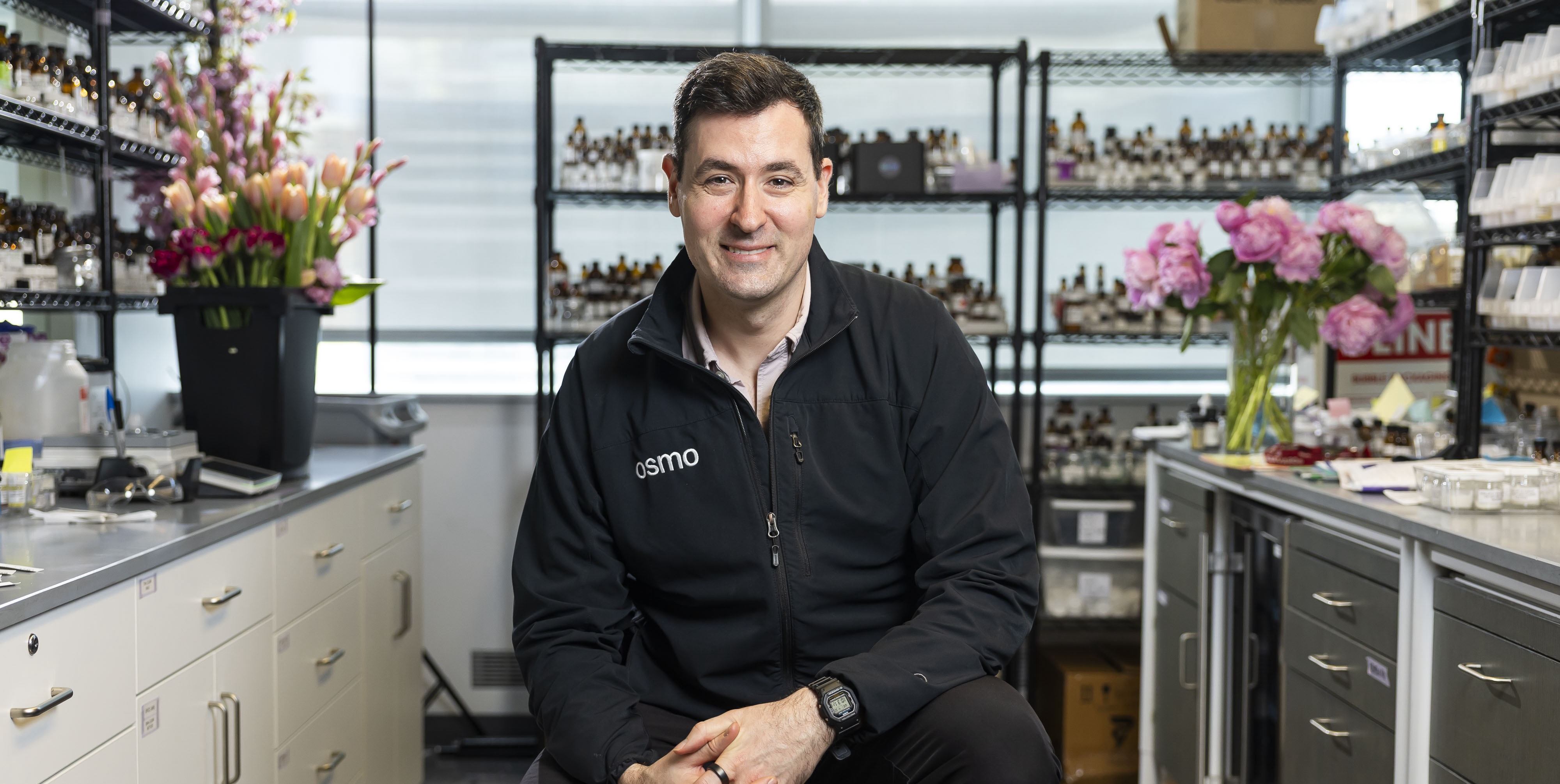
In 2024, inside a Manhattan lab cluttered with beakers, vials, and robotic formulation equipment, a Harvard-trained olfactory neuroscientist named Alex Wiltschko held a slice of coconut in front of a gas chromatography machine and pressed go. What emerged on the other side of the room was not the coconut itself but a synthesized replica of its scent, generated entirely by artificial intelligence with zero human intervention at any step. Wiltschko had spent the better part of eighteen years working toward that moment: a PhD studying how the brain processes odor, five years at Google Brain building Alphabet's olfaction group, and then Osmo, the spinout company he launched in 2022 with a thesis that would reshape one of the oldest industries on earth. The digitization of smell, he argued, was not a fragrance project. It was an infrastructure project, as fundamental as the creation of the JPEG.
The Map That Made Everything Possible
Before anything else, Osmo had to solve a problem that had stymied both neuroscience and the fragrance industry for over a century: smell has never had a coordinate system.
Vision has RGB. Three values describe any color in existence, and those three values are what allowed photography to go digital, screens to display anything, and images to be transmitted across the world. Sound has frequency: a one-dimensional spectrum that encodes every song ever recorded. Smell had nothing. Your nose contains over 300 distinct odor receptors, each responding to different molecular features in ways that were poorly understood. Matching a molecule to a smell required a human nose, and predicting a smell from a molecular structure alone was considered impossible.
Wiltschko's team at Google Brain built the answer. Using graph neural networks trained on roughly 5,000 molecules, each labeled by master perfumers with descriptors like "creamy" or "grassy," they produced a Principal Odor Map: a multidimensional mathematical space in which every molecule has a coordinate, and those coordinates predict, with measurable accuracy, what the molecule smells like before anyone has sniffed it. The research was published in Science in August 2023. In a prospective validation test on 400 novel odorants, the model matched the average trained panelist's description more closely than any individual human panelist could. On 53 percent of molecules tested, the AI performed better than the median human nose.
This was not incremental. It was the olfactory version of the moment in 1994 when JPEG compression made photographs transmissible over dial-up connections. Once you have a map, you can read, write, and transmit anything on it.
What Scent Teleportation Actually Does
Osmo's Scent Teleportation process, which the company achieved in its first full automated form in 2024, works through four stages that together constitute the complete digitization pipeline.
A physical sample, whether a slice of fruit, a flower petal, or a material, is placed in headspace analysis equipment that traps the scent molecules in the surrounding air. The gas chromatography-mass spectrometry machine breaks the resulting sample into its constituent molecules and uploads the raw data to Osmo's cloud infrastructure. There, the molecular profile is mapped onto the Principal Odor Map, translated into a synthesizable formula using available molecules, and transmitted to a robotic formulation system that mixes the result. The process requires no human intervention at any point between the physical sample and the reconstituted fragrance.
The first successful full attempt used coconut; subsequent tests refined toward more complex profiles, including the fresh-cut summer plum that Wiltschko later cited as proof of the system's maturity. Each week, Osmo now transmits hundreds of scent descriptions using safe, synthesizable molecules, running monthly teleportation trials to improve speed, automation, and fidelity. The team has built what it describes as the largest AI-compatible scent data library in the world, and that library grows larger with every trial.
What makes this consequential to private equity observers is not the technical elegance. It is the structural implication. Sound became fully digital in 1999 and the music industry went through a decade of violent reorganization before Spotify emerged as the dominant infrastructure layer. Osmo is arguing, with considerable evidence, that smell is at the 1999 moment. Once a sensory dimension is fully digitized, it enters every supply chain, every creative workflow, and every consumer product format simultaneously.
The $40 Billion Oligopoly That Didn't See It Coming
For the better part of a century, the global fragrance industry has been controlled by four conglomerates: DSM-Firmenich, Givaudan, IFF, and Symrise. Between them, they formulate the scents in nearly every major consumer product on earth, from Sephora's bestselling perfumes to the detergents, shampoos, and candles that make up the invisible olfactory layer of daily life. Givaudan alone generated revenues of CHF 7.4 billion in 2024. Collectively, the big four represent roughly $40 billion in market capitalization.
Their competitive moats were built on three things: massive libraries of proprietary molecules, relationships with master perfumers whose skills took decades to develop, and a development process so slow and opaque that only the largest consumer brands could afford to participate. Crafting a signature scent with one of the major houses could take upward of a year and required budgets that effectively locked out smaller brands.
Osmo's Generation fragrance house, launched in March 2025, attacks all three simultaneously. A brand can input a natural language brief, a mood board, a set of fragrance notes, or even a texture and performance goal, and Generation's Olfactory Intelligence platform returns a draft formula that Osmo's in-house perfumers then refine. Wiltschko estimates the company can deliver a first-iteration fragrance in as little as 48 hours. Working with nearly 100 brands since its commercial launch, Generation has scented everything from functional fragrance brands to the Museum of Pop Culture in Seattle, which became the first museum to commission its own proprietary scent.
The incumbents have not been idle. Givaudan's Carto tool visualizes scent combinations for perfumers in real time. Symrise's Philyra platform, developed with IBM, analyzes 1.7 million in-house formulations to identify novel combinations. IFF launched ScentChat and a suite of performance-tuning tools in early 2025. But none of these platforms can screen billions of novel molecules overnight. None of them digitized smell. They layered AI onto existing human workflows; Osmo replaced the workflow.
The patent record makes this visible. In 2025, Osmo published more new fragrance ingredient patents than all other major fragrance companies combined. In a decade when several major players were publishing few or no new ingredient patents, a five-year-old startup out-innovated the entire inherited infrastructure of an industry measured in billions.
The $70 Million Bet and What It Buys
Osmo closed a $70 million Series B in February 2026, bringing total capital raised to $130 million. The round was led by Two Sigma Ventures, with participation from Valor, Atreides, Amplo, Alumni Ventures, and Patrick Collison, CEO of Stripe. The Stripe connection is not incidental: Collison has a track record of backing infrastructure bets in industries undergoing structural digitization.
"Osmo proves this technology works commercially," said Colin Beirne, Partner at Two Sigma Ventures, now a board observer. "But fragrance is just the beginning. We're backing the infrastructure layer for digital olfaction, with applications spanning healthcare diagnostics to environmental monitoring."
The funding is being deployed across several vectors. The company has moved into a 60,000-square-foot headquarters and manufacturing facility in Elizabeth, New Jersey, a region with deep roots in fragrance chemistry, consolidating operations from its Manhattan office. The executive team now includes Mike Rytokoski as Chief Commercial Officer, who spent thirty years at Unilever, Clorox, and Amyris in ingredients and fragrances; COO Mateusz Brzuchacz, formerly of Givaudan and IFF; and CFO Nate Pearson, previously at Mercedes-Benz's North American EV charging platform. The team reads less like a startup and more like a launch vehicle.
The commercial applications beyond fragrance are the reason Two Sigma's thesis goes beyond beauty. Unilever, independently, has committed 85 million pounds to build an AI-enabled fragrance design unit that uses neuroscience to research how scent influences mood and emotional wellbeing across its global brand portfolio. As the former Unilever veteran in Osmo's C-suite knows, the pharmaceutical flavor-masking market, the hospital environment market, and the digital therapeutic scent market are all addressable from the same OI infrastructure.
The Last Undigitized Dimension
What Wiltschko understood, and what the fragrance industry missed, is that the economic significance of digitizing smell is not bounded by the fragrance market. It is bounded by the total surface area of human experience.
The experience economy proposes that the most durable commercial value is created not through goods or services but through memorable experiences that engage all five senses. For decades, three of the five primary senses, sight, sound, and touch, have been fully digitizable, searchable, and transmissible. Smell remained stubbornly analog: impossible to compress, impossible to index, impossible to send across a wire. A filmmaker could direct every visual frame and sonic layer of a scene and have zero control over what the audience actually smelled in the theater.
That constraint is dissolving. The implications run across industries in ways that are genuinely difficult to fully map. Scented digital content accessible to consumers, one of the applications Wiltschko has named publicly, would represent the addition of a new sensory track to every digital format that supports it: streaming platforms, social media, gaming environments, virtual reality. Museum and immersive experience design, where Osmo is already operating with clients like Seattle's Museum of Pop Culture and the ARTE Museum, points toward a future where architects specify scent environments with the same precision they apply to acoustic design. Public health applications include faster pandemic tracking through environmental odor monitoring and new generations of insect repellents, an area where the Gates Foundation invested $8.5 million specifically because Osmo's odor map predicted insect olfaction as well as human olfaction.
The challenge for any incumbent investor watching this sector is that the disruption is not contained. Osmo is not building a better perfume company. It is building the olfactory layer of an infrastructure stack that does not yet exist, in a world that is about to need it. The music industry analogy runs darker than it first appears: in 1999, the labels did not understand that their catalog was about to become weightless. In 2026, the fragrance houses may be at a similar inflection. Osmo out-patented them last year. It out-automated them in 2024. The question that private equity should be asking is not whether this technology works. The question is how many adjacent markets become addressable once smell joins the digital stack, and which companies will own the infrastructure when that happens.
Wiltschko framed the stakes plainly at the opening of Osmo's New Jersey facility: "What we are doing is decoding the understanding of our oldest sense, the oldest language that's been spoken on this planet." The coconut slice in 2024 was the proof of concept. What comes next is the product roadmap.