The Italian Atelier That Builds Billionaires a Second, Disposable Version of Their Own Multi-Million-Dollar Race Car
A consortium of twelve Italian workshops will build a client an exact copy of his own seven-figure Ferrari, down to the engine internals, so he can crash it instead of the original.
By Carry and Conquer Publications
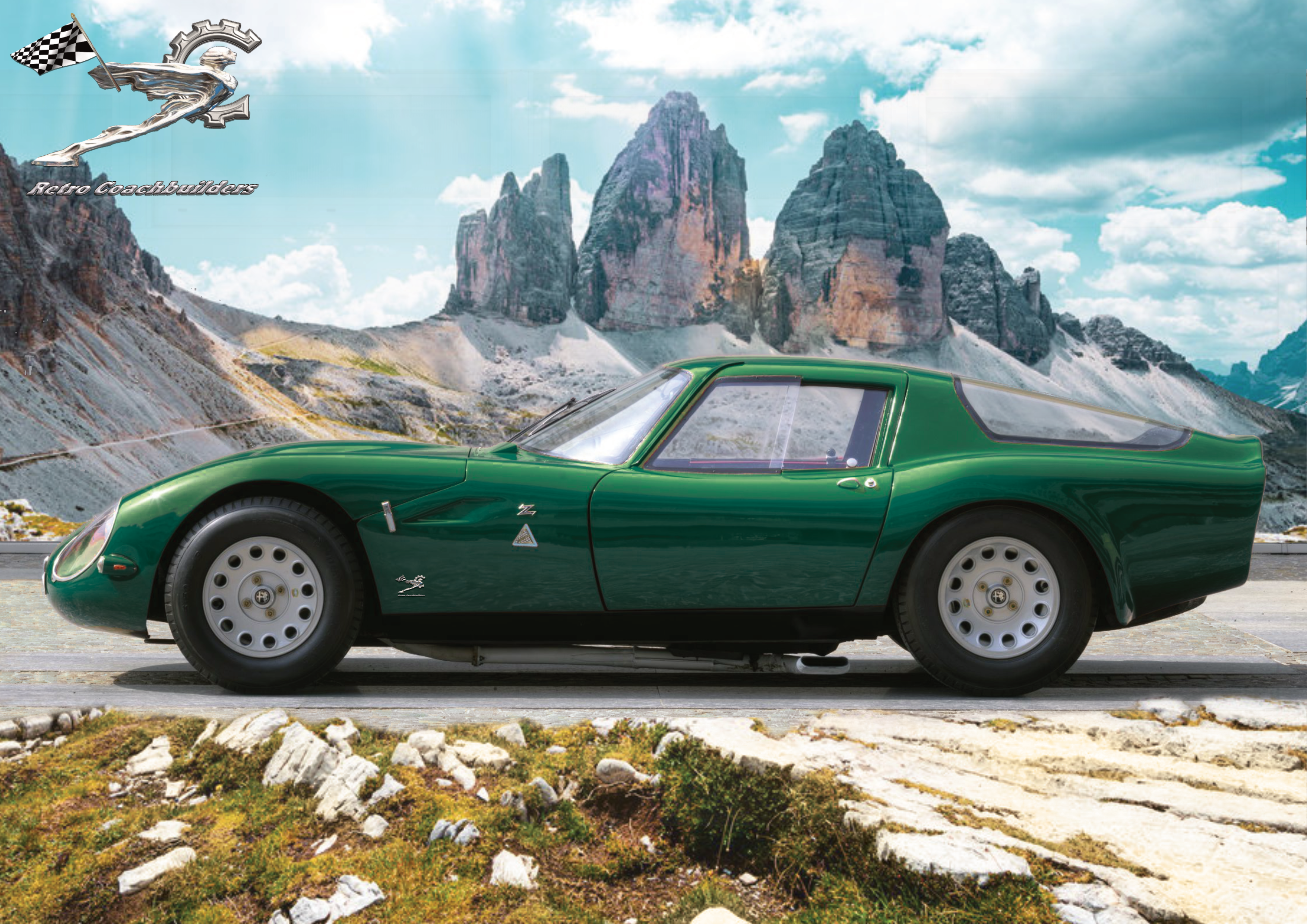
Somewhere in a climate-controlled vault, a collector's numbers-matching race car sits untouched, its provenance and paint intact. On a circuit an hour away, that same collector is redlining an identical car through a chicane, dropping two wheels onto the curbing without a second thought, because the car underneath him is not the original at all. It is a nut-and-bolt reproduction built to the smallest tolerance by Retro Coachbuilders, a boutique consortium of twelve Italian ateliers that has quietly built a business on a piece of collector psychology almost nobody outside the ultra-wealthy car world discusses openly: buy the real thing, then commission a second one you are actually willing to destroy.
A Business Built on Insuring Against Yourself
Retro Coachbuilders was founded in 2015 by the Rodrigues family, which also runs the ultra-luxury marque Automobili Rodrigues, and describes itself as a single Italian boutique coachbuilder formed from twelve specialized ateliers and machine shops spread across the country. The firm's own account of its origin is explicit about what it considers its core service, stating that some collectors ask it to build exact reproductions of their ultra-rare, multi-million-dollar race cars to the smallest original detail so they can race without worrying about wrecking them and keep the originals safe in a collection or museum. That sentence describes an insurance product disguised as a car commission. The client does not buy a second car because he wants two of the same thing. He buys it because owning one genuinely irreplaceable object and using it are mutually exclusive activities, and Retro Coachbuilders sells the only mechanism that resolves the contradiction: a copy so exact that the risk-taking and the wealth-preservation can happen in parallel, on two different chassis, under one roof.
The mechanics of the reproduction are not superficial. The firm states it can rebuild complete vintage and racing engines, transmissions, chassis, suspension and electrical systems to original specification, including recreations of period Ferrari Colombo V12 units and the Alfa Romeo Tipo 33 Stradale's 2.0-liter racing V8. A car built this way is not a tribute with the right badge glued on. It is closer to a second, parallel original, built from the same drawings, in some cases by the same family lineages of craftsmen who built the first one sixty years ago, engineered so that the driving experience, the sound, the weight transfer and the failure modes are indistinguishable from the museum piece down the road. The entire point is that if the client puts it into a wall at Imola, nothing of consequence is lost except a fraction of what the original would have cost to lose.
The Talent Pool No Money Can Recreate
What makes this workable at all is a labor pool that is not being replenished. Retro Coachbuilders says its first and second-generation master coachbuilders previously worked for Ferrari, Lamborghini, Lancia, Alfa Romeo and Maserati and their respective coachbuilders, including Scaglietti, Vignale, Ghia, Pininfarina, Bertone, Italdesign, Drogo and Frua, the houses that hand-built the original aluminum bodies of cars now worth tens of millions of dollars. The craft at the center of that work is battilastra, the Italian tradition of shaping aluminum body panels entirely by hand and eye over a wooden buck, a skill built through decades of apprenticeship rather than a curriculum. Industry accounts of Italy's coachbuilding trade describe battilastra artisans as already rare and difficult to find in the modern carrozzeria world, a scarcity that predates Retro Coachbuilders and will outlast it. The firm is not manufacturing a supply of these craftsmen. It is aggregating what remains of an existing one, consolidating twelve independent shops precisely because no single shop retains enough of the old skill base to complete a car alone anymore.
That labor scarcity is the real moat, more than any trademark or design patent. Design houses like Pininfarina and Bertone spent the postwar decades training in-house battilastra teams because there was no other way to build a body; when Bertone collapsed into bankruptcy in 2014 after 102 years in business, decades of accumulated hand-forming knowledge scattered rather than transferred cleanly to a successor. Retro Coachbuilders' pitch to collectors is implicitly a pitch about time running out: the artisans who can panel-beat an Alfa Romeo 33/2 Coupe Speciale roofline from a flat aluminum sheet are in their sixties and seventies, and the firm markets access to them as a finite resource rather than a repeatable manufacturing process.
Resurrecting What Never Existed
The reproduction-for-track-use business would be a strong story on its own, but Retro Coachbuilders' second line of work is stranger. Its Concepts Reborn program reproduces show cars and concepts that were destroyed, lost or never built beyond a single prototype, working from period photographs, archival drawings and 3D scans rather than an extant original. The firm's public project list includes the 1968 Alfa Romeo Carabo, Marcello Gandini's Bertone wedge design credited with introducing scissor doors years before the Lamborghini Countach; the 1969 Alfa Romeo 33/2 Coupe Speciale by Leonardo Fioravanti for Pininfarina; the Giorgetto Giugiaro-designed Alfa Romeo Iguana; the 1971 Maserati Boomerang, built by Italdesign on a Maserati Bora platform; and the three Alfa Romeo BAT aerodynamic concepts designed by Franco Scaglione in the 1950s. Each of these existed as one or two hand-built cars, shown at a single motor show, then dismantled, lost or absorbed into a museum where no collector could ever drive one.
Reproducing an object from photographs and blueprints is a fundamentally different exercise than copying one that survives, and it inverts the market's usual hierarchy of authenticity. A recreation of a car that still exists competes, at least philosophically, with an original that a purist can point to and call the real one. A recreation of a car that no longer exists in any form has no original to compete with; it simply is, for practical purposes, the only version of that design a human being can own and drive. Retro Coachbuilders frames these projects as bringing back cars that "never left the drawing board," and the firm's own materials draw no meaningful distinction between reviving a lost one-off and building a car that was, in the truest sense, imagined but never completed.
Old Craft, New Tooling
None of this would be commercially viable at the tolerances collectors demand without a layer of modern engineering sitting underneath the hand skills. Retro Coachbuilders describes using computer-aided design, finite element analysis and five-axis CNC milling to plan and rough out body structures and components before its metalworkers do the final hand-forming and fitting. The firm's own description of this hybrid process is that the precision of digital tooling now lets a small number of surviving master coachworkers achieve results that would previously have required far larger workshops and far more time. This is a familiar pattern in other corners of the continuation and restoration car industry. Jaguar Classic's factory continuation program, which has recreated the Lightweight E-Type, the D-Type and the C-Type since 2016, has said its engineers cross-reference laser scan data from an original car with computer-aided design to produce what the company calls the most authentic possible new example, before human craftsmen complete the hand finishing.
Retro Coachbuilders extends that same digital-plus-artisanal model further than most factory continuation programs are willing to go, because it is not bound to any single marque's archive or approval process. Its output ranges from what it calls Reborn Classic versions, built to run exactly as the original did in period, to Reborn Retro cars that pair a vintage silhouette with a modern engine and drivetrain, to full Reborn EV builds that drop an electric powertrain into 1960s coachwork entirely. A client can order a 1960s-bodied car that drives like a 1960s car, one that outruns a modern supercar, or one that is silent and electric, all from the same design lineage and the same ateliers.
A Market That Already Decided Copies Can Be Real
Retro Coachbuilders is not inventing collector tolerance for non-original cars; it is positioning itself at the far end of a spectrum the market has already normalized. Manufacturer-sanctioned continuation programs have made the case commercially for over a decade. Aston Martin priced its DB4 GT Zagato continuation pairing, sold alongside a modern DBS GT Zagato as part of its Centenary Collection, at 6 million pounds, or roughly 7.9 million dollars, for the pair. Jaguar's continuation D-Types, limited to the final 25 of an originally planned 100-car run, sold for roughly 1.5 million dollars each and moved quickly despite being unsuitable for road use. Secondhand examples of these factory continuations have since traded at auction for multiples of what even the best independent replicas bring, evidence that serious collectors treat manufacturer-built, digitally-verified reproductions as a distinct and legitimate asset class rather than a lesser substitute for an original.
What Retro Coachbuilders offers that no factory continuation program can is scope. Jaguar can only build Jaguars it owns the rights and archives to reproduce, in runs the company itself decides to authorize. Retro Coachbuilders will reproduce a client's own privately owned Ferrari, Porsche or Lancia to that specific car's own history and specification, in a run of exactly one, without needing sign-off from a manufacturer that in many cases no longer exists in its original form or has no interest in the project. The value of the underlying originals gives the arrangement its logic: a 1962 Ferrari 250 GTO sold for 48.4 million dollars at a 2018 RM Sotheby's auction, and a 1955 Mercedes-Benz 300 SLR Uhlenhaut Coupe, a car Retro Coachbuilders lists among its own reproduction projects, sold privately through RM Sotheby's in 2022 for 142 million dollars, the highest price ever paid for a car. Against numbers like that, the cost of an exact second chassis, however expensive in absolute terms, is a rounding error next to the value being protected.
No Waitlist, No Price List, No Interest in Either
Retro Coachbuilders carries almost no public footprint for a firm capable of producing a 142-million-dollar car's stunt double. Its Instagram account has fewer than sixty followers. It publishes no pricing on its site, no client list and no waitlist, and its own materials describe a three-stage process that begins with a private consultation on specification and vision, moves to design and engineering once a contract is signed, and ends with twelve to eighteen months of handcrafted construction and type-approval homologation. There is no funnel, no lead-generation form and no advertising presence that search turns up. Commissions move through word of mouth inside the same closed international network of collectors who exhibit at Pebble Beach and the Concorso d'Eleganza Villa d'Este, gatherings where the owners of the world's rarest cars already know one another and increasingly know who can quietly build them a second one.
That opacity is not an oversight. A business whose entire value proposition rests on discretion, on craftsmen who cannot be replaced and on clients who would rather not have their insurance strategy discussed in public, has no incentive to build a marketing funnel. The absence of published financials or transaction data means there is no way to size this market from the outside, no way to know how many of the world's most expensive race cars are quietly living a double life with a workshop-built twin doing the actual racing. What is verifiable is the model itself: a dozen aging ateliers, a finite and unrenewable supply of hand-forming skill, and a clientele wealthy enough to solve the tension between having something and using it by simply building it twice.