The German Startup Selling Cyborg Insects to NATO
A Kassel startup founded in 2024 says it is already selling remote-steerable cockroach swarms to NATO militaries, years ahead of any independent confirmation or regulatory framework for bio-hybrid systems.
By Carry and Conquer Publications
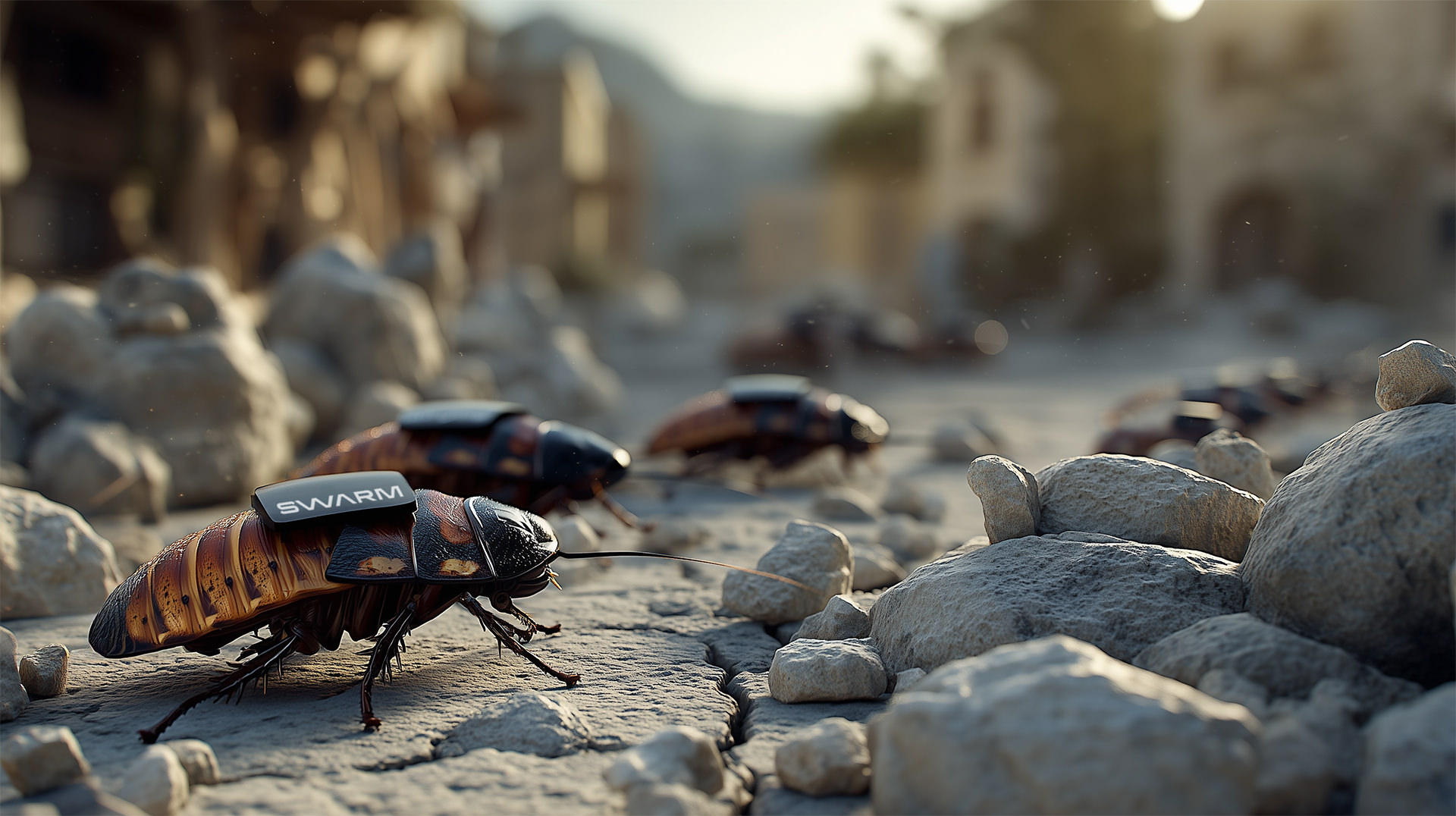
SWARM Biotactics turned a lab full of Madagascar hissing cockroaches into a paying defense contract with the Bundeswehr in under two years, and it did it by refusing to build a better drone.
A German startup founded in Kassel in 2024 is now telling the public, on the record, that it has sold living, remote-steerable insects to NATO militaries for battlefield reconnaissance. In February 2026, CEO Stefan Wilhelm posted a blunt update: a year earlier, programmable cyborg insect swarms did not exist as a fielded product. Now, he said, they are built, field-tested, and deployed with paying NATO customers, the German Bundeswehr among them. The company has raised roughly 13 million euros, grown past 40 engineers and neuroscientists in its first year, opened a subsidiary in San Francisco, and is already pitching the same hardware for disaster response and industrial inspection. It is a small company making an outsized claim, and the claim is built entirely on cockroaches.
From cardboard box to combat pitch
SWARM's core product is the Madagascar hissing cockroach, chosen for reasons Wilhelm has laid out in interviews with unusual candor. The species is large, durable, and already well studied by biologists, which matters because the company is not designing an insect, it is retrofitting one. Each cockroach carries a custom backpack strapped to its thorax containing a battery, microelectronics, and a set of electrodes wired to the insect's antennae. Stimulating those electrodes lets an operator steer the animal's natural walking behavior in a chosen direction, the same way a bit and reins redirect a horse without replacing its legs. Wilhelm has compared the backpacks to saddles rather than replacements for the animal, framing the whole platform as augmentation of an evolved body rather than a machine built from scratch.
That framing matters commercially. A cockroach does not need batteries recharged between missions the way a drone does, does not require a factory line to produce more of it, and generates no heat signature or rotor noise that a sensor can pick up. Wilhelm has said the insects can carry a payload of several grams, enough for a microphone, a small camera, or a chemical sensor, and can survive punishment, heat, and chemical exposure that would disable conventional micro-robotics. Early reporting on the backpacks put their weight near 15 grams, with the company since working to shrink that closer to 10. The pitch to defense buyers is not that a cockroach is better than a quadcopter in the open field. It is that a cockroach can go where no drone can: into rubble, into pipes, into a collapsed building's crawl spaces, into a tunnel a human scout would refuse to enter first.
Thirteen million euros and a two-year sprint
SWARM's capital raise has come in modest pieces by defense-tech standards. A 3 million euro pre-seed round was followed in June 2025 by a 10 million euro seed round, backed by Vertex Ventures US, Possible Ventures, and Capnamic, the last of which had also written the pre-seed check. The round was oversubscribed, with backers from Europe, the United States, and Australia joining, and several early investors increasing their stakes. Co-founder and CTO Moritz Strube described the goal at the time as building a scalable, dual-use intelligence platform adaptable to any terrain or mission, language that reads as boilerplate until you notice how quickly the company tried to prove it.
Within twelve months of founding, SWARM says it grew to more than 40 engineers, neuroscientists, and field specialists split between Kassel and a new San Francisco office, later followed by a foothold near San Diego. That is an aggressive headcount curve for a company with 13 million euros in the bank, and it signals a bet that speed to a fielded product, not runway, was the binding constraint. The bet appears to have paid off on the customer side faster than on the fundraising side. By February 2026, Wilhelm was telling the public the systems had cleared field validation in both European and US operating environments and were already generating revenue from Bundeswehr-linked NATO customers, a claim made well before the company has raised anything close to a Series A.
The ghost of HI-MEMS
None of this is conceptually new to defense research, which is part of what makes SWARM's timing notable. The US Defense Advanced Research Projects Agency opened a program called Hybrid Insect Micro-Electro-Mechanical Systems in 2006, aiming to implant control hardware into insects during the pupal stage so that the animal's own tissue would grow around the electronics as it matured. Program manager Amit Lal framed the goal explicitly as domesticating insects the way cavalry once domesticated horses. Researchers at MIT, the University of Michigan, and the Boyce Thompson Institute produced radio-steerable beetles and moths by the end of the decade, and DARPA's public messaging on the program went quiet not long after.
Two decades later, the underlying problem, that mechanical micro-drones are fragile, expensive to mass produce, and short-lived compared to a living organism, has not changed, but the geopolitical urgency around solving it has. SWARM's rise tracks almost exactly with Germany's post-2022 defense buildup and a broader European push for what officials call strategic autonomy, accelerated by tension over how committed the United States remains to NATO's eastern flank. Quantum Systems, a German drone maker whose ISR platforms have already proven themselves in Ukraine, is frequently cited alongside SWARM in coverage of that buildup, but SWARM occupies a stranger niche: it is not proposing a better version of what already works, it is proposing that biology solve a problem robotics has not.
What nobody has independently confirmed
The company's claims run well ahead of any outside verification. As of early 2026, no independent evaluation, published performance benchmark, or third-party customer confirmation of SWARM's Bundeswehr contract exists publicly. Every detail about deployment, field validation, and paying NATO customers traces back to statements from Wilhelm himself, delivered through press releases, a CBS 60 Minutes segment, and his own social media posts. Some commentators have been openly skeptical, noting that SWARM's most viral demonstration material is an AI-generated concept video rather than combat footage, and that a roach walking across a table with a backpack attached is a long way from a validated ISR asset.
There is also a legal quirk underpinning the entire business. Under German law, insects fall outside the protections of the Animal Welfare Act that would apply to research on mammals, meaning SWARM's work on cockroaches faces essentially no domestic regulatory friction of the kind that would slow research involving rodents or primates. Wilhelm and his team maintain that the antenna stimulation used to steer the animals causes no pain, but animal behavior researchers who have studied comparable consumer-grade "RoboRoach" kits have pushed back on the idea that severing antennae or implanting electrodes is harmless simply because an insect cannot vocalize distress. No regulatory body in Germany or at NATO level currently governs bio-hybrid systems as a category, which means SWARM is operating in a genuine gray zone, both technically and ethically, with no external body yet positioned to check its claims against reality.
Selling the same swarm twice
SWARM is not waiting for defense contracts alone to prove out the model. The company has stated it is developing parallel protocols for search-and-rescue operations, disaster response, chemical-leak detection, and industrial-site inspection, pitching the identical hardware stack to fire departments and infrastructure operators that it pitches to militaries. The logic is straightforward: a sensor platform that can survive a collapsed building and squeeze through debris to find a heat signature is exactly as useful for finding an earthquake survivor as an enemy combatant, and civilian procurement carries none of the ethical and export-control baggage that comes with a weapons label.
That dual-use positioning is also a hedge. A company this early, with claims this unverified, benefits from having a second market that does not depend on a single defense ministry's budget cycle or a single government's continued willingness to underwrite biological ISR research. Whether SWARM's cockroaches ever save a trapped civilian or merely spy on one is a distinction that, at this stage, no outside party has the information to settle. What is verifiable is simpler and stranger: a 13 million euro startup working out of Kassel has convinced at least one branch of a NATO military to write it a check for insects wired to obey a joystick, and the rest of the defense industry is now watching to see if that check clears into something real.