The Five-Generation Saddlery That Sells $1 Million Sleep Systems
A Swedish family that has been hand-stitching horsehair since the reign of King Oscar I now sells beds at supercar prices, with a single-digit number of craftspeople worldwide certified to build the flagship.
By Carry and Conquer Publications
In 1852, a 22-year-old saddler named Pehr Adolf Janson received his master certificate directly from King Oscar I of Sweden, the kind of credential that in nineteenth-century Sweden could only be issued by the monarch himself. Janson's workshop in the small town of Hed, near Köping, made saddles, harnesses, and the horsehair-stuffed cushions that cushioned carriage seats. He had no way of knowing that the horsehair, not the leather, would be the part of the business that outlived horse-drawn transport by more than a century. Today that workshop is Hästens, a name that translates literally to "the horse's," and its flagship product is a mattress that can cost as much as a Lamborghini.
From Saddles to the Swedish Crown
Janson's son, Per Thure Janson, took over the saddlery in 1885 just as the automobile began making the horse-drawn carriage obsolete, and it was Per Thure's son, David Stefanus Janson, who made the pivotal decision in the early 1900s to wind down saddle production and pour the family's expertise in horsehair entirely into bedding. By 1917, the company had introduced its horse-head logo and built a dedicated horsehair mill, sourcing premium hair from Arabian horses in Egypt by the 1920s. The materials philosophy never changed even as the product did: the same hand-teased horsetail hair, wool, cotton, and flax that once cushioned a coachman's seat now fills a Hästens mattress.
The royal connection deepened rather than faded. In 1952, exactly a century after Janson received his master certificate, King Gustaf VI Adolf named Hästens the official bedding supplier to the Swedish Royal Court, a title the company has held for more than seventy years and shares only with IKEA, which received its own royal warrant decades later in 1984. The company's fourth-generation steward, Jack Ryde, who married into the family, introduced the now-iconic blue-and-white check pattern in 1978, a design so central to brand identity that, according to factory staff, any young marketing recruit who suggests changing it is quickly corrected.
A Bed for the Price of a House
Jan Ryde, the fifth generation to run the company, took control at 25 years old in 1998 after abandoning a path toward academia, leaving behind a role as an associate professor of marketing at Linköping University. He inherited a company in poor health: annual revenue then hovered around 1.8 million Swedish kronor, the rough equivalent of $170,000. Ryde made himself a promise that when sales hit one billion Swedish kronor, roughly $94 million, he would write a book explaining how a business could be run on love.
The company's flagship product traces back to a 2006 dare. Ryde challenged his most senior craftspeople to design a bed with no constraints on time or material cost, and the result was the Vividus, a mattress that originally took 160 hours to build and has since grown to roughly 300 to 330 hours as the design has been refined, with only 70 made per year. Customers who bought the Vividus kept coming back and telling Hästens that if the company made an even better bed, they would buy that one too. The answer arrived in 2020 with the Grand Vividus, a collaboration with Toronto-based interior designer Ferris Rafauli, who had been specifying Hästens beds for his own ultra-high-end residential projects for years before the partnership was formalized.
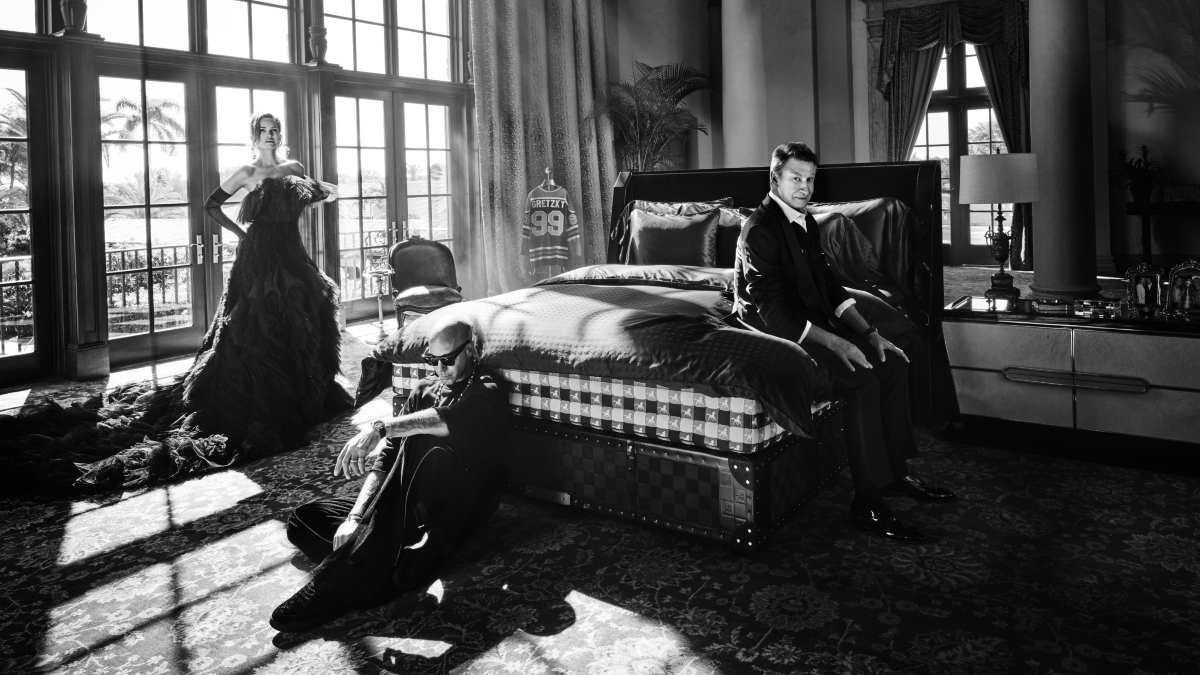
The Grand Vividus takes 600 hours to assemble and is built by just eight of Hästens' most accomplished craftspeople worldwide, a production constraint that has nothing to do with manufactured scarcity and everything to do with the limited number of people on Earth trained to the standard the bed requires. Ryde describes the secret as taking a piece of art and elevating it to something more than a piece of art. Pricing has fluctuated with materials costs and customization since launch, reported variously between $390,000 at debut and roughly $832,000 to $1,000,000 for the complete three-piece set today, with the company stating that the full Grand Vividus set, including mattress, headboard, and bed frame, is, as far as it knows, the most expensive bed set in the world. The bed launched first in Paris in the early months of the pandemic and has carried a waiting list ever since; Canadian rapper Drake was reportedly its first buyer.
The Wall of Fame
Hästens does not gift beds to celebrities, and the company maintains strict discretion about its client list, going so far as to require visitors to its Köping headquarters to sign non-disclosure agreements before touring the factory floor. Even so, the names that have surfaced publicly read like a casting call for global fame: Beyoncé, Tom Cruise, Brad Pitt, Drake, and hockey legend Wayne Gretzky, who now appears alongside his wife Janet in the company's official advertising campaign for the updated Grand Vividus. Tennis champion Maria Sharapova has said publicly that a Hästens bed was one of the first major purchases she made after she began earning prize money, and rapper Post Malone references the brand by name in his 2022 song "Wasting Angels."
The beds have also found their way into hospitality. Regent Seven Seas' ultra-premium cruise ships outfit their owner's suites with Hästens Vividus mattresses, and hotels including the Lotte New York Palace, the Peninsula Beverly Hills, and the Thompson Dallas have installed Hästens sleep systems in their top suites. The term "sleep system," which sounds at first like marketing language, is in fact a literal description: a Hästens bed is sold as a three-part stack of base, mattress, and topper engineered to work as a unit, and the company's position is that buying only the mattress forfeits much of the design's benefit.
Building a Business Beyond the Bed
Ryde reached his self-imposed sales milestone and, true to his word, spent three years writing "When Business Is Love," a memoir that walks through the company's 172-year history and Ryde's philosophy of running a manufacturing business on compassion rather than competition. The book required final sign-off from his 87-year-old aunt before publication and was released by Simon & Schuster in January 2024. In it, Ryde frames the company less as a luxury house competing with names like Hermes or Rolls-Royce and more as a wellness provider whose target customer is, in his words, anyone who prioritizes sleeping well.
That framing has become a business strategy in its own right. In 2021, Hästens opened its first hospitality venture, a fifteen-room Sleep Spa Hotel in Coimbra, Portugal, built in partnership with the Portuguese hospitality group O Valor do Tempo and designed as a tribute to the city's UNESCO-listed Joanina Library. Every room features a Hästens mattress, a pillow menu drawn from the company's range of fourteen specialty pillows, and bathroom walls lined with more than a thousand hand-carved, gold-plated marble book spines, a four-month project that took eighteen craftspeople to complete. The hotel allows only single-night stays, and a sleep specialist is on call at the front desk.
That same year, Hästens launched its first standalone digital product: the Restore app, developed in partnership with cardiologist-turned-mathematician Dr. Jussi Eerikäinen and life-potential mentor Peter von Ah. The app combines frequency tones and curated soundscapes intended to improve focus, creativity, and stress management, extending the Hästens brand from a physical object you sleep on to a service you carry on your phone. Ryde has been explicit that the app was not built to sell more beds. According to Ryde, the goal of Restore was never to sell pillows, down products, or beds, but to offer everyone a healthier and happier life.
What a Million Dollars of Horsehair Actually Buys
The skepticism is not hard to find. Independent owner-satisfaction surveys have put Hästens beds at roughly 77 percent satisfaction, only modestly ahead of the 73 percent average for all mattresses regardless of price, a gap that critics argue is awfully small for a product that can cost a hundred times more than a well-reviewed conventional mattress. Customer reviews on Trustpilot include complaints about delivery delays stretching to four and a half months, persistent body impressions after only two years of use on a model costing more than 50,000 euros, and a returns process that some customers describe as quick to blame the buyer's maintenance technique rather than the product itself.
Hästens' own defenders argue the comparison misses the point. The materials are unambiguously real: no foam, no synthetic fill, no industrial adhesives, only horsehair, wool, cotton, flax, and steel springs assembled by hand in a factory where, as one visiting journalist noted, even a fully automated assembly line would have nothing for a robot to do beyond moving fabric into position. Every Hästens bed carries a 25-year warranty, can be fully disassembled and rebuilt rather than discarded, and is designed to be returned to the factory for maintenance, a model closer to a Patek Philippe watch passed through generations than to a disposable consumer good replaced every decade. Whether that argument justifies a price difference measured in hundreds of thousands of dollars depends entirely on what kind of value a buyer is purchasing: measurable sleep quality, or a 172-year-old story stitched into every layer of horsehair.
What is harder to dispute is the trajectory. A company that posted $170,000 in annual revenue when Jan Ryde took over in 1998 has grown into an operation selling in fifty countries, supplying the Swedish monarchy for more than seventy years, and now extending its brand into hotel rooms and smartphone apps that have nothing to do with mattresses at all. The sixth generation of the family, Ryde's sons Lukas and David, has already joined the business, ensuring that the saddlery built on a king's certificate in 1852 will keep finding new rooms to occupy long after the last horse-drawn carriage has been forgotten.