The Firm That Advises Boards on Surviving Wars They Cannot Stop
How KnightsbridgeSG turned classified military wargaming into a boutique advisory practice for hedge funds, mining companies, and multinationals bracing for the next great power conflict.
By Carry and Conquer Publications
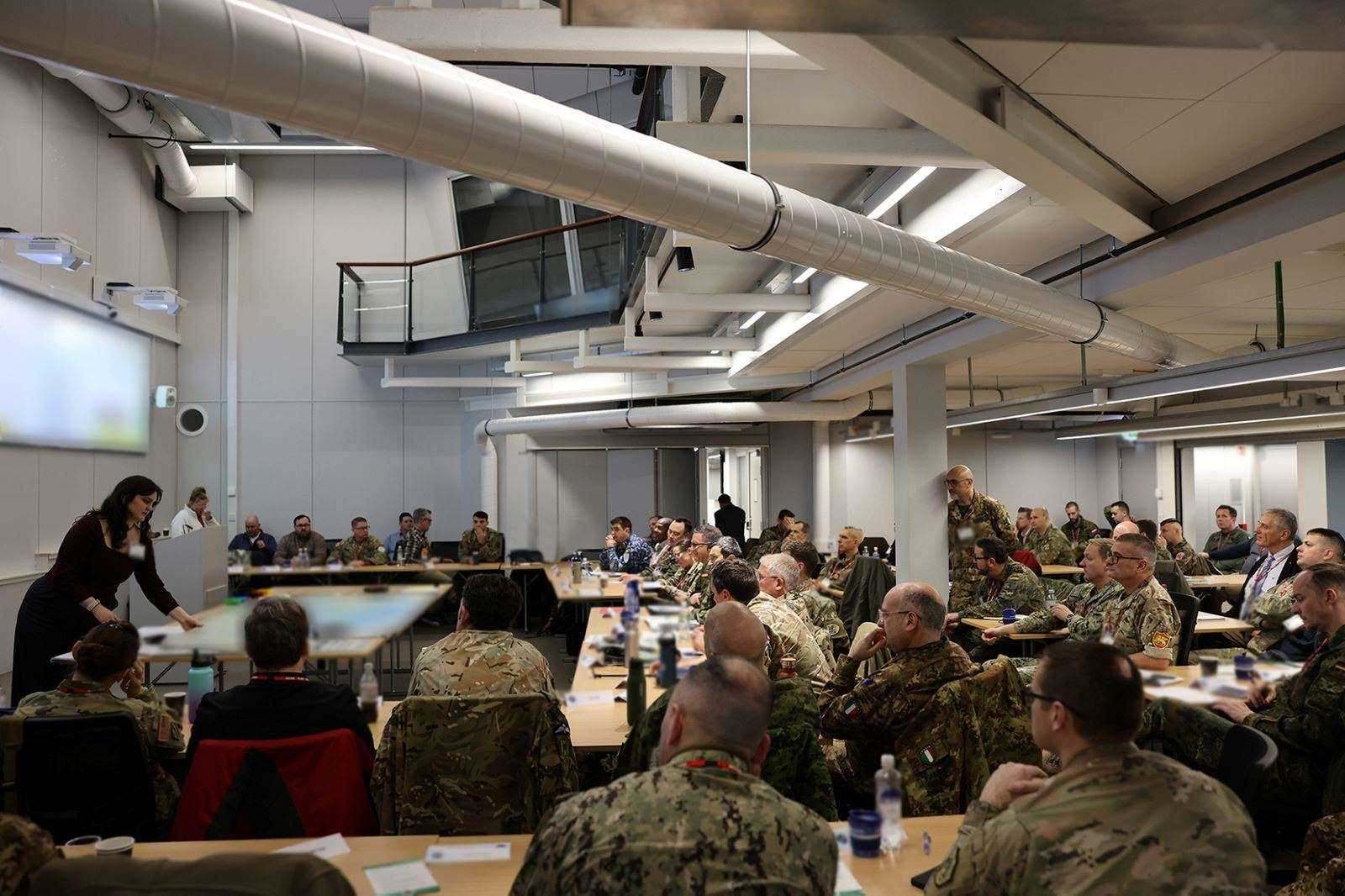
In February 2024, a group of defense and intelligence specialists gathered to run a simulation. The scenario: Donald Trump wins the presidency and begins systematically hollowing out NATO from within, never formally leaving the alliance but starving it of funding, freezing its military command, and encouraging Turkey and Hungary to drift toward Moscow. The exercise ran through multiple turns. By simulated October 2026, Ukraine had signed a treaty ceding Crimea and additional territory to Russia. The scenario was not run for a government. It was run by Knightsbridge Strategic Group, a boutique London-based advisory founded just months earlier, and the output was published online as a marketing document. Rolling Stone covered it. CBS News covered it. Business Insider covered it. In a single wargame, a firm with eleven employees had produced something that most think tanks would spend a year failing to deliver: a scenario so specific, so mechanically argued, that it became actual news.
The Methodology Behind the Curtain
Wargaming is one of the oldest tools in statecraft. The Prussian military codified it in the 19th century. RAND Corporation industrialized it during the Cold War, using it to model nuclear exchange outcomes that were too catastrophic to test in the real world. Sandia National Laboratories ran tabletop exercises for the U.S. Department of Energy that gamed out infrastructure collapse, radiological incidents, and adversarial escalation dynamics. These were not presentations. They were adversarial, multi-turn simulations where decisions in one round constrained options in the next, and where the "enemy" was played by someone whose job was to defeat you.
What Knightsbridge Strategic Group has done is extract this methodology from classified government contexts and sell it to the private sector. The firm's founder and CEO, Finley Grimble, spent eleven years in strategic advisory, policymaking, wargaming, and diplomatic roles across the UK Cabinet Office, the Ministry of Defence, the Foreign Office, and Parliament, designing wargames for the National Security Council itself: the highest decision-making body in the British national security system. His clients included the Prime Minister, the Defence Secretary, the Foreign Secretary, and the National Security Advisor. He left that world in April 2024 and immediately started building for a different kind of client.
The premise behind KSG is architecturally simple but operationally distinct from anything the consulting establishment offers. Most geopolitical risk advisory produces reports: dense documents full of scenario analysis that get filed in a folder and influence no one's actual decision-making. KSG does something else. It runs live, adversarial, multi-turn exercises where the client's own executives or strategists play competing state actors and respond dynamically to each other's moves across multiple wargame phases. The friction is the point. As Grimble has explained: "The benefit of wargaming is that it allows people to plan, consider, assess, and think many turns into the future. Whereas a simple meeting discussion might only permit exploring one turn ahead."
What the Games Actually Look Like
KSG's publicly available wargame outputs reveal the operational texture of what the firm sells. The NATO collapse simulation, run in February 2024, walked participants through the precise mechanisms by which a U.S. president could destroy an alliance without formally leaving it. The key insight: the Supreme Allied Commander Europe answers to the U.S. president. "You tell the SACEUR to stop cooperating, to stop enacting the plans, and the whole thing falls apart," Grimble told CBS News. That single structural observation, surfaced through adversarial simulation, is qualitatively different from the kind of analysis that McKinsey or EY would put in a slide deck.
The China-Taiwan hedge fund exercise, run for a London-based fund and partially published, demonstrates the commercial application in granular detail. KSG set a starting scenario: a Chinese invasion of Taiwan at 0800 local time, May 2, 2025. Precision strikes, cyber warfare, naval crossings. U.S. military intervention within ninety minutes. The hedge fund then played through its own crisis response across three turns spanning roughly one month of simulated time. Turn one: liquidate South China Sea exposure, rotate to gold, U.S. Treasuries, and South American markets. Turn two: the comprehensive Western sanctions package forces total divestment, with the fund conceding it has no prepared "off the shelf" strategic shift ready. Turn three: a global economy in early 2008-style distress, with the fund gaming out bets on alternative semiconductor manufacturers and defense equities. The wargame's most commercially valuable moment was not a strategic insight but a structural gap it forced the fund to identify: the absence of a pre-built crisis playbook. That gap is what KSG was hired to fill.
In September 2025, KSG ran what is arguably its most operationally complex published exercise: a ten-year simulation of China's dominance over rare earths and critical minerals, spanning 2026 to 2036. The participant list included representatives from hedge funds, sovereign wealth funds, mining companies, semiconductor manufacturers, European automakers, defense contractors, and government policy officials. Across five turns, KSG played China as an aggressive actor using export quotas, licensing restrictions, and eventually maritime interdiction of Western-bound mineral shipments to coerce the West. By 2030, the simulation's private sector participants had reached a verdict: "Western efforts to diversify had failed." By 2036, the U.S. had internally approved a military campaign plan named Operation Rising Eagle. This was not a government exercise. It was a commercial product.
The Architecture of Controlled Disclosure
KSG's decision to publish partial wargame outputs is itself a strategic move that deserves analysis. The firm publishes enough to demonstrate intellectual credibility and generate media coverage, but the published versions are explicitly described as condensed outputs, with full reports restricted to paying clients. This creates a closed-loop marketing mechanism borrowed directly from intelligence tradecraft: you reveal enough to establish capability, and withhold enough to make access to the full product essential. The NATO collapse simulation got Rolling Stone and CBS. The Taiwan hedge fund simulation got Business Insider. The rare earths simulation, published in 2025, produced a fifty-page exercise report that made a cogent case for why the West was structurally losing the resource competition with China. None of these reports give a client everything they need. They give the market exactly enough to want to pay for the rest.
The Strategic Intelligence Advisory Service, or SIAS, is the firm's anchor product. SIAS partners receive continuous intelligence reporting, direct analyst access, and priority access to wargaming capabilities. Crucially, the service is capped: the website lists it as available to just ten partners, a constraint that functions not primarily as a capacity limit but as a scarcity signal. Grimble personally runs SIAS, and KSG currently has him embedded directly at NATO, providing wargaming and strategy services to the alliance while simultaneously running a commercial practice serving hedge funds and extractive industry clients. The overlap is not incidental. It is the credential.
Why the Big Four Cannot Do This
The consulting establishment's answer to geopolitical risk is the geostrategic advisory practice: EY's Geostrategic Business Group, McKinsey's geopolitics team, Kroll's intelligence arm. These are large, institutional functions with deep client access and significant research budgets. What they produce, almost uniformly, is scenario planning output: structured analysis of possible futures organized into matrices, probability assessments, and strategic implications slides.
The difference is adversarial friction. Scenario planning produces a document. A wargame produces an experience. In the KSG model, the client's senior executives are not reading analysis about what happens if China invades Taiwan; they are playing through it, making real-time decisions, discovering that their crisis communications function has no defined owner, that their lawyers cannot tell them what sanctions compliance looks like inside a 24-hour window, and that their portfolio has been positioned for a world that no longer exists. The wargame does not just identify risks: it produces the institutional memory of having survived a simulated version of them.
As Grimble put it to The Diplomat in June 2025: "We do not simply read open-source information in government communications or the media but rely on building deep human networks to acquire intelligence to answer those questions that no publicly available information can truly answer." The implication is that KSG's analytical product is not a synthesis of public information, but a network-derived intelligence function that sits closer to a private intelligence service than a consulting firm.
The Client Market Taking Shape
KSG's career postings are a useful diagnostic of where demand is concentrating. In 2025, the firm was actively recruiting Geopolitical Intelligence Advisors for embedded roles in the finance sector, with requirements including "experience in strategic-level wargaming, particularly political, economic, or geopolitical scenarios" and a "strong understanding of energy markets, energy security, and global supply dynamics." The embedded model, where KSG places a specialist directly inside a client organization, is the premium tier of the product. Grimble himself has been embedded at both Google and NATO in this capacity, providing ongoing intelligence and wargaming support from inside the organization rather than as an external advisor.
The target market is legible from the exercise portfolio: hedge funds and asset managers with concentrated exposure to geopolitical flashpoints; mining and extractive companies operating in politically volatile jurisdictions; multinationals whose supply chains pass through the South China Sea, the Red Sea, or sub-Saharan African mineral corridors; and private equity firms acquiring infrastructure or industrial assets in geopolitically contested markets. These are entities that cannot afford the one-turn thinking of a board discussion when the scenario they face has fifteen cascading consequences.
The firm's team, numbering eleven by public count, includes former members of the UK and U.S. national security communities, former armed forces personnel, former diplomats, and AI and data science specialists. The advisory board carries Jeremy Bentham, who spent over forty years in the energy sector including senior positions at Shell, and who joined KSG in early 2025. KSG draws additional expertise from a network with roots in Oxford, Cambridge, Harvard, Yale, and King's College London. Grimble himself holds a master's degree in International Relations and National Security Studies from King's College London and completed his undergraduate studies while embedded in government advisory roles.
The Counterintelligence Inversion
There is a structural irony at the center of what KSG does that most coverage misses. The firm is, by design, producing outputs that look like intelligence products for audiences that traditionally do not have access to intelligence products. But those outputs also function, by design, as signals to potential clients about what the firm knows and how it thinks. Every published wargame report is simultaneously a commercial asset and a demonstration of analytical methodology. The selectivity of disclosure serves the same function as a declassified CIA assessment: it establishes credibility through apparent transparency while ensuring that everything of genuine operational value remains proprietary.
The rare earths simulation is the clearest example. The published version describes five wargame turns, outlines the positions of sixteen countries and regions, and concludes that by 2036 the United States had approved a military campaign plan against China to secure mineral access. This is a document that, in a government context, would be classified. Released publicly by a boutique advisory with eleven employees, it generated press coverage, demonstrated KSG's capacity to model decade-scale strategic dynamics, and almost certainly attracted multiple paying engagements. The clients who commissioned the full, unredacted version received something that the public version, even in its detail, cannot provide: the analytical process, the data behind the findings, and the exercise facilitation itself.
The Irreversibility of the Shift
The corporate wargaming industry is not new. Business wargaming as a distinct practice has existed since the 1990s, typically focused on competitive strategy, market entry, and product launch scenarios. What KSG represents is something different: the wholesale transfer of geopolitical military planning methodology into the corporate advisory context, executed by practitioners whose government credentials are not incidental but load-bearing.
The period from 2022 onward has made this transfer urgent. The Russian invasion of Ukraine demonstrated that geopolitical risk was not a background variable but an operational discontinuity capable of destroying supply chains, capital markets, and regulatory environments within weeks. October 7, 2023 demonstrated that even the most surveilled borders in the world could produce strategic surprises. Taiwan remains the single most consequential unresolved flashpoint in the global economy. Private equity and hedge fund capital is now deeply interwoven with geographies and industries that carry genuine conflict risk. The question is not whether corporate boards need to wargame these scenarios. The question is whether they can afford to wait for a simulation exercise to tell them what they have already lost.
KSG's answer to that question is operational: you run the exercise before the scenario, not during it. The hedge fund that played through a Taiwan invasion in 2024 left with a specific action item: build the crisis response playbook that the wargame revealed did not exist. That playbook is the product. The wargame is the method of discovering its absence. In this sense, what KSG is selling is not analysis. It is institutional preparedness manufactured under adversarial conditions, using a methodology refined in the most consequential rooms in the British national security establishment and now available, at a price, to anyone willing to sit through multiple turns of a simulated world ending.