The Farm Breeding Six Billion Cockroaches a Year for Medicine
An insect most of the world pays billions of dollars a year to kill is being raised as livestock in southwestern China and turned into medicine worth hundreds of millions of dollars annually.
By Carry and Conquer Publications
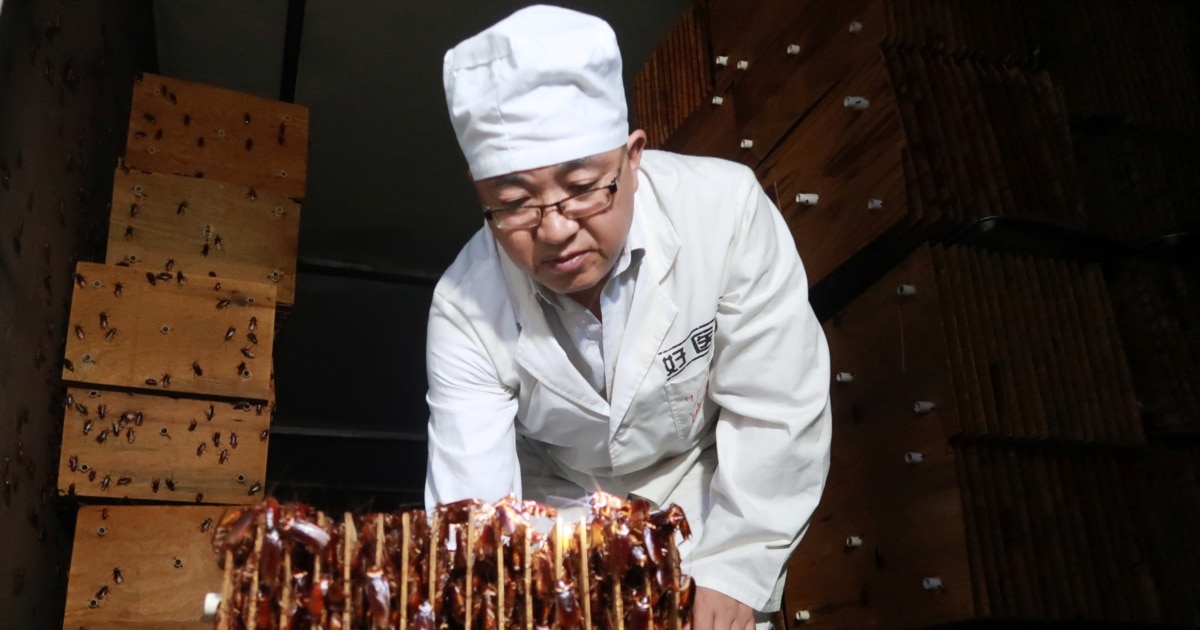
The building sits in Xichang, a city in Sichuan province, and belongs to Gooddoctor Pharmaceutical Group. It is a concrete structure the size of two sports fields, and inside, rows of narrow shelves stretch across multiple stories kept permanently dark, warm, and humid, sealed against visitors like a vault. There is no natural light and no season. An artificial intelligence system tracks temperature, humidity, feed consumption, and even genetic mutation across a population that, at full scale, numbers in the billions and outnumbers the human population of the planet several times over. This is not an infestation. It is a production line.
Six Billion a Year, No Sunlight
Gooddoctor breeds roughly six billion American cockroaches, Periplaneta americana, every year at the Xichang facility, making it the largest single cockroach breeding operation in the world. The insects live for about six months, free to roam the shelves to feed and reproduce, before their working life ends. When it does, they are killed with steam, washed, dried, and fed into a nutrient extraction tank that strips the dried bodies down to their active compounds.
Wen Jianguo, who oversees the facility, has described the security measures built around a population that size with a mix of pride and dark comedy. The building is fully sealed, and a moat filled with water and fish surrounds it. If any cockroaches ever escaped, he has said, they would fall into the moat and the fish would eat them, a defense against a disaster-movie scenario he treats as a real design constraint rather than a joke.
What comes out of the extraction tank is a light brown liquid called Kangfuxin, patented in China as a Traditional Chinese Medicine ingredient. It is prescribed for gastric ulcers, respiratory ailments, burns, pressure ulcers, and chronic wounds, sold in bottles of about 100 milliliters for roughly four dollars each. According to a government report cited by the South China Morning Post, Gooddoctor's cockroach based products generated 684 million dollars in a single year, sold through more than four thousand hospitals to what the company and local authorities describe as tens of millions of patients.
A Medicine With a Pedigree, and a Patent
Kangfuxin is not a folk remedy dressed up for a press release. Its formulation traces to work begun in 1978 by the pharmacist Li Shunan, who studied the therapeutic use of the American cockroach among the Bai people and spent decades developing an extraction process, eventually patented under the number Z51021834, that isolates the insect's active compounds. It has been approved by Chinese drug regulators and used in clinical practice for more than forty years.
It has also drawn real, published research. Peer reviewed studies in journals including Molecules, the International Wound Journal, and Advanced Science have identified specific bioactive fractions in the extract, including dihydroisocoumarin glucosides and a peptide called leucokinin VIII that appears to accelerate diabetic wound healing by activating a specific cellular signaling pathway. A meta-analysis of randomized controlled trials found the liquid measurably effective in treating pressure ulcers, and separate clinical studies have reported significantly higher healing rates for burn wounds compared with control treatments. A researcher from the Chinese Academy of Medical Sciences summed up the more cautious scientific position to the South China Morning Post: the potion is not a panacea and has no magic power against all diseases, but its effect on certain symptoms is well established and confirmed by molecular science and large scale hospital application. That is a notably more measured claim than the one printed on some promotional material, which credits the medicine with curing more than forty million people of a broad range of ailments, a figure for which there is no independent verification.
An Industry Built on an Insect Nobody Wants
Xichang is the largest node in a much bigger network. China is estimated to be home to the overwhelming majority of the world's cockroach farming capacity, with total national output estimated at somewhere between ten and fifteen billion cockroaches a year across roughly a hundred large scale operations, a count that has held steady since the industry first drew international attention in the early 2010s. Dried cockroaches have sold for as much as twenty dollars a pound, a price that has pulled in operators well outside the pharmaceutical industry.
Outside Jinan, in Shandong province, a company called Shandong Qiaobin Agricultural Technology runs a farm built around a different business model entirely: waste disposal. About a billion cockroaches there are fed roughly fifty tons of restaurant food scraps a day, delivered through pipes into individual wooden cells, consuming an amount of waste equivalent in weight to seven adult elephants. The company has framed the operation as a way to divert food waste from landfills in a rapidly urbanizing country, a case made more urgent after African swine fever outbreaks led China to ban the use of food waste as pig feed and left cities looking for another outlet. The surviving cockroach biomass, once processed, becomes protein rich feed for pigs and fish.
At the smaller end of the industry, individual farmers have carved out a living raising cockroaches by the millions rather than the billions. Li Bingcai, a former mobile phone vendor in a remote Sichuan village, has invested roughly 146,000 dollars to build a colony of 3.4 million cockroaches, which he sells to pig farms, fisheries, and pharmaceutical buyers. Every three months he harvests part of the population by boiling and dehydrating it, a batch that in one recent year sold for about 13,500 dollars a ton. He describes the animals by their Chinese nickname, Little Strong, a reference to their capacity to survive for days even after being cut in half.
The Escape That Exposed the Gap
The industry's vulnerability surfaced in 2013, when more than a million cockroaches escaped a farm in Dafeng, in the eastern province of Jiangsu, after an unknown intruder destroyed the plastic greenhouse where they were being raised. Farm owner Wang Pengsheng had invested more than sixteen thousand dollars in 102 kilograms of cockroach eggs, expecting a substantial profit margin on the harvest. Instead, more than 1.5 million insects had already hatched by the time the greenhouse was breached, and they scattered into the surrounding cornfields. Local disease control authorities dispatched a team of investigators to organize a large scale disinfection effort to contain what regional media dubbed the Great Escape.
The incident underscored how little formal regulatory oversight covers an industry that is, by most farmers' own accounts, tolerated by Chinese authorities rather than actively supervised, so long as it does not generate exactly the kind of public spectacle that unfolded in Jiangsu. Operators need a license to breed insects, but beyond that the barriers to entry are low enough that a mobile phone salesman with a spare building and a few thousand dollars can become a cockroach farmer within a matter of months.
The Inversion
Set the Xichang facility against the industry built around the opposite premise. The global market for killing cockroaches and the insects that share their ecological niche is worth billions of dollars a year and is forecast to keep growing, built on baits, sprays, and professional extermination contracts sold to homeowners, hospitals, and restaurants trying to keep the same species out of their buildings. In China, an AI-managed facility the size of two sports fields is breeding that species on purpose, at a scale that dwarfs any home infestation by orders of magnitude, and selling the result back into hospitals as medicine.
Nothing about Kangfuxin's revenue or its patent number makes cockroaches any less repellent to the people spending those billions on extermination elsewhere. That is precisely what makes the economics interesting: the same organism, priced as vermin in one market and as a regulated pharmaceutical ingredient in another, with the difference resting entirely on what happens to it after it is harvested and how thoroughly a company has been willing to industrialize an insect that most of its potential customers would rather never see again.