The Edge-AI Breakthrough: SiMa.ai and Cerence Debut the First Small Language Model (CaLLM) Running Locally Inside a Vehicle Dashboard
SiMa.ai and Cerence AI demonstrated CaLLM Edge - an automotive small language model running entirely on-chip inside a vehicle dashboard at under 10 watts, without any cloud connection - at CES 2026 on January 6, 2026.
By Carry and Conquer Publications
The car dashboard has long been the battleground where automakers and tech giants fight for the driver's attention. But for years, the most sophisticated AI in that space required one thing the road cannot always guarantee: a cloud connection.
When the Cloud Goes Dark
Every driver knows the feeling. A tunnel swallows the signal. A mountain pass drops the bars. A rural stretch of highway renders the voice assistant mute or sluggish. Cloud-dependent AI in vehicles is not a minor inconvenience - it is a structural flaw in how intelligence has been delivered inside cars for the better part of a decade. The processing happens far away, the latency compounds, and the data flows outward before a single syllable comes back. For automakers building the next generation of "intelligent cockpit" experiences, this is the problem that has resisted a clean solution.
Until now.
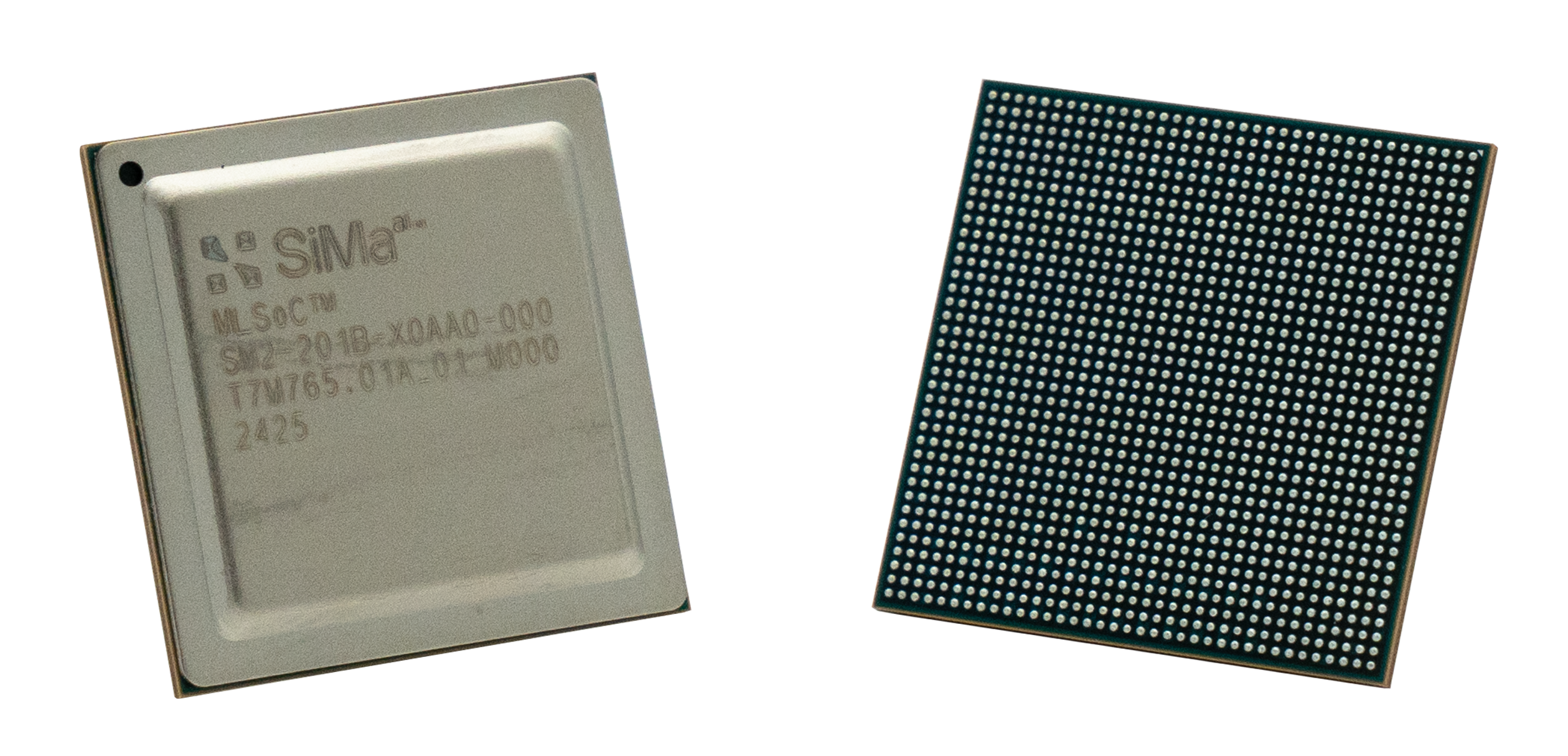
On January 6, 2026, the opening day of CES 2026 in Las Vegas, SiMa.ai and Cerence AI jointly demonstrated what they are calling the next evolution in automotive AI: CaLLM Edge, Cerence's small language model (SLM), running entirely on SiMa.ai's Modalix machine learning system-on-chip (MLSoC) - directly inside the vehicle dashboard, with no cloud connection required, drawing less than 10 watts of power. The demo, staged at Cerence's Booth 6826 in the West Hall of the Las Vegas Convention Center, marks the most significant step yet toward conversational AI that is genuinely embedded in the car itself.
Two Companies, One Platform
SiMa.ai, the San Jose-based edge AI semiconductor company founded in 2018 by Krishna Rangasayee, is not a household name outside of hardware circles. But within the embedded edge AI market, the company has built a quietly formidable position. Having raised $355 million in total funding - including an $85 million oversubscribed round closed in August 2025 - SiMa.ai has spent seven years developing a silicon architecture specifically designed for the demanding constraints of embedded AI: extreme power efficiency, multimodal inputs, and the ability to run large models without thermal throttling.
The Modalix MLSoC, SiMa.ai's second-generation chip, is the hardware at the center of this automotive breakthrough. Built on TSMC's N6 process, it scales from 25 to 200 tera operations per second (TOPS) in multiple configurations and is engineered to run LLMs, transformers, and generative AI models at the embedded edge. The chip's patented static scheduling architecture - in which every operation is pre-planned at compile time rather than dispatched dynamically - delivers deterministic, predictable inference timing. That matters enormously in a car, where response latency and reliability are not engineering preferences but safety requirements. SiMa.ai has reported that the Modalix can run Cerence's CaLLM Edge at under 10 watts, with passive cooling - meaning no fan required.
Cerence AI (NASDAQ: CRNC), the Burlington, Massachusetts-based automotive AI company, brings the other half of the equation. Spun off from Nuance Communications in October 2019, Cerence inherited twenty years of voice recognition expertise built into the automotive industry. Today, Cerence technology has shipped in more than 525 million vehicles worldwide - roughly one in every two cars on the road globally. The company's CaLLM family of language models - designed specifically for automotive use cases, not repurposed from general consumer applications - is what powers the new in-vehicle AI experience.
The two companies first demonstrated the CaLLM Edge and Modalix pairing at IAA Mobility 2025 in Munich in September 2025. CES 2026 represented the second, more advanced chapter: CaLLM Edge now powering the full Cerence xUI platform with enhanced multimodal capabilities, including the ability to process voice, touch, and visual inputs simultaneously. Harald Kroger, president of automotive at SiMa.ai, has noted that porting Cerence's SLM to the Modalix chip took SiMa.ai's team just a few days - a sign of the platform's flexibility and of how deliberately Modalix was designed to support rapid model integration.
What Changes for the Driver
The practical implications of this shift are more significant than a press release can capture. Today's cloud-based voice assistants in vehicles suffer from a predictable set of failure modes: latency that breaks the natural rhythm of conversation, dropped responses in low-connectivity environments, and the privacy exposure that comes with routing every spoken word through a remote server. A small language model running locally on the dashboard eliminates all three.
Kroger has described the vision in concrete terms: a driver says "park me at the charging station" - and the car's onboard AI identifies a charging station in the camera feed, plans the maneuver, and executes it, without waiting for a round-trip to a cloud server. This kind of multimodal, context-aware interaction - processing language, vision, and vehicle state simultaneously - has been the stated destination of automotive AI for years. The Cerence-SiMa.ai collaboration is the first time that capability has run at low power, inside production-grade automotive hardware, without a network connection.
The Cerence xUI platform that CaLLM Edge now powers extends the AI experience across the full vehicle ecosystem. At CES 2026, Cerence also introduced two new domain-specific agents - an ownership companion for vehicle health and maintenance queries, and a dealer assist agent for sales and service automation. The mobile work agent, developed in collaboration with Microsoft and debuting its first in-car demonstration at CES, gives drivers voice-first access to Microsoft 365 Copilot including Teams, Outlook, and OneNote, with proactive navigation suggestions tied to calendar events.
The Semiconductor Angle
For investors tracking the automotive semiconductor space, the SiMa.ai-Cerence partnership is a case study in where the edge AI value chain is consolidating. The race to build AI into vehicles is no longer primarily a software competition - it is fundamentally a hardware efficiency problem. Cloud compute is unlimited but expensive and latency-prone. Traditional automotive processors are reliable but not designed for generative AI workloads. Purpose-built edge AI chips like Modalix occupy a narrow but increasingly valuable position between those two extremes.
SiMa.ai has positioned Modalix as hardware-agnostic at the software layer, meaning automakers and Tier 1 suppliers can switch underlying AI models as the field evolves without re-engineering the silicon. Kroger has made this point explicitly: in a world where new large language models emerge every two months, the automotive supply chain cannot afford to be locked to a single hand-tuned model. The Modalix architecture is designed to run almost any LLM that fits within its memory and power envelope - a deliberate hedge against the pace of AI development.
Cerence, for its part, has moved aggressively to run CaLLM Edge across multiple chipset partners simultaneously. At CES 2026, the company demonstrated the model running on several different hardware platforms, not just Modalix - a sign that CaLLM Edge is designed as a portable automotive AI standard, not a proprietary lock-in. The company has FY2026 revenue guidance of $300 million to $320 million, with five active xUI customer programs and first xUI-powered vehicles expected on roads in 2026.
A Market at the Inflection Point
The automotive AI cockpit is becoming a genuine investment thesis. Global demand for in-vehicle AI is accelerating as software-defined vehicles become the norm and OEMs compete on the intelligence of the cabin experience. Cerence's partnership web - which now spans NVIDIA, Microsoft, MediaTek, SiMa.ai, TCL, and most recently Neusoft in a January 22, 2026 MOU for LLM-based voice AI - reflects how rapidly the ecosystem is assembling around whoever can deliver reliable, scalable, in-car AI.
SiMa.ai's trajectory tells a similar story. Named to Fast Company's Most Innovative Companies list for 2025 at number six in the computing category, the company has moved from computer vision on industrial cameras to running language models in the cockpits of production vehicles in under seven years. With $355 million raised and a chip architecture that delivers more than 10 times the performance per watt of stated alternatives, SiMa.ai is competing directly with Nvidia, Qualcomm, and MediaTek for the embedded edge automotive slot - and the Cerence partnership is its clearest automotive proof point to date.
The CES 2026 demonstration did not announce a production vehicle or a named OEM launch date. But it established something perhaps more important: that the technical barrier to cloud-free conversational AI in the car has been cleared. What follows is the commercialization race - and the companies holding the silicon and the software to make it work at under 10 watts are now in front.