The Drone Light Show Is a Trojan Horse for Air Taxi Certification
EHang stages New Year's spectacles over the one park in China where its autonomous air taxi is also flying paying passengers, and the overlap is not a coincidence.
By Carry and Conquer Publications
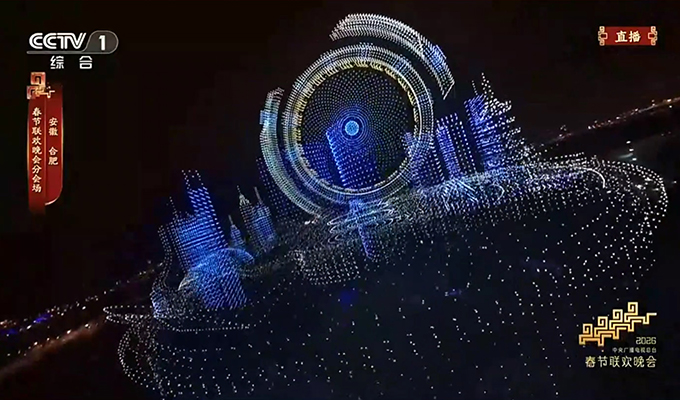
On the night of February 3, 2026, 22,580 drones rose into the sky above Luogang Park in Hefei, China, and held position there under the command of a single computer. Twenty of the 22,600 drones loaded for the attempt failed to launch. The rest performed a sequence of three-dimensional animations: a sky city, a time tunnel, the horse-head walls of Hui-style architecture, all timed to the broadcast of the China Media Group Spring Festival Gala reaching roughly a billion television sets across the country. Guinness World Records certified it as the most multirotor aircraft ever airborne simultaneously from a single computer. Thirteen days earlier, in the same park, EHang Holdings Limited had quietly closed the loop on a different kind of milestone: the EH216-S, its pilotless, two-seat, human-carrying eVTOL, had been flying paying passengers under one of China's first Air Operator Certificates for autonomous aircraft, granted to its joint-venture operator at that exact site. The festival did not happen near the air taxi program. It happened on top of it.
One Park, Two Products, One Regulator
Luogang Park is not a generic civic green space that happened to host a drone show. EHang's own corporate materials list it as a designated "Hub-style Dual-Pad Operating Site" for the EH216-S, one of a handful of locations nationwide where the aircraft conducts revenue or trial passenger flights. On the same night as the Guinness-certified light show, EHang staged a second, smaller performance directly above the gala's main stage: 16 EH216-S aircraft, the actual human-carrying model, took off together and formed a circle above a structure EHang branded the "Eye of Anhui," equipped with stage lighting and flown in full view of the broadcast audience. EHang's own announcement called it the largest simultaneous public flight of pilotless human-carrying eVTOL aircraft ever conducted. The drone swarm built the spectacle; the air taxi closed it. Both shows ran through the same command-and-control infrastructure, in the same airspace, cleared by the same regulator, the Civil Aviation Administration of China.
The CAAC's interest in Luogang Park predates the festival by years. In March 2025, the CAAC issued the first batch of Air Operator Certificates for civil human-carrying pilotless aerial vehicles in China to two entities: Guangdong EHang General Aviation, EHang's wholly owned subsidiary, and Hefei HeYi Aviation, EHang's joint venture in the city. That certificate was the fourth and final piece of a regulatory set EHang had been assembling since October 2023, when the EH216-S received the world's first Type Certificate for a passenger-carrying eVTOL, followed by a Standard Airworthiness Certificate and a Production Certificate. With the Air Operator Certificate in hand, EHang became, by its own description, the first eVTOL company anywhere to hold the complete suite: type, production, airworthiness, and operator. One aviation analyst tracking the announcement at the time noted that the certificate as written restricted Hefei HeYi Aviation to low-altitude sightseeing flights confined to Luogang Park itself, not the kind of point-to-point urban air mobility EHang's marketing implies.
A Decade of Selling the Sky Before It Was Cleared to Fly
The trajectory makes more sense once you account for where EHang has been. The company went public on Nasdaq in December 2019 after years of staging passenger-grade demonstration flights, including a 2018 crewed test at Amsterdam's Arena with Dutch prince Pieter Christiaan aboard, long before any regulator had cleared the aircraft to carry a paying customer. Founder and CEO Huazhi Hu has acknowledged the company had "some vehicle incidents" during its early autonomous flight testing that began in 2017, though he maintains there have been no major accidents in the roughly 90,000 flights completed since, including overseas demonstrations in Japan, the UAE, and Southeast Asia.
In February 2021, short seller Wolfpack Research published a 33-page report describing EHang as "an elaborate stock promotion, built on largely fabricated revenues based on sham sales contracts," alleging that its primary customer at the time, Shanghai Kunxiang Intelligent Technology, had signed contracts designed to inflate EHang's reported sales rather than reflect genuine demand. The report also accused EHang of overstating the significance of European and North American test permits in its English-language press releases, which it claimed implied commercial regulatory approval the company did not actually hold. The stock fell 63 percent in a single trading session, from an all-time high near $130 to roughly $46. EHang called the report "deceptive" and threatened legal action; a shareholder lawsuit followed within days. The company never lost its Nasdaq listing, and the CAAC certification track it had been building since continued uninterrupted through the controversy, the pandemic, and years of unprofitable operations.
That history matters for reading the current festival strategy correctly. A company that spent its first decade being accused of substituting spectacle for substance has now built spectacle into the literal architecture of how it earns public and regulatory trust for its next product. The 2026 Spring Festival Gala did not happen despite EHang's credibility problem; it happened as the solution to it; a few hundred million live viewers watching 22,580 drones perform flawlessly is a more persuasive trust signal than any prospectus.
What "Culture" Is Doing in the Press Release
EHang's official framing of the Hefei program describes the goal as building, in the company's words, a citywide ecosystem integrating low-altitude technology and culture. That phrase is doing real work. Culture is the load-bearing justification for why a Nasdaq-listed aerospace manufacturer is permitted to fly tens of thousands of aircraft, including human-carrying ones, low over a crowded public park on the country's most watched night of television. Strip the cultural framing away and what remains is closer to a live, full-scale systems test: command-and-control software handling 22,580 simultaneous flight paths, contingency protocols for 20 to 25 failed launches out of an enormous batch, synchronized descent of the entire fleet, and a human-carrying aircraft flown in formation in front of cameras, all conducted in the identical airspace where the same operator's air taxi license is being exercised commercially. Regulators get a stress test disguised as a holiday broadcast. The public gets desensitized to autonomous aircraft swarming overhead before being asked to buy a ticket to ride in one.
This is consistent with China's broader sequencing strategy for the low-altitude economy, a sector the country's National Development and Reform Commission has organized around a "three firsts, three laters" principle: cargo flights before passenger flights, segregated airspace before integrated airspace, and suburban operations before urban ones. Hefei functions as a controlled environment where all three boundaries can be tested simultaneously under cover of festival programming, with EHang absorbing the reputational risk of any malfunction in exchange for owning the first-mover relationship with CAAC reviewers as rules get written in real time. China's low-altitude economy was elevated to a national strategic emerging industry at the 2023 Central Economic Work Conference and folded into the 2026 to 2030 Five-Year Plan as a priority cluster alongside quantum computing and artificial intelligence, a designation that converts what would otherwise be aspirational provincial press releases into funded mandates with land grants, airspace allocations, and subsidy schedules attached.
The Numbers Behind the Spectacle Tell a Rougher Story
EHang's financials complicate the triumphant version of this narrative. The company posted its first GAAP-profitable quarter in the fourth quarter of 2025, with net income of RMB10.5 million on quarterly revenue of RMB243.8 million, up 48.4 percent year over year, and full-year 2025 revenue of RMB509.5 million. That momentum did not carry into 2026: first-quarter results showed revenue of roughly $25.7 million against analyst expectations near $54 million, a 58 percent year-over-year sales decline and an 84 percent sequential drop, with only four EH216-series units delivered against a Bank of America estimate of fourteen. By May 2026 the stock traded near $9.44 a share, down from a 2021 peak above $129, with a market capitalization that had fallen to roughly $519 million, close to a 52-week low. Bank of America cut its price target on the stock to $13 while maintaining a Buy rating, betting on the certification moat rather than current unit economics.
That gap between regulatory achievement and commercial traction is the real argument for why the festival strategy exists. EHang cannot yet sell enough EH216-S units or fly enough revenue passengers to justify its valuation on operating numbers alone. What it can do is convert a Guinness World Record and a billion-viewer broadcast slot into the appearance of inevitability, both for retail investors parsing press releases and for the CAAC officials deciding how fast to expand the air taxi's operational envelope beyond Luogang Park's currently restricted, sightseeing-only certificate. Commercial EH216-S passenger operations in China were slated to begin in earnest in March 2026, almost exactly one month after the Spring Festival Gala aired the aircraft's most-watched performance to date.
The Sandbox Is the Strategy
What makes Hefei distinctive is not that EHang is testing technology in public, which every aerospace company eventually has to do, but that it has fused the testing and the marketing into a single recurring annual event scheduled to coincide with the most-watched broadcast night in the country. Every other eVTOL manufacturer racing toward certification, in the United States, Europe, or elsewhere in China, has to build public trust and regulatory trust through separate channels, on separate timelines, with separate audiences. EHang has collapsed them into one park, one regulator, and one night of programming that Chinese state television beams into homes by the hundreds of millions. The festival is not a marketing event that happens to occur near a regulatory milestone. It is the mechanism by which the regulatory milestone gets made to feel ordinary, well before the underlying business case for the air taxi itself has been proven at any commercial scale.