The Compounding Machine
How five engineers in Milan turned a $40,000 failure into one of tech's most ruthless and remarkable companies.
By Carry and Conquer Publications
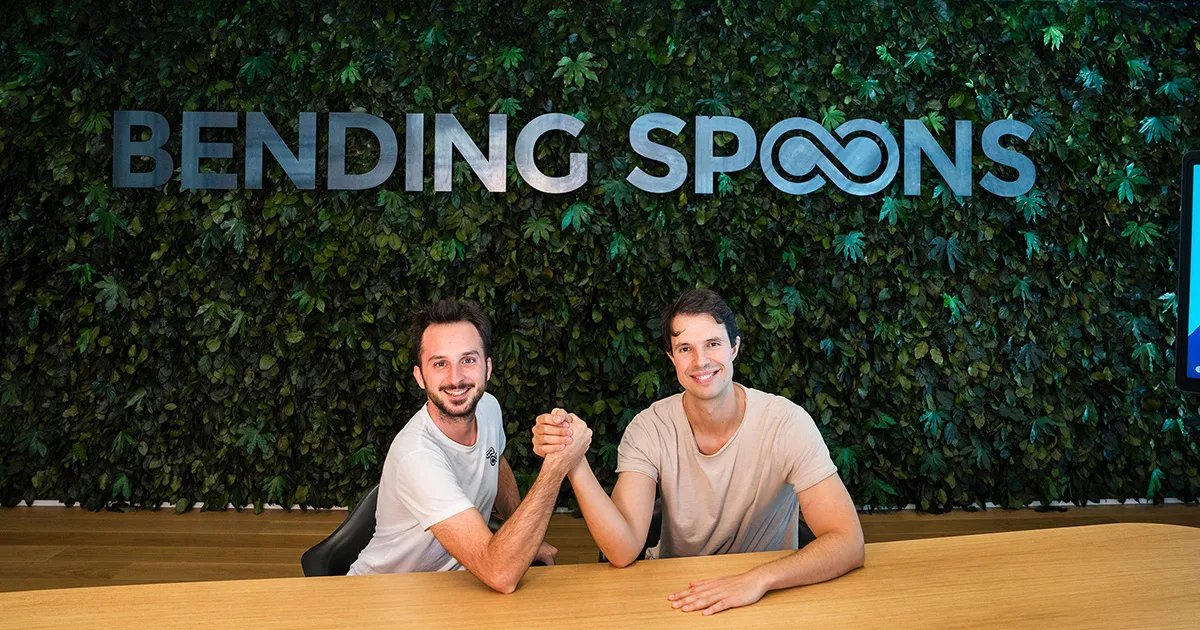
In the summer of 2013, Luca Ferrari and four colleagues sat in a Copenhagen office with exactly $40,000 in their bank account and one failed startup behind them. Evertale, the AI-powered digital diary they had spent three years building, was dead. Rather than grieve, Ferrari felt something closer to relief. They had made every possible mistake. Now they could try again, and this time they would never have to find product-market fit again. What emerged from that decision is Bending Spoons, a Milan-based company that has quietly assembled one of the most extraordinary compounding machines in technology: a firm that buys the internet's most beloved but broken institutions, tears them down to studs, and rebuilds them into profit engines without writing a single line of original product vision.
The Lesson That Changed Everything
Ferrari's insight from the Evertale failure was surgical. He identified two separate problems in building a technology company and concluded that luck governs one of them completely. Finding product-market fit is largely a matter of chance. Even brilliant founders fail at this step constantly. But operating a digital business once it has found its audience? That is purely a matter of skill. After three years grinding through Evertale, Ferrari's team had developed real skill at operations. The problem was they had spent it on a product nobody wanted.
The solution was simple in theory and radical in practice: stop competing in the lottery. Buy businesses that have already won it.
The first acquisition cost ten thousand euros. It was a keyboard personalization app for iOS, unremarkable in every way except that it had users and the founders had not properly monetized them. Bending Spoons improved the app, introduced subscription pricing, doubled their investment, and bought another one. Then another. For five years, no one outside a small circle of Italian tech observers knew the company existed. They acquired fitness apps, lifestyle utilities, anything with a loyal user base and a founder who had run out of ambition or runway. Total M&A spend in 2018 was 8.7 million euros for six companies combined.
That year also contained what Ferrari would later call their first watershed acquisition: Splice.
The Orphan Asset Thesis
GoPro in 2018 was a company in distress. The action camera pioneer had just killed its drone program, was burning cash, and had hired JPMorgan to explore a possible sale of the entire company. Inside that chaos sat Splice, a mobile video editing app that GoPro had acquired and then essentially forgotten. It was not monetized at all. It was not strategically important. It was an orphan: a well-made product with a real user base that simply did not fit anywhere inside a struggling hardware business.
Bending Spoons paid what amounted to a rounding error for it. Today, Splice alone generates nearly 80 million euros in annual revenue.
The Splice deal crystallized what would become Bending Spoons' core sourcing thesis: the best acquisition targets are not failing products, they are orphaned ones. Products owned by companies whose attention is elsewhere, whose strategic priorities have shifted, whose investors want liquidity, whose founders have stopped caring. The product itself may be genuinely good. The neglect is purely circumstantial. When that is the case, the gap between what the asset is earning and what it could earn under focused operation is enormous.
This thesis required a very specific kind of buyer: one with no ego about what it was building, genuine indifference to brand identity, and an obsessive focus on the operational mechanics of digital subscription businesses. Ferrari's team was all three.
The Machine That Eats Companies
Behind every Bending Spoons acquisition is a proprietary infrastructure the company calls the Spoon Engine. It is a universal operating system for digital subscription products: over 50 shared services covering authentication, billing, A/B testing, analytics, AI inference, marketing optimization, and customer support automation. When Bending Spoons acquires a company, the first act is migration onto this platform. The second act is usually mass redundancy, because once the product is running on the Spoon Engine, most of the original headcount is simply no longer necessary.
This is not cruelty for its own sake, though it has been received as such. It is the logical consequence of having built centralized infrastructure good enough to make distributed teams redundant. When Bending Spoons acquired WeTransfer in July 2024, it laid off 75% of the workforce within two months. When it acquired Vimeo for $1.38 billion and closed the deal in late 2025, former employees described the subsequent layoffs as cutting almost everyone, including the entire video engineering team. The pattern is identical every time because the logic is identical every time: the Spoon Engine already does what those people were doing.
The company also runs a proprietary data lake called Pico that processes billions of events daily, enabling product teams to execute pricing experiments within minutes. A/B testing is run against every variable, with tests often revealing that users will tolerate subscription price increases exceeding 80% before meaningful churn occurs. That number is not a hypothetical. It is empirical data extracted from a portfolio of hundreds of millions of users.
The AI layer on top of this infrastructure has accelerated dramatically. By the end of Q1 2026, more than 90% of pull requests at Bending Spoons were authored or co-authored by AI, with roughly 70% written by AI alone. Revenue per full-time equivalent employee climbed from $1.12 million in 2023 to $2.57 million in 2025. The direction of travel is unmistakable: a smaller number of extremely high-performing people, backed by an AI platform that handles an ever-growing share of the work, operating an ever-larger portfolio of legacy digital assets.
Buying the Wreckage of the ZIRP Era
The 2021 tech bubble created the conditions for Bending Spoons' most ambitious phase. When interest rates were near zero and venture capital was functionally free, companies raised at absurd valuations, acquihired at absurd premiums, and went public at prices that had no relationship to underlying cash flows. Hopin paid $250 million for StreamYard at peak euphoria. Vimeo went public in 2021 at $52.08 per share. Eventbrite had been valued at $1.76 billion at its 2018 IPO. When rates rose and sentiment shifted, these companies faced a reckoning that their user bases did not share.
Bending Spoons was the prepared buyer. StreamYard came via Hopin at a fraction of its peak price, because Hopin had burned through cash and needed to sell its assets to survive. Vimeo, trading between $3 and $5 per share in the months before the deal, was acquired for $1.38 billion: a 90% decline from its IPO price on a business whose subscribers had never stopped paying. Eventbrite was taken private for roughly $500 million, less than a third of its 2018 IPO valuation, despite still running the largest independent event ticketing network in the world.
Ferrari has been explicit that Bending Spoons avoids auctions and seeks bilateral deals, specifically targeting public companies at distressed multiples because SEC filing history provides years of audited financials that make underwriting fast and accurate. A public company's investor day presentations and 10-K filings are, in effect, a free due diligence package. Bending Spoons uses them the same way a private equity buyer uses a data room, except the information is freely available to anyone willing to read it carefully.
The Controversial Principles
None of this would work without a very specific kind of internal culture, and Bending Spoons is unusually transparent about what that culture demands. The company publishes a document titled "Controversial Principles" that it shares with all job candidates before they join. It is worth reading, because it is remarkably honest about what is being asked.
The principles include "uncompromising excellence," meaning that Spooners who consistently fall short of expectations are let go, with no softening of that language. They include "radical candor," meaning Spooners are expected to say exactly what they think without diplomatic filtering. They include "hard work," with an explicit acknowledgment that "challenges, workloads, and expectations are considerable, which we recognize isn't for everybody." They include "individual responsibility for personal growth and well-being," which means the company will not introduce policies to manage stress; the Spooner is expected to manage it themselves.
The document concludes with a choice framed with genuine directness: if a Spooner cannot fully commit to these principles after honest reflection, "parting ways is best for all involved." There is no culture deck rhetoric about psychological safety or work-life integration. The company is saying, plainly, that it runs at a level of intensity that not everyone can sustain, that it will not pretend otherwise, and that the people who thrive there do so precisely because the environment is demanding.
This culture explains things that look paradoxical from the outside. The company has no career ladders: everyone is simply "Software Engineer" or "Lead," regardless of seniority. There are no performance bonuses. Compensation is entirely flat and fixed. The hiring bar is among the strictest in the industry; in 2025, 800,000 people applied and 286 were hired. But among those who get in, annual unwanted turnover is approximately 1%, a figure that would be remarkable at any company and is almost unbelievable for one operating at this intensity.
Ferrari describes the philosophy as "radical simplicity" applied to organizational design as much as to engineering. Every layer of complexity, whether career bands, bonus structures, titles, or policies, is a form of overhead that consumes attention and generates politics. Strip it out. Keep what produces output. This is the same logic he applies to acquired products: eliminate everything that is not directly generating value, because everything else is drag.
The Compounding Scorecard
The results of executing this philosophy across thirteen years are documented in the F-1 Bending Spoons filed with the SEC on June 8, 2026. Revenue grew from $387 million in 2023 to $671 million in 2024 to $1.31 billion in 2025, a compound annual growth rate of 84%. Operating profit more than doubled to $278 million in 2025. In Q1 2026, revenue hit $601 million, 132% higher than the prior year period, and the company swung to a $27.5 million net profit after posting a $112 million net loss in the same quarter of 2025. Monthly active users reached 500 million in March 2026, up from 111 million in December 2023. The company has identified more than 1,000 further acquisition targets representing nearly $400 billion in aggregate annual revenue.
The IPO targets a valuation of roughly $20 billion, nearly double the $11.7 billion at which Bending Spoons raised its last private round just eight months earlier. Goldman Sachs, J.P. Morgan, and Allen & Company are leading the offering. A dual-class share structure ensures the four co-founders retain voting control regardless of how much equity they sell. Ferrari has framed the ambition with characteristic bluntness: the goal is to build one of the greatest companies of all time. He cites Henry Singleton at Teledyne and Tom Murphy at Capital Cities as his operational models, capital allocators who compounded for decades by maintaining iron discipline on returns, reinvesting aggressively, and eventually buying back their own shares when external opportunities dried up.
What Gets Lost
The case against Bending Spoons is not that the model does not work. The financials confirm that it does. The case is about what the model costs, measured in things that do not appear on income statements.
WeTransfer's co-founder publicly criticized the company's direction in December 2025 and announced he was building a replacement service. Filmic Pro, once the mobile filmmaking tool of choice for independent directors worldwide and a regular feature of Apple keynotes, has received minimal updates since its original 22-person team was let go in 2023. Meetup users wrote that they were watching "the beginning of sunset for this great product" as Bending Spoons restructured the platform that had organized millions of in-person communities across every city on earth. When WeTransfer briefly attempted to use uploaded files to train AI models before reversing course under backlash, it was a vivid illustration of what happens when a platform built on user trust is operated purely as an asset extraction vehicle.
These are not abstract concerns. Bending Spoons acquires products whose value was co-created with their communities: the Meetup groups that have met weekly for a decade, the Komoot trails that hikers mapped themselves, the Evernote notebooks that knowledge workers have been adding to for fifteen years. The subscription revenue those communities generate is real. So is the relationship of trust that generated it, and that trust does not appear anywhere on the balance sheet Bending Spoons files with the SEC.
Ferrari and his co-founders probably accept this trade-off consciously. The Controversial Principles document is not only a hiring filter; it is a worldview. Pragmatism is listed as a core value. Speed is the tiebreaker "in uncertain cases." Applied to product strategy, this philosophy produces exactly the outcomes critics describe: fast monetization, restricted free tiers, community features deprioritized in favor of conversion funnels. For the nine million people who were already paying customers as of March 2026, Bending Spoons is restoring functionality to products their previous owners had let decay. For the hundreds of millions who were using those products for free, the company is a landlord who bought the building and is now charging rent.
The IPO will not resolve this tension. It will move it onto a public market, where quarterly earnings calls create pressure to accelerate the exact dynamics that critics object to. The compounding machine Ferrari built in Copenhagen with $40,000 and a lesson about luck is about to discover what happens when the cycle speed is set by Wall Street rather than by the four engineers who wrote the original code.