The Company Trying to Make the 200-Year-Old Sewing Machine Extinct, With Glue
CreateMe Technologies has built a commercial factory line that replaces the needle with a microadhesive called Pixel, betting the current tariff climate finally makes bonded, thread-free manufacturing beat sewing on cost.
By Carry and Conquer Publications
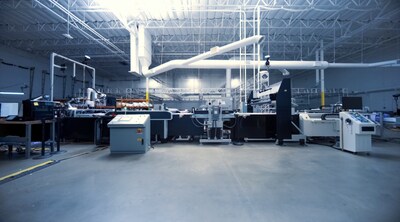
CreateMe Technologies has built a factory with a million T-shirts of annual capacity per machine and not one needle inside it.
In a 35,000-square-foot building in Newark, California, Cam Myers runs a company with a genuinely strange premise: that the single most durable tool in industrial history, the sewing machine, is finished. Elias Howe patented the lockstitch machine in 1846, and in the nearly two centuries since, the device has been refined, motorized, computerized, and miniaturized, but never replaced. It still does what it always did: drive a threaded needle through fabric, over and over, to hold two pieces together. CreateMe's answer is to skip the needle entirely. Its platform, MeRA, takes flat fabric in one end and returns finished garments out the other, bonded instead of stitched, using a proprietary microadhesive called Pixel. "We are the no-thread company," Myers says. "We think the world of the sewing machine is going to go away."
A Bet Built on a Century of Failure
Myers is not the first person to try this. Apparel is, by wide agreement among manufacturing engineers, one of the least automated major industries on earth, precisely because fabric refuses to behave like the rigid materials robots are good at handling. It stretches, bunches, drapes, and shifts unpredictably under a robotic gripper in ways that steel, glass, and silicon do not. In 2016, a Seattle startup called Sewbo claimed the first robotically sewn garment, a T-shirt, by stiffening the fabric with a temporary thermoplastic coating before feeding it through a conventional sewing machine. A year later, SoftWear Automation partnered with Chinese manufacturer Tianyuan Garments to build an automated T-shirt line in Arkansas, backed by supply-chain giant Li & Fung, aiming for a 2018 opening and eventually a billion T-shirts a year made on demand in the United States. That factory still is not running. SoftWear's partnership with Li & Fung has ended, and the company has shifted its ambitions down to small-batch runs for independent brands.
The common failure point across a decade of well-funded attempts was always the needle. Sewing demands two-sided access to the fabric, continuous feeding, and dynamic thread tension, a set of mechanical requirements that turns every stitch into an unstable control problem for a robot. Myers's team, which includes co-founders Ben Waller, Jason Bennett, Joy Wheeler, and Vibhav Prasad, concluded the industry had spent thirty years trying to teach robots to imitate a human hand at a task human hands are uniquely suited for, and that the fix was not a smarter needle. It was removing the needle. "By reframing garments as 2D and 3D forms to be shaped and bonded, not pierced and stitched, we created a solvable substrate for automation," the company argues. Bonding allows single-sided access and static fabric placement, which converts an unstable manipulation problem into one a vision-guided robot can actually solve.
The Glue Doing the Work
The mechanism at the center of MeRA is Pixel, a digital microadhesive applied in seams under a millimeter wide. Rather than a bead of glue laid down and pressed, Pixel is deposited in engineered micro-patterns that are activated and cured with heat, giving CreateMe control over the strength, stretch, and drape of each individual join. The company says the resulting seam is lighter, more uniform, and mechanically comparable to or stronger than a stitched seam, while eliminating the needle punctures, thread bulk, and seam-tape stiffness that stitching introduces. A companion formulation, Thermo(re)set, is thermoreversible: garments can be reheated to separate trims, zippers, and fabric layers for recycling, something conventional stitching, which typically requires manual de-stitching or relies on permanent bonding tape, does not allow. CreateMe developed the adhesive science in part through a partnership with the University of Warwick, and has tested it across roughly 100 different fabrics. The portfolio behind all of it runs to more than 95 patents, which CreateMe and outside coverage both describe as the largest apparel automation IP position in the industry.
Physically, the MeRA line resembles a newspaper press more than a garment factory. Fabric stays flat and two-dimensional for as long as possible, tracked and aligned by vacuum fixtures and machine vision across more than 57 axes of coordinated robotic motion, before the system transitions to controlled three-dimensional operations near the end of the line for the parts of a garment, a collar, a shoulder seam, a waistband, that cannot stay flat. The system already runs commercially. CreateMe's first product line, women's intimates, was a deliberate choice: bonded seams were already normalized in that category before CreateMe arrived, since intimates brands had used bonded construction for years to eliminate chafing. On that line, MeRA produces 220 to 250 units an hour, a figure the company puts at 10 to 20 times the output of a human sewing line, with new operators trainable in one to three days rather than the roughly 15 days it typically takes to train a sewing machine operator.
The Tariff Windfall Nobody Engineered For
CreateMe was founded in 2019, four years before the current wave of American tariff policy made onshore manufacturing newly attractive on paper. Myers describes the original insight as coming from watching e-commerce apparel brands cycle through the same failure again and again: poor sell-through, heavy discounting, and mountains of unsold inventory written off or sent to landfill, a pattern he traced back not to bad merchandising but to a manufacturing system incapable of responding to real-time demand. The company spent its early years less as a factory than as a materials science and robotics lab, working out how to keep deformable fabric under stable robotic control while a proprietary adhesive replaced the needle.
By the time CreateMe brought MeRA to commercial production in September 2025, the macroeconomic backdrop had shifted underneath it. Onshore, thread-free manufacturing is now, by CreateMe's account, priced at parity with landed, duty-paid Asian imports on basic categories: roughly six dollars for a U.S.-made T-shirt, matching what a comparable shirt costs once it clears customs from overseas. That parity did not exist five years ago, when offshore labor costs alone made reshoring uneconomical for commodity apparel regardless of how fast a robot could work. Myers is candid that the timing helped rather than drove the thesis. "For a long time, offshoring made economic sense on a narrow labor-cost basis, and it still does for certain products and volumes," he has said, framing tariffs and supply-chain risk as accelerants on a bet CreateMe had already placed.
The Newark facility has room for eight MeRA machines; CreateMe is currently operating its first and building its second. Each unit, at full utilization, is capable of a million T-shirts a year, which would put a fully built-out single facility, at capacity, in range of the scale SoftWear Automation targeted and never reached in Arkansas. CreateMe has also drawn interest from automotive and furniture manufacturers exploring soft-goods handling, inquiries the company says accelerated noticeably after the April 2025 tariff announcements, though apparel remains the near-term focus.
Proving It to a Brand That Didn't Have To Bet
The clearest signal that MeRA works outside a demo reel came in February 2026, when CreateMe announced a commercial partnership with UNTUCKit, the New York menswear brand built around shirts designed to be worn untucked, and Supima, the trade group behind America's premium extra-long-staple cotton. The deal puts CreateMe's bonding process into a men's T-shirt made from U.S.-grown Supima cotton, manufactured at the Newark facility, with plans to scale to roughly 50,000 bonded T-shirts a year starting in the third quarter of 2026. UNTUCKit had already tried and abandoned one U.S. manufacturing relationship, a partnership with Garland Apparel Group at a former Brooks Brothers plant in North Carolina that has since shuttered, which makes its willingness to try again with an unproven bonding process a meaningful vote of confidence rather than a marketing favor.
Bjorn Bengtsson, UNTUCKit's chief product and supply chain officer, put it bluntly to Sourcing Journal: the resulting tee is indistinguishable from a sewn shirt, with no quality or durability trade-offs, and the automation actually removes the human-error inconsistencies that show up in conventional garment manufacturing. Buxton Midyette, Supima's vice president of marketing and promotions, framed the technology in a line that doubles as CreateMe's whole pitch distilled: the company has found a way to have a needle of the highest quality, even though there is no needle at all.
What Happens If This Actually Scales
CreateMe's ambitions extend well past T-shirts. The company's near-term roadmap moves from men's tees into women's styles, then into polos and V-necks, categories the flat, symmetrical men's T-shirt was chosen specifically to avoid at first because they are geometrically simpler to bond. Myers has framed the long-term vision as a distributed network of automated micro-factories producing close to the consumer, a model that would let brands compress the months-long lead times and speculative inventory bets that currently define offshore apparel sourcing into a system that responds to actual, real-time demand. The apparel industry generates an estimated 92 million tons of textile waste annually and loses more than 180 billion dollars to inefficiencies tied to forecast-driven, rather than demand-driven, production, a number CreateMe cites as the scale of the problem MeRA is built to address.
None of that guarantees the sewing machine actually disappears. CreateMe's own materials concede that certain niche applications and highly textured fabrics may still favor traditional stitching, and the company's most successful prior category, intimates, succeeded partly because that market had already normalized bonded seams before CreateMe showed up; T-shirts, menswear, and structured apparel carry no such head start with consumers. The company's most direct competitors in soft-goods automation, including SoftWear Automation and newer entrants like unspun, spent years discovering that commercial-scale apparel robotics is harder to ship than to prototype. What CreateMe has that its predecessors did not is a live commercial line, a named retail partner willing to put its brand on the result, and a tariff environment that turned a decade-old engineering bet into a live pricing argument. Myers's claim is not subtle: in two hundred years, the sewing machine has barely changed. He is betting that the next eighteen months, not the next decade, are what finally break that streak.