The $2 Billion Fleet of Hybrid Vessels Nobody Noticed
Private capital is outrunning the shipping industry's incumbents on decarbonisation, and Purus Marine is the clearest proof.
By Carry and Conquer Publications
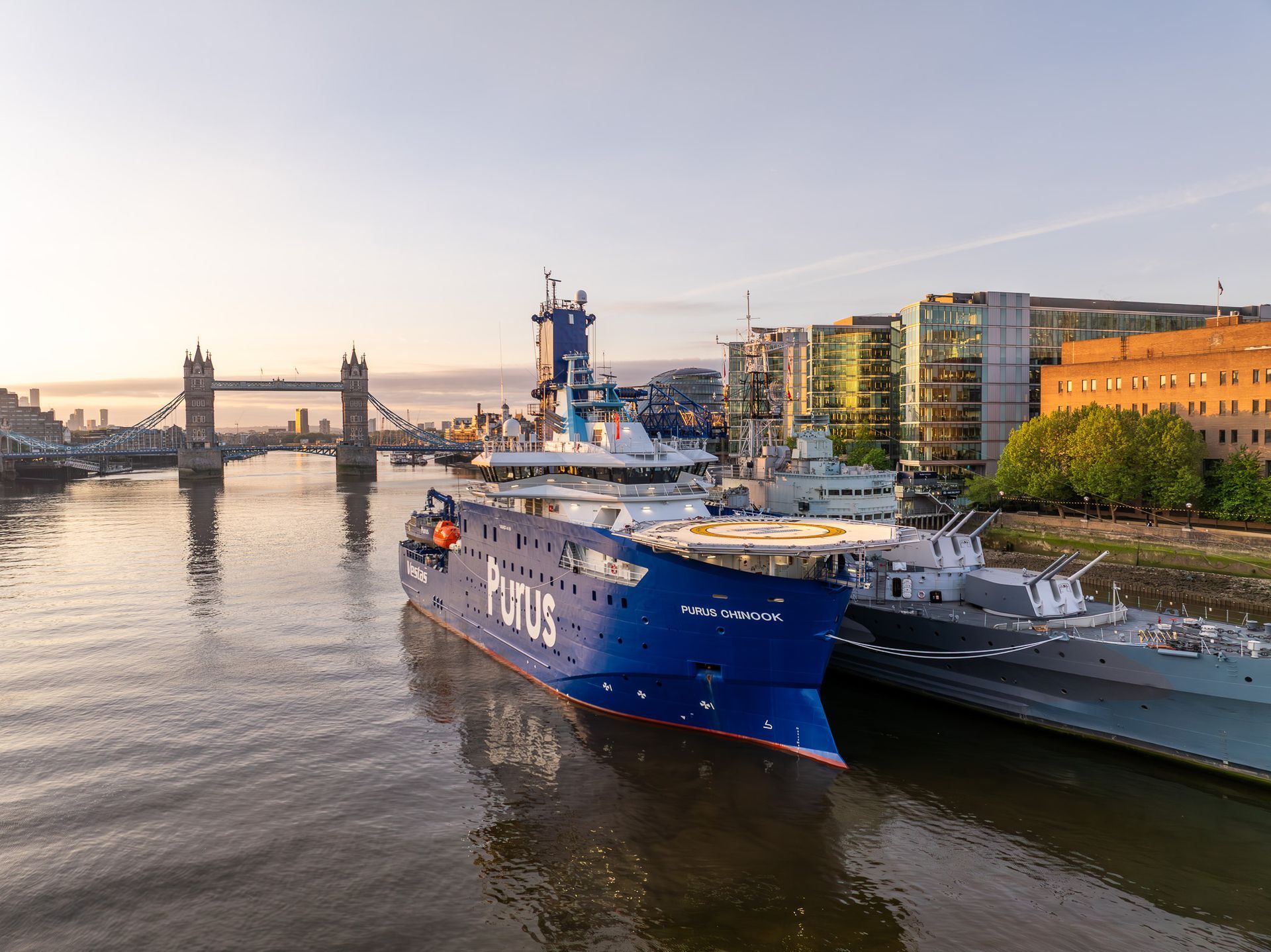
On 8 May 2025, a naming ceremony was held at an undisclosed London venue for a vessel called Purus Chinook. The guest list included government MPs, representatives from Norwegian shipbuilder VARD, wind energy giant Vestas, and classification society DNV. It was, by any measure, a significant moment: the launch of what is among the most technologically advanced commissioning service operation vessels ever built. And yet almost nobody outside the industry noticed. Purus Marine, the London-headquartered company behind the vessel, has always preferred it that way. In four years of quietly acquiring ships, forging partnerships across Asia and Europe, and assembling a fleet of 75 low-carbon vessels worth roughly $2 billion in committed capital, it has operated in a register well below the public radar. That obscurity is now becoming difficult to sustain.
The Architect of the Fleet
Purus Marine was established in 2021, launched by New York-based alternative asset manager EnTrust Global through its Blue Ocean 4Impact Fund. The fund had raised $2.1 billion in December 2020, and its chairman, Gregg S. Hymowitz - a former Goldman Sachs vice president who had founded EnTrust in 1997 - had identified maritime decarbonisation as a generational investment thesis. Hymowitz serves as chairman of Purus Marine's board.
But the operational mind behind the fleet is Julian Proctor, the company's founder and CEO. Proctor arrived at the role after more than two decades navigating the upper tiers of finance and shipping. He spent eight years as Chief Strategy Officer and board member at BNP Paribas Fortis Asia Pacific, then crossed into pure shipowning as Chief Investment Officer at Tiger Group, a Hong Kong and Tokyo-based operator running more than 190 vessels. In 2020, he joined EnTrust Global to raise capital for what would become Purus Marine. Cambridge and LSE-educated, and by all accounts deeply reluctant to seek personal visibility, Proctor has built the company in his own image: technically meticulous, commercially precise, and thoroughly underexposed.
By May 2025, TradeWinds described Purus as a company that had "quietly built up a mixed fleet of 67 ships with a decarbonisation theme." That number has since grown. The company now owns and operates 75 low-carbon vessels across two primary segments: offshore infrastructure support for the wind industry, and gas carriers moving ammonia, LNG, and ethane. In both areas, the strategy is the same - build or acquire the most technologically advanced vessels available, lock them into long-term charters with investment-grade counterparties, and extract the premium that the market increasingly attaches to lower-carbon operations.
What Makes the CSOVs Different
The Purus Chinook is the first of two VARD 419-design commissioning service operation vessels ordered by the company. Its sister ship, Purus Coriolis, is due for delivery in 2026. Both are registered under the Isle of Man flag, built across yards in Norway, Romania, and Vietnam, and designed with a degree of technical specificity that distinguishes them sharply from conventional offshore support vessels.
The Chinook is battery-hybrid - its propulsion system can run on zero emissions for defined periods, reducing engine hours and fuel burn during the slow, station-keeping work that CSOVs routinely perform near wind turbines. It is also methanol-ready: onboard tanks have been pre-installed for future conversion to low-emission methanol fuel, with dual-fuel capability targeted from 2027. At 87.7 metres, the vessel can accommodate 120 people in DNV COMF-V1-certified quarters - a comfort-class standard that covers noise, vibration, and climate control. That crew welfare specification matters commercially: offshore wind technicians working extended rotations at sea have become increasingly selective about vessel standards, and operators like Vestas factor habitability into charter decisions.
At the naming ceremony, DNV formally presented two notations: the COMF-V1 designation and the Cyber Secure Essential certification - making the Chinook among the first vessels of its kind to carry formal protection for its digital infrastructure. That last detail is quietly significant. Offshore wind installations have become targets for cyber interference, and the vessels that service them are increasingly part of that risk surface.
The multi-year contract between Purus and Vestas, signed in 2024, will see the Chinook support wind farm operations across multiple European sites, beginning in the UK. The exact financial terms have not been disclosed, but CSOV day-rates in the current market sit in a range that makes the economics of a new-build hybrid vessel competitive within a relatively short period - particularly when the vessel is designed to meet emissions regulations that older tonnage cannot satisfy without expensive retrofits.
The Bet on Ammonia
The CSOV story is the most visible part of Purus's fleet strategy, but the larger commitment - by asset count and capital deployed - is in gas carriers. Specifically, ammonia.
Purus has assembled what it describes as one of the world's largest ammonia transport fleets, currently comprising nine medium-sized gas carriers (MGCs). Three 40,000 cbm vessels are already operational; six additional 45,000 cbm newbuilds are under construction at Hyundai Mipo Dockyard in South Korea, with deliveries running through 2025 and 2027. In January 2025, the company's vessel Green Power completed the first co-loaded shipment of ammonia and propane in a single voyage - loading ammonia in Louisiana and LPG in Texas, then discharging them separately in the UK and the Mediterranean. The counterparty was Trafigura; the cargo recipient was CF Industries.
That operation mattered beyond its logistical complexity. Ammonia - when produced from renewable energy - is one of the leading candidate fuels for deep-sea shipping decarbonisation, and for the industrial sectors that currently use fossil-fuel-derived ammonia as a feedstock. The ability to move it safely and efficiently in co-loaded configurations expands the viable economics of ammonia trade. Purus's vessels are also ammonia propulsion-ready, positioning them to run on the same fuel they carry as the technology matures.
In March 2025, Purus signed a memorandum of understanding with Climate Impact Corporation (CIC), an Australian renewable hydrogen developer building two 10-gigawatt production projects. The deal is designed to create a net-zero shipping pathway for CIC's hydrogen-derived fuels, closing the lifecycle emissions gap that undermines most current claims of green hydrogen. CIC chairman David Green framed the partnership around a target green hydrogen price of $2 per kilogram - a threshold the industry widely treats as the commercial viability floor.
Gas and the Long Horizon
Alongside ammonia, Purus has moved aggressively into LNG. As of June 2025, the company had 10 gas carriers under construction at Hyundai Group-affiliated yards in South Korea - including a 180,000 cbm dual-fuel LNG carrier ordered from Hyundai Heavy Industries for delivery in the fourth quarter of 2027, when it will enter a long-term charter with an undisclosed leading energy company. Four earlier 180,000 cbm LNG carriers - built at Samsung Heavy Industries - were already delivered in 2024 and 2025. The fleet now has a total gas capacity of 1.58 million cubic metres, with an average vessel age of 0.6 years.
The LNG position reflects a deliberate bet on the bridge fuel argument: that liquefied natural gas, while not a zero-carbon solution, displaces significantly more emissions than conventional marine fuels in the near term, and that the infrastructure being built around LNG now - bunkering, storage, carrier logistics - will be repurposed as the energy system transitions toward hydrogen and ammonia. A dual-fuel LNG carrier can reduce CO2 emissions by up to 25% and NOx emissions by roughly 85% compared to conventional vessels. It can also use boil-off gas from its own cargo as propulsion fuel - a design detail that collapses the boundary between cargo and engine room.
In October 2025, Purus extended further into adjacent gas infrastructure, ordering two 18,900 cbm LNG bunker vessels from China's CIMC SOE. Both ships will be chartered to Shell and delivered in 2028. It was a lateral move that positioned Purus not just as a carrier, but as a participant in the refuelling infrastructure that makes low-carbon shipping economically possible.
The Capital Stack
The investor base behind Purus is as deliberately assembled as the fleet itself. Itochu Corporation, the Japanese trading conglomerate, made an equity investment in 2023, with the explicit aim of developing low-carbon maritime assets targeting the Japanese market - particularly in the ammonia supply chain, where Japan has made substantial national commitments. Sumitomo Mitsui Finance and Leasing has also invested, as has S2G Investments. First Citizens Bank provided debt financing. The result is a capital structure that pairs the patient, impact-oriented equity of EnTrust's Blue Ocean Fund with the strategic industrial alignment of Japanese trading houses - exactly the configuration needed to secure long-term charters with Asian energy companies.
That alignment is worth pausing on. Traditional shipping companies have generally struggled to attract the kind of patient institutional capital that green shipbuilding requires, because the lead times between investment and return are measured in years, and the technology is still maturing. Purus has solved that problem by positioning itself explicitly as a vehicle for impact capital, while delivering the financial discipline - long-term charters, investment-grade counterparties, locked-in day rates - that institutional investors require. The result is a company that sits at the intersection of private equity infrastructure logic and maritime operations, in a sector that has historically resisted both.
What the Fleet Reveals
The broader argument embedded in Purus's existence is uncomfortable for the established shipping industry. The company was founded in 2021 and had assembled more than 60 vessel positions within two years. By 2025, it operated 75 vessels with an average age well below the global fleet average. It has moved into ammonia, LNG, offshore wind support, carbon-capture containerships, electric ferries, and LNG bunkering - covering virtually every segment where low-carbon technology is commercially deployable now, rather than theoretically viable in the future.
The International Maritime Organization has set a target of net-zero shipping emissions by or around 2050, with an interim reduction of up to 30% by 2030. Meeting those targets requires replacing roughly 5% of the global fleet with zero-emission vessels and establishing green fuel corridors between major port hubs. As of early 2025, European shipowners had committed almost $2 billion toward offshore wind support vessel newbuilds alone - a figure that encompasses Purus and its peers. The IMO is expected to implement a GHG pricing mechanism beginning in 2027, which will sharply accelerate the economic penalty for operating older, conventionally fuelled vessels.
Purus's position - building now, locking in long-term charters now, establishing fuel partnerships now - is a bet that the policy inflection point will arrive on schedule. More specifically, it is a bet that when it does, the premium attached to genuinely low-carbon vessels will be significant enough to justify the capital deployed in advance. Julian Proctor and Gregg Hymowitz have made that bet across 75 vessels, a newbuilding program of more than 10 additional ships, and partnerships stretching from Vestas in northern Europe to CIC in Australia to Trafigura in the Atlantic. The fleet nobody noticed is now large enough that the industry cannot look away.