No More Leash: How a Shenzhen Startup Just Untethered Augmented Reality
The AR glasses race now has a new leader in a crucial technical category.
By Carry and Conquer Publications
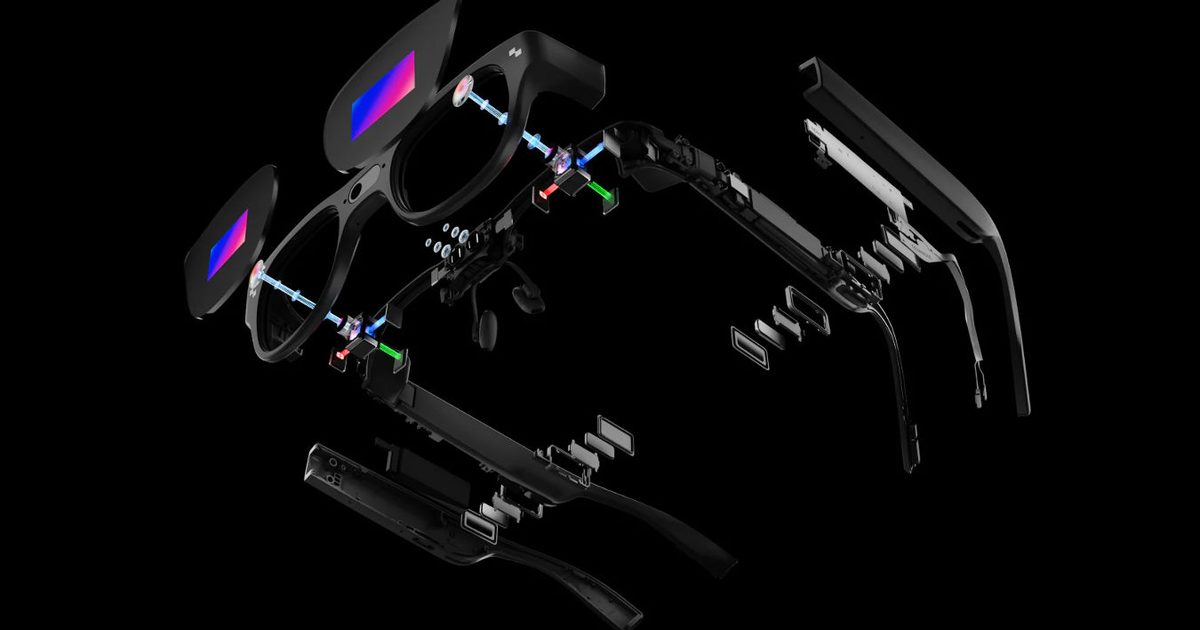
The question of whether augmented reality glasses will ever replace the smartphone has haunted the industry for over a decade. The answer has always bumped into the same wall: without a phone in your pocket, the glasses go dark. At CES 2026 in Las Vegas, a four-year-old Chinese company built inside the TCL family quietly dismantled that assumption. RayNeo unveiled the X3 Pro - Project eSIM, the world's first consumer AR glasses concept with integrated eSIM and 4G connectivity. In a single announcement, it also disclosed a new funding round backed by subsidiaries of China Unicom and China Mobile - the first time China's major state telecommunications operators had entered the smart glasses sector. The message from Shenzhen was direct: AR glasses are no longer a smartphone accessory. They are a phone.
The Tether Problem
Smart glasses have carried a structural handicap since the category was born. Almost every consumer device on the market - including Meta's widely popular Ray-Ban smart glasses - offloads its connectivity to a paired smartphone. The glasses capture, the phone processes; the glasses speak, the phone transmits. The hardware on your face is only as capable as the device in your pocket, and the moment you leave the phone behind, the experience degrades or disappears.
This has been more than an inconvenience. It is the single most cited barrier to AR glasses becoming a primary device. Analysts at Omdia project that as late as 2035, roughly 92 percent of XR devices will still rely on tethering to smartphone companions for their cellular connectivity, with truly standalone cellular integration expected to remain rare outside enterprise use cases well into the 2040s. RayNeo's announcement does not wait for that timeline.
The X3 Pro - Project eSIM embeds a standalone eSIM (4G) system directly into the glasses frame. Camera, display, and cellular networking occupy the same chassis. A user can make calls, stream music, access real-time translation across 14 languages, and sync photos instantly to the cloud - all without carrying a handset. RayNeo's pitch is not incremental. It is a redefinition of what category the device belongs to.
Who Is RayNeo
RayNeo was founded in 2021 and incubated by TCL Electronics, the Shenzhen-based consumer electronics giant whose television business reaches more than 160 countries. That parentage gave RayNeo manufacturing infrastructure and distribution reach that most AR startups spend years trying to build. By the third quarter of 2025, Counterpoint Research ranked RayNeo as the global leader in consumer AR glasses with a 24 percent market share - a position it reached in just four years.
The company's product history shows a pattern of deliberate technical escalation. At CES 2023 it debuted the world's first full-color Micro-LED optical waveguide AR glasses - a display breakthrough that took competitors years to match. At MWC 2023 its NXTWEAR S won Best Connected Consumer Device at the Global Mobile Awards. At CES 2025 it previewed the X3 Pro with a proprietary "Firefly" MicroLED engine 40 percent smaller than the prior generation, paired with waveguide technology developed in partnership with Applied Materials that reduced the rainbow interference effect by 95 percent and enabled outdoor visibility in direct sunlight.
RayNeo's founder and CEO, Li Hongwei, has consistently articulated a four-part benchmark for what he considers "true AR glasses": small size, natural display, all-weather usability, and genuine virtual-real combination. The eSIM integration announced at CES 2026 addresses the fifth dimension that no one had formally added to that list: independence from the smartphone.
The Telecom Bet
The funding announcement that accompanied the X3 Pro - Project eSIM debut was as significant as the hardware itself. Investors included Unicom Innovation Capital, a subsidiary of China Unicom, and the investment arms of China Mobile - CM Beijing Fund and CM Shanghai Fund. The round also included Goldstone Investment, owned by CITIC Securities. Reported figures placed the round at over 1 billion yuan, roughly 143 million US dollars, though RayNeo has not officially confirmed the amount.
What matters is not the number but who wrote the checks. China Unicom and China Mobile are not venture firms. They are state-owned telecommunications operators with hundreds of millions of subscribers, nationwide retail infrastructure, and direct control over the cellular networks that an eSIM-enabled device depends on to function. Their entry into the smart glasses sector is not a financial bet on a startup. It is a strategic declaration that AR glasses belong inside national communications infrastructure.
The operators bring specific capabilities that no venture capital round can replicate: eSIM provisioning networks, 5G-Advanced connectivity architecture, and the distribution channels to introduce AR glasses to consumer segments far beyond tech early adopters. The "device-with-plan" subscription model that built smartphone mass adoption in the 2000s becomes immediately applicable. A consumer walks into a China Unicom retail location, picks up a pair of RayNeo X3 Pros, and activates cellular service on the spot - the same transaction that normalized smartphone ownership a generation ago.
The Competitive Context
The announcement lands at a moment when Western competitors are navigating a different set of constraints. Samsung revealed consumer AR glasses at MWC 2026 with a design that deliberately tethers to Galaxy smartphones, prioritizing cost reduction and ecosystem integration over standalone capability. Meta's Ray-Ban Display glasses paused their international rollout in January 2026 due to supply shortages despite strong US demand. Snap spun off its Spectacles unit in January 2026 to seek independent investment and faster scaling.
None of these moves address the tether problem. They work around it, defer it, or acknowledge it as a design choice. RayNeo's X3 Pro - Project eSIM confronts it directly. The global smart glasses market was valued at approximately 2.5 billion US dollars in 2025 and is projected to reach over 14 billion dollars by 2033, growing at a compound annual rate of 24 percent. The company that solves standalone connectivity first stands to define the product category for the cycle that follows.
The challenge RayNeo has not yet answered is the one Digital Trends noted in its CES coverage: the X3 Pro - Project eSIM remains a concept, with no confirmed pricing, release window, or clarity on where eSIM activation would be supported across global carrier networks. The hardware milestone is real. The commercial milestone is pending.
What Comes Next
The investor coalition RayNeo has assembled represents something beyond a funding event. It is an infrastructure alliance. China's two largest telecom operators have a direct financial interest in making eSIM AR glasses work at scale - and the network assets to ensure that they do. That alignment between hardware maker and carrier does not exist for any competing product in the Western market.
For private equity and growth investors tracking the consumer technology hardware cycle, the pattern is familiar. The moment a platform-level device category acquires both a credible technical architecture and a distribution alliance capable of reaching mass-market consumers, the category accelerates. The smartphone followed this logic. The tablet followed. The question for AR glasses has always been which company would engineer both conditions simultaneously.
RayNeo has not shipped a mass-market standalone AR device. What it has done is demonstrate the technical prototype and secure the infrastructure partnership before any competitor reached either milestone. In a technology race defined by sequence, that combination is the lead. The market will decide how durable it proves - but in Las Vegas in January 2026, the leash came off.