Lebanon Built the World's Third Most Expensive Car While Its Economy Was Quietly Dying
A Beirut-founded startup built a $3.4 million, diamond-headlight hypercar out of a country whose debt, banks, and politics were already unraveling years before its currency finally collapsed.
By Carry and Conquer Publications
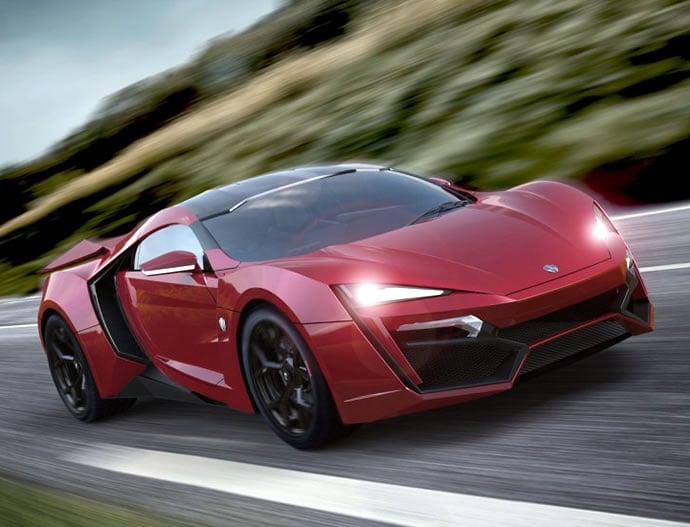
In July 2012, a young Lebanese entrepreneur named Ralph Debbas registered a car company in a country that had never built one. Lebanon had no automotive industry, no supplier base, no test track culture to speak of, and a banking sector that, according to later analysis from the Middle East Institute, had already spent years lending roughly three quarters of its customers' deposits to a government running one of the most unsustainable debt loads in the world. Debbas called the company W Motors. Seven months after founding it, he stood in Doha and unveiled the Lykan HyperSport: a 740-horsepower hypercar with headlights inlaid with hundreds of diamonds, a price tag of $3.4 million, and a claim that would follow it for a decade, that this was the first sports car ever designed indigenously in the Middle East.
A Company Born Into a Country Already Running Out of Road
W Motors did not launch during a moment of Lebanese stability that later crumbled. It launched squarely inside the buildup to the crisis. By the time Debbas unveiled his prototype in February 2013 at the Qatar Motor Show, Lebanon was absorbing the early waves of refugees fleeing the Syrian civil war next door, a strain that would eventually push the country's population up by roughly a quarter. The following year, in 2014, Lebanon's parliament failed to elect a president, opening a vacancy that would stretch on for two and a half years, into 2016, while the country's institutions effectively idled. Parliamentary elections that should have happened on a normal cycle were postponed five separate times, finally taking place in 2018. None of this was hidden. The Middle East Institute later concluded that Lebanon's 2019 collapse was less a shock than an outcome that had been "predictable" for years, built from stacked, visible failures: a public debt load spiraling toward unsustainability, a decade of essentially zero growth in the productive economy, and a banking system quietly insolvent long before anyone declared it so.
W Motors' seed capital came from inside that same fragile system. The company's initial funding, more than $13 million, was backed by FFA Private Bank, a Beirut-based institution that took a stake in the young carmaker. It was, in miniature, the exact bet Lebanon's entire elite was making through the 2010s: that the country's banks, propped up by high-yield deposits and a currency peg that had held since 1997, were solid enough to finance ambitious, capital-intensive projects. W Motors bet on that solidity to build a car. Within a decade, that same banking system would freeze depositors out of their own money.
Engineering a Hypercar From a Country With No Auto Industry
The Lykan HyperSport was, in the most literal sense, not built in Lebanon. Its 3.7-liter twin-turbocharged flat-six engine came from Ruf Automobile in Germany. Its bodywork and chassis were shaped by Italian coachbuilders including Studio Torino, drawing on decades of European supercar-building tradition that Lebanon itself had no access to. What Lebanon supplied was the idea, the capital, and the engineering leadership, Lebanese and Italian engineers working under Debbas to assemble a genuinely indigenous hypercar brand out of a country that, at the time, could not reliably keep the electricity on. The car's headlights alone carried titanium LED blades set with 440 diamonds, roughly 15 carats, with buyers able to substitute rubies, yellow diamonds, or sapphires depending on taste. Only seven units were ever built, each priced at $3.4 million, which made the Lykan the third most expensive production car in the world at the time of its debut, trailing only a handful of European ultra-limited runs.
The car became a global name not through racetrack results but through a single sequence in the 2015 film Furious 7. Stunt coordinator Andy Gill built three full-scale, forty-foot glass-and-steel structures on a soundstage in Atlanta to simulate Abu Dhabi's Etihad Towers, then had a stunt driver put a Lykan HyperSport through each one at speed, a practical stunt later blended with CGI for the finished sequence. The production also spent nearly a week filming on location in Abu Dhabi for aerial shots. It was one of the last major action sequences to feature Paul Walker's character before his death partway through filming, which cemented the scene's place in franchise history and, with it, the Lykan's global visibility, far beyond what seven hand-built cars could have generated on their own.
The Skepticism the Diamonds Couldn't Buy Off
Fame brought scrutiny the company never fully answered. Automotive analyst Nolan Sykes, reviewing the car for the YouTube channel Donut Media, pointed out that in years of coverage no one had ever published benchmark footage of the Lykan actually reaching its claimed 395 km/h top speed or matching its 0-60 numbers against rival hypercars; every clip in circulation showed the car stationary or moving at moderate speed. Sykes went further, identifying what looked like an identical "Number 1" plaque appearing on two different Lykan units of different colors, raising the uncomfortable possibility that W Motors' seven-car production run was not what it claimed to be. Independent tracking by outlets covering the car found only two confirmed sales in the years since: one to a private Middle Eastern buyer around the car's 2013 debut, and one, formalized in September 2018, to the Abu Dhabi Police, which paid roughly Dh12.8 million for a unit it now displays at malls and tourist sites as a road-safety outreach tool aimed at drivers aged 18 to 30, the group responsible for nearly half the capital's traffic incidents. Whether the other five owners exist in some undocumented private garage or never took delivery at all remains, a decade on, an open question that W Motors has never definitively closed.
What Survived the Collapse, and What Didn't
W Motors relocated its headquarters to Dubai almost immediately after the 2013 unveiling, a decision that, in hindsight, likely saved the company. Lebanon's crisis, when it finally arrived, was total. Beginning in the summer of 2019, depositors found they could no longer withdraw their own dollars. Banks shut for two weeks that October during nationwide protests, then reopened with informal capital controls that were never approved by parliament and never fully lifted. By March 2020 the government had defaulted on its debt for the first time in the country's history. The Lebanese pound, pegged at 1,507 to the dollar since 1997, was trading at roughly 34,000 to the dollar on the street by mid-2022, a loss of about 95 percent of its value. Three quarters of the population fell into poverty. FFA Private Bank, W Motors' early backer, remained a going concern but operated inside a Lebanese banking sector that Lebanese and international press alike would come to describe as a network of zombie banks, technically open, functionally unable to return depositors' money.
W Motors, headquartered in Dubai by then, kept building. In January 2020, the company opened a Dh370 million, 11,130-square-meter manufacturing facility in Dubai Silicon Oasis, with plans to eventually employ up to 500 people and, per CEO Ralph Debbas, to help "position the UAE on the international automotive map." The company pushed forward with a second model, the 110-unit Fenyr SuperSport, and by 2022 had supplied Dubai Police with a bespoke Ghiath patrol SUV. A planned expansion of that Dubai facility, targeted for completion by the end of 2023, has since slipped behind schedule.
What is left of the Lykan HyperSport story is not really a car company narrative at all. It is a case study in where capital, ambition, and instability can coexist for years before the instability wins. Lebanon's economy did not collapse the week the Lykan was unveiled in Doha in February 2013, or the week its diamonds first caught television lights at the Qatar Motor Show. It collapsed six years later, after absorbing a war next door, a two-and-a-half-year presidential vacancy, five postponed elections, and a banking system quietly hollowing itself out the entire time. W Motors was built, financed, and staffed by people betting that Lebanon's fragile arrangement would hold long enough to matter. For the company, headquartered in Dubai before the worst of it arrived, that bet paid off. For the bank that financed it, and for the three quarters of Lebanon's population that fell into poverty in the years after, it did not.