Japan's Capsule-Toy Machines Are a Bigger Business Than Most Countries' Film Industries
A vending-machine gimmick invented in 1960s America has compounded, in Japan, into a market now closing in on the country's own record-breaking box office, according to figures both industries released within weeks of each other in early 2026.
By Carry and Conquer Publications
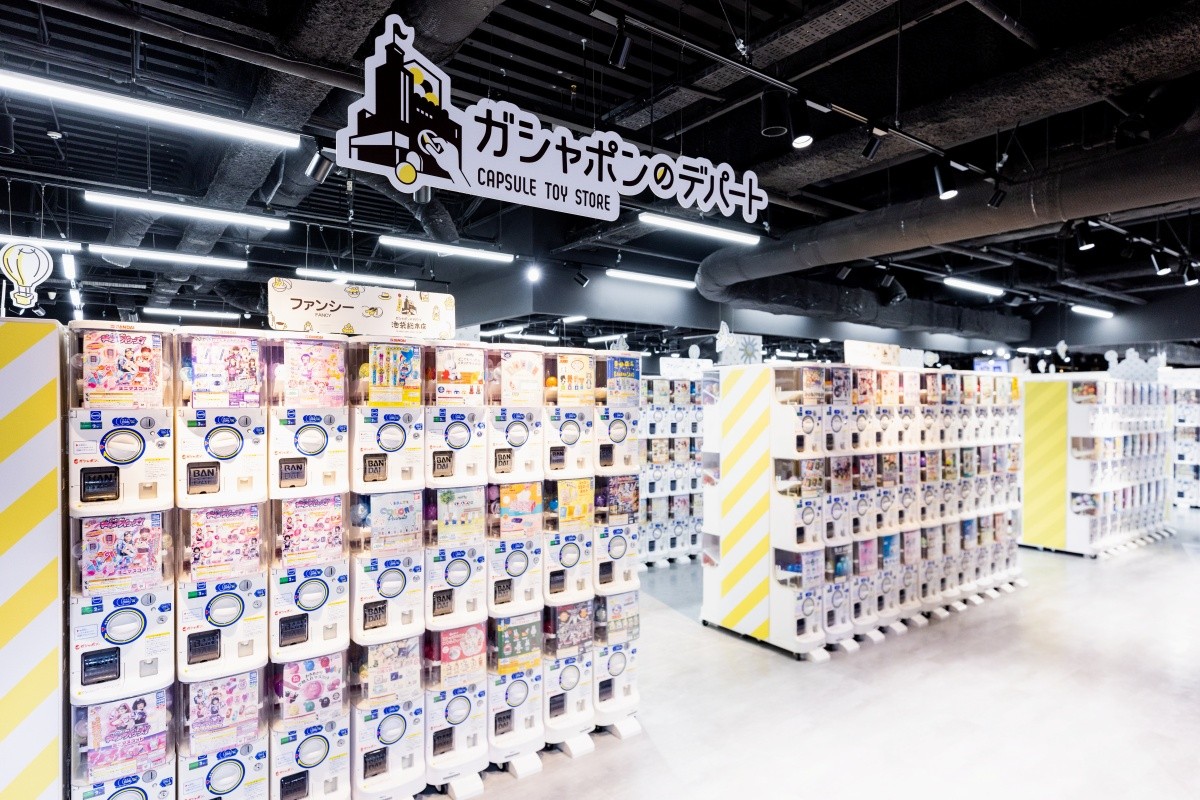
Japan's capsule-toy business just posted its best year on record. The Japan Capsule Toy Association's annual trend survey, released February 19, 2026, put fiscal 2025 shipment-basis market size at approximately 196 billion yen, up 39.0 percent from 141 billion yen the prior year, the fastest growth rate JACTA has recorded and a new all-time high. That figure covers only products made for domestic capsule-toy machines; JACTA estimates that once event sales and corporate-original goods sold in capsule format are included, the true market already exceeds 200 billion yen. For comparison, Japan's entire film industry, ticket sales and all, also just posted a record year: the Motion Picture Producers Association of Japan announced on January 28, 2026, that 2025 box office revenue hit an all-time high of 274.45 billion yen, up 32.6 percent, powered by "Demon Slayer: Kimetsu no Yaiba: Infinity Castle" and the prestige hit "Kokuho." Two very different Japanese entertainment sectors, reporting in the same six-week window, both just posted the best year in their history, and the gap between them has never been narrower. Broader trackers that count the full retail ecosystem around gachapon, not just factory shipments, put the number even higher, with some estimates of the total consumer ecosystem running as high as 400 to 610 billion yen once specialty stores, adjacent merchandise, and secondary resale are folded in. Dispensed from somewhere between 600,000 and 700,000-plus machines nationwide, it is, by any of these measures, already a business the size of most countries' entire film industries.
From Gumball Machines to a National Obsession
Capsule vending machines did not originate in Japan. They trace back to 1880s New York, where coin-operated machines dispensed gumballs and small trinkets in plastic capsules. An entrepreneur named Ryuzo Shigeta imported the concept to Japan in 1965, setting up machines outside neighborhood sweet shops. Bandai entered the category in 1977, coining "Gashapon," an onomatopoeia combining "gasha," the sound of the crank turning, and "pon," the sound of the capsule dropping into the tray. Tomy, through its T-Arts subsidiary, trademarked the rival term "Gacha." Between them, the two companies have controlled roughly 60 percent of the market for decades, according to Onoo Katsuhiko, head of the Japan Gachagacha Association, even as some 30 smaller manufacturers have carved out space targeting adult collectors.
For most of its history the category was small and stagnant. Onoo puts the market at around 30 billion yen through the second half of the 2010s. Bandai's own Gashapon executives describe the same plateau: the business hovered near 30 to 35 billion yen for years, propped up mostly by convenience-store corners and shared shopping-mall corridors, where the number of machines any single retailer could host was inherently capped. From that base, JACTA's own shipment-basis figures show the climb that led to today's record: roughly 141 billion yen in fiscal 2024 after a 22.6 percent jump from fiscal 2023, itself already close to double fiscal 2022, before the 39.0 percent leap to 196 billion yen in fiscal 2025.
The Pandemic Rewired Retail Around Empty Space
The inflection point, by Bandai's own account, was 2020. Tenants withdrew en masse from prime real estate in urban centers and shopping districts during the pandemic, and the vacated square footage created unusually favorable conditions for a low-overhead, staff-light retail format. Bandai opened its flagship Gashapon Department Store in Ikebukuro's Sunshine City complex in August 2020, filling the space with roughly 3,000 machines; it now holds the Guinness World Record for the largest single-venue collection of capsule-toy machines on earth. As of March 2024, Bandai had opened 312 dedicated capsule-toy stores nationwide in under four years, a rollout speed that would have been unthinkable under the old model of scattering machines into whatever corner space a host retailer could spare.
Bandai wasn't alone in reading the moment. LULUARQ Inc., a vending-machine operator dating to 1958 that opened Japan's first capsule-toy specialty store in 2014, launched its "Gachagacha no Mori" ("Capsule Toy Forest") chain in 2017 and then scaled it hard once the pandemic-era real estate math shifted in its favor. Its stores run 600 to 2,000 machines apiece, staffed by employees who restock in real time and track sales through networked sensors. Sales manager Makoto Nakagawa has described the company's original problem directly: unstable sales because "capsule toys were thought of as something just for kids." The fix was redesigning stores around adult browsing behavior, bright wood-toned interiors, women's product displays placed near the entrance, the deliberate encouragement of wandering and conversation rather than a quick transaction. The strategy worked well enough that ORIX Corporation, a Tokyo-listed financial conglomerate with roughly 34,000 employees across 30 countries, acquired all shares of LULUARQ in April 2025, a private-equity-grade vote of confidence in what used to be filler for dead mall corners. The rollout across the industry has only accelerated since: JACTA counted more than 900 dedicated capsule-toy specialty stores nationwide as of January 31, 2026, an increase of over 200 stores in a single year, with the trade group noting that new openings are increasingly street-facing storefronts rather than tenant space inside malls, a shift JACTA expects to add more than 100 further stores in 2026 alone.
The Analog Alternative to a Scrutinized Digital Mechanic
Gachapon's timing is not incidental to what has been happening in mobile gaming. The word "gacha" made the leap into Japanese mobile games as early as 2004, years before smartphones existed, when feature-phone developers built randomized reward mechanics directly modeled on the capsule-toy machine. That digital gacha became the template for what the rest of the world now calls the "loot box," and it has not aged well under regulatory and public scrutiny. Japan's own industry self-regulatory body outlawed a specific mechanic called "complete gacha," which required players to collect an entire random set to unlock a reward, back in 2012 after consumer-protection concerns. Clinical literature has since documented gaming-disorder cases tied specifically to loot-box overspending, and multiple countries, South Korea prominent among them, have moved to force probability disclosure and other consumer protections onto mobile gacha mechanics.
Physical capsule toys carry none of that baggage, despite running on the identical psychological mechanism: pay a fixed, capped amount, receive one randomized item, repeat if you want to complete a set. The difference is structural rather than cosmetic. A capsule-toy purchase costs a fixed 100 to 500 yen (rising toward 600 to 1,500 yen for "Premium Gashapon" lines), delivers a physical object immediately, and cannot be topped up indefinitely inside an app with a stored credit card. There is no mechanism for a single session to spiral into the six-figure yen losses that show up in mobile-gacha gaming-disorder case reports. Collectors and commentators have increasingly framed the format explicitly as the "honest" version of the loot-box thrill: the odds are visibly finite, the object in hand is real, and the transaction ends the moment the capsule hits the tray. As mobile gacha faces tightening scrutiny in multiple jurisdictions, the analog original may be positioned to absorb spending that would otherwise go toward the regulated digital version.
From Trinkets to Intellectual Property
The other engine behind the market's growth has been a shift in what's actually inside the capsule. Bandai's Gashapon line now leans heavily on licensed intellectual property: Mobile Suit Gundam, One Piece, Dragon Ball, My Hero Academia, Jujutsu Kaisen, Sanrio characters, and dozens of other franchises rotate through monthly product drops. Bandai has said its capsule-toy division releases new items on a roughly monthly cadence; JACTA's fiscal 2024 survey found the average monthly count of new products rising from about 500 in 2023 to roughly 700 in 2024, a 1.4-times increase. Takara Tomy Arts, the other dominant player, has built a parallel reputation for functional novelty items, miniature working fans, tiny vending machines, and small arcade cabinets that have gone viral internationally, alongside long-running lines like a 32-year-old miniature-insect series timed to Japanese summer.
The scale of that IP strategy showed up directly in Bandai Namco's most recent full-year results, published May 13, 2026. For the fiscal year ended March 31, 2026, the company's Toys and Hobby segment, which houses Gashapon alongside Gunpla model kits and trading cards, posted record sales of 673.9 billion yen, up 12.9 percent year over year, with an 18.8 percent operating margin. Gundam overtook Dragon Ball as Bandai Namco's single highest-earning franchise for the first time, generating 254.3 billion yen groupwide, a 65.7 percent jump, while capsule toys were named alongside model kits and card games as one of the segment's continued growth drivers. Nine months into that fiscal year, through December 2025, Bandai Namco's company-wide net sales crossed 1 trillion yen for the first time in its history, a threshold Toys and Hobby did the heavy lifting to reach. JACTA's own February 2026 survey points to a specific trend inside that growth: a wave of nostalgia for "Heisei-era girl" (heisei joshi) culture, with capsule-toy revivals of Sanrio and Tamagotchi characters and collaborations with brands popular in the early Heisei period selling especially well in 2025, alongside continued strength in goods tied to oshikatsu, the fan-support culture built around supporting a favorite idol, character, or performer.
The IP strategy extends past merchandising into cultural legitimization. Bandai Namco Toys & Collectibles America installed 60 Gashapon machines inside the "Art of Manga" exhibition at San Francisco's de Young Museum, an exhibition that has drawn more than 175,000 visitors since opening in September 2025. It is a deliberate repositioning: capsule toys presented not as impulse-buy trinkets but as an extension of a fine-art and manga-history exhibition, sitting a few feet from original drawings by artists like Rumiko Takahashi and Hirohiko Araki. Average price points have risen accordingly, from roughly 200 yen historically to a more common 300 to 500 yen band today, a shift Nakagawa attributes directly to quality: miniatures detailed enough, he has said, that a customer would expect to pay 2,000 yen for the equivalent in a regular retail store. JACTA's fiscal 2025 data confirms the same price migration at the industry level: 400 yen and 500 yen price points combined now account for 48.1 percent of all capsule-toy sales, a shift the association attributes directly to yen weakness and rising material and labor costs, even as a newly introduced 90-millimeter capsule format has let makers fit larger figures and plush toys into machines for the first time, broadening what the format can physically contain.
A Business Built on Physical Scarcity
The mechanics of the format create a retail experience closer to a treasure hunt than a purchase. With 600 to 700 new products entering circulation every month and popular items known to disappear from shelves within weeks, LULUARQ's stores lean into urgency as a designed feature rather than an accident of supply. JACTA's fiscal 2025 figures put a number on just how routine that treasure hunt has become: dividing the year's market size by average unit prices implies roughly 550 million capsules sold nationwide in a single year, or about four to five capsule-toy purchases for every person in Japan, children and adults included. The number of companies making capsule toys has grown to around 70, a low barrier for manufacturers, though JACTA notes the barrier stays high for capsule vendors, the operators who need to actually secure machines and shelf space, keeping competition for prime real estate concentrated among a smaller set of established players. Search interest in the Japanese keyword for "capsule toy" has climbed steadily since 2004, according to Google Trends data cited in JACTA's survey work, spiking hardest during the pandemic and again at the end of 2024, with Tokyo Disneyland-themed capsule searches ranking among the most common associated queries. Narita Airport's capsule-toy machines are reported to post some of the highest per-machine sales figures in the country, capturing travelers' last unconverted 100-yen coins before departure, and JACTA's 2025 survey found that even a feared falloff in Chinese group tourism in the second half of the year left sales largely unaffected, with capsule toys tied to globally popular anime films like "Demon Slayer" and "Jujutsu Kaisen" helping carry inbound demand instead.
Not every signal points straight up. JACTA itself flagged that sales of capsule toys tied to corporate collaboration campaigns, a staple of the category for years, have started to saturate and slow, with vendors now differentiating through niche creator-made goods and original in-house product lines instead. Some market watchers, cited in Japanese trade coverage of the JACTA survey, are more cautious still, suggesting the domestic specialty-store boom could peak as soon as 2026 as competition for prime locations intensifies; a handful of specialty stores have already been reported closing even as the overall store count grows. JACTA's own outlook, by contrast, expects further expansion in 2026, including more than 100 additional specialty stores and continued mergers and acquisitions among capsule-toy vendors, several of which took place in 2025 alone as outside industries started paying closer attention to the category.
None of this has come from a single blockbuster product or a single company's marketing push. It is the compounding effect of a sixty-year-old mechanical format, a pandemic that emptied out exactly the kind of retail space this format needed, a licensing strategy that turned trinkets into collectible IP merchandise, and a digital cousin whose regulatory troubles have made the analog, capped-cost, physically-real version look, by comparison, like the responsible way to gamble on a toy. A machine that once sat by the door of a candy shop for the price of loose change now anchors ORIX-owned retail chains, museum exhibitions, and, on the freshest numbers both industries have, a market that just grew faster in a single year than Japan's own record-breaking film business.