How BASE Bahay Is Using Bamboo To Rebuild
A Philippine non-profit is rewriting the rules of disaster-resilient construction - and a new global design competition wants the world's best engineers to push the technology further.
By Carry and Conquer Publications
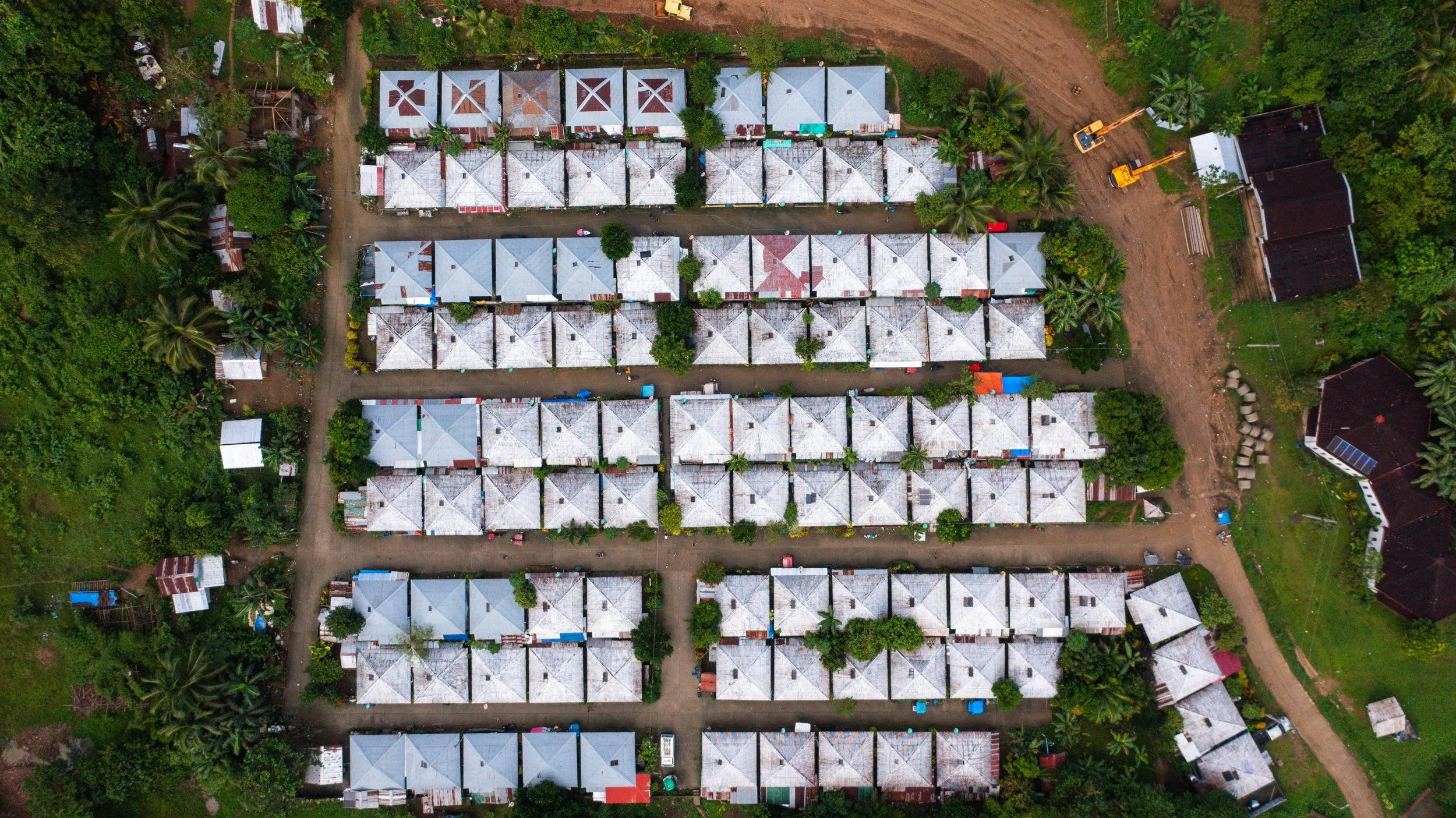
In the mountains of Colombia's coffee region, a young civil engineering student named Luis Felipe Lopez watched old bamboo houses survive earthquake after earthquake while newer concrete structures crumbled around them. The 1999 Armenia earthquake killed more than a thousand people, but once again the bamboo homes held. Lopez put down his thesis and made a decision: this would not be a research project. It would be his life's work. Twenty-five years later, that obsession has taken him to the Philippines, where the foundation he helps lead has sheltered more than 10,500 people in disaster-proof bamboo homes - and launched a global competition to accelerate the next generation of the technology.
The Problem BASE Was Built to Solve
The Philippines sits at one of the most dangerous intersections of geography and poverty on the planet. The country averages 20 typhoons per year, sits on the Pacific Ring of Fire, and ranked first on the World Risk Index in 2022 - the global measure of natural disaster exposure relative to a population's coping capacity. Against that backdrop, roughly 60% of Filipino homes are informally built and structurally vulnerable. The National Economic and Development Authority has put the national housing shortage at approximately 6.8 million units.
The country's traditional response to this crisis has been concrete and steel - expensive imported materials that, as any Filipino survivor of Typhoon Yolanda in 2013 can attest, are not automatically safer than the alternatives. In the aftermath of that disaster, when Tacloban City's coastline looked like a war zone, one of the sharpest questions facing reconstruction teams was whether it was even possible to build permanent, affordable, typhoon-proof housing at scale. The BASE Bahay Foundation said yes - and it said the answer was a piece of grass that had been growing in Philippine forests for centuries.
The Technology: Reinventing a Forgotten System
Cement-Bamboo Frame Technology (CBFT) is not a new idea dressed up in modern packaging. It is a rigorous engineering system built on a centuries-old construction method called Bahareque Encementado, developed in the Andes of South America, where bamboo frames reinforced with wire mesh and coated in cement mortar had long proven their seismic credentials. BASE Bahay, founded in 2014 as an initiative of Liechtenstein-based Hilti Foundation, took that Andean system, crossed it with Philippine bamboo construction traditions, and ran it through European structural timber engineering standards.
The result is a prefabricated frame of treated, load-bearing bamboo poles reinforced with metal connections and finished in a mortar-cement plaster skin. The skin is critical: as Luis Lopez - now BASE's General Manager and the man who co-authored Colombia's national bamboo structural design code (NSR-10) - explains, the bamboo is not embedded in concrete as many observers assume. The cement layer is only two to three centimeters thick. The bamboo provides the tensile strength and flexibility; the cement provides the skin that seals it from moisture, insects, and perception.
That last point matters. One of BASE's more underappreciated engineering challenges has been cultural rather than structural. In the Philippines, as in much of the developing world, bamboo carries the stigma of poverty housing - the traditional nipa hut, a material for people who cannot afford anything better. CBFT homes are designed to look like concrete houses from the outside. That choice is deliberate. The negative public perception of bamboo is, according to BASE's own project documentation from Tacloban, one of the primary barriers to adoption - and the visual design of CBFT homes is itself a technology solution.
What the Numbers Say
The structural performance of CBFT homes has been tested not in laboratories alone, but in the field, repeatedly, in one of the most disaster-prone regions on earth. As of 2025, Nischal Pradhan, Head of the BASE Innovation Center, reported that with over 1,500 houses built across the Philippines - each one subjected to one or two typhoons per year - there have been zero reported instances of structural failure. The CBFT system is certified by the Philippines' Accreditation of Innovative Technologies for Housing (AITECH) and is engineered to withstand Category 5 typhoons with sustained winds of 250 kilometers per hour, as well as earthquakes consistent with the values specified in the National Structural Code of the Philippines.
The cost data is equally compelling. A CBFT home costs roughly 30% less than an equivalent conventional concrete house, according to BASE's figures. Because bamboo is locally grown and abundant in the Philippines, it carries no import or transport premium, insulating it from the inflation that has hit conventional building materials hard since 2021. A life-cycle analysis conducted in collaboration with ETH Zurich found that CBFT homes produce 60% less carbon over their lifetime compared to standard concrete construction. A separate analysis by Lopez himself found that, before a bamboo building reaches end of life, the biogenic carbon effects of the bamboo material offset approximately 43% of total production emissions - with temporary carbon storage effects reducing that figure further. Against concrete, bamboo construction cuts net emissions by 70%.
The lifetime estimate for a CBFT home is 60 years - comparable to conventional construction, and far beyond the 10-to-15-year horizon that governs most informal housing in the Philippines.
Building the Industry, Not Just the House
What distinguishes BASE Bahay from other alternative construction advocates is that it has spent a decade building not just houses but an entire industry ecosystem - the supply chains, regulations, training programs, and entrepreneurial networks without which any promising construction technology eventually stalls at the pilot stage.
The BASE Innovation Center (BIC) in Makati collaborates with more than 25 universities internationally, including ETH Zurich, Coventry University, and De La Salle University in Manila. It has contributed to the development of bamboo structural standards in Colombia, Peru, Ecuador, Nepal, and the Philippines, and played a central role in the publication of ISO 22156, the international standard for bamboo structures. Lopez sits on the ISO Committee TC 165 representing Colombia, and was appointed Co-Chair for Chapter 8 (Bamboo) of the Philippines' National Structural Code 8th Edition.
The Bamboo Academy, BASE's training arm, certifies contractors, builders, and farmers in every link of the bamboo construction value chain - from sustainable harvesting and treatment to structural assembly and quality control. BASE has established treatment facilities using a 15-step zero-waste process: bamboo poles are washed to remove the starch beetles feed on, sun-dried to maximize absorption, then submerged in a boron or pyrethrin solution that repels termites. Since the poles absorb the solution rather than displacing it, the treatment bath never needs to be replaced - only topped up.
Partners in the ecosystem include Habitat for Humanity, All Hands and Hearts, Holcim, Arup, and Operation Blessing Foundation. Together, BASE and its partners have delivered more than 2,400 CBFT homes across the Philippines, Nepal, India, and Sri Lanka.
The Bamboo Housing Challenge: Calling the World's Best Minds
In February 2026, BASE and Bali-based bamboo education enterprise Bamboo U launched the Bamboo Housing Challenge - an international design competition asking architects, engineers, students, and creative thinkers worldwide to design a bamboo-based home prototype that can be built for under USD 10,000, or roughly PHP 578,000. The competition, supported by the Hilti Foundation, is not a conceptual exercise. The winning design will be constructed at full scale in Bali, Indonesia during an 11-day build course in October 2026, and will serve as a permanent residence for a member of the local community.
"We firmly believe bamboo holds immense potential to revolutionize sustainable and affordable construction globally," Lopez said at the competition's launch. "This challenge is a direct embodiment of our mission to push the boundaries of bamboo construction, inviting the world's brightest minds to contribute to solutions that are not only environmentally sound but also dignified and accessible for vulnerable communities."
The competition's registration deadline fell on March 15, 2026 - today - with design submissions due April 17, 2026, and a winner announced May 15, 2026. The judging panel is a formidable assembly of the global bamboo construction establishment: Austrian architect Anna Heringer, winner of the Aga Khan Award for Architecture; Colombian bamboo pioneer Simon Velez, the engineer credited with transforming Guadua bamboo into a mainstream structural medium across 11 countries; Elora Hardy, the IBUKU founder whose TED Global talk on bamboo architecture has influenced a generation of designers; and Orin Hardy, Bamboo U co-founder and director of PT Bamboo Pure in Bali.
The design requirements are stringent and specific: entries must produce a dignified, functional, and resilient bamboo home of no more than 80 square meters, rooted in tropical environmental conditions and structurally sound against seismic and wind loads. Proposals are evaluated on bamboo as the primary structural material, cost realism, adaptability to diverse environmental conditions, and what the organizers call "human-centered living" - comfort, functionality, and community belonging.
The Bigger Picture
The numbers behind BASE's work become more urgent when placed in their global context. By 2035, projections suggest more than three billion people could be living in substandard housing worldwide. The Global South - where bamboo grows abundantly, where building material inflation bites hardest, and where earthquake and typhoon risk is concentrated - is where this crisis will be most severe.
CBFT has already demonstrated that bamboo construction is not simply a niche or artisanal response to that challenge. It is a scalable, code-compliant, commercially viable building technology. The gap that remains is regulatory: BASE's stated long-term goal is the full development and ratification of national bamboo building codes in the Philippines, Nepal, Fiji, Colombia, and Peru. Without those codes, contractors and developers - particularly government housing programs - cannot adopt bamboo construction at institutional scale regardless of its performance.
Lopez understood this constraint from the beginning. His decision to not merely build with bamboo but to write the rules for building with bamboo - in Colombia's NSR-10, in ISO 22156, in the Philippines' National Structural Code - is what separates BASE Bahay from advocacy organizations that demonstrate a technology and then wait for the market to follow. BASE has been writing the market's operating manual.
The Bamboo Housing Challenge is the latest extension of that logic. By engaging the global design and engineering community in a competition anchored to a hard price constraint and ending in a real built structure, BASE and Bamboo U are doing what good infrastructure institutions have always done: expanding the network of people who know how to do this work, and raising the visibility of what bamboo construction is actually capable of. The Colombian engineer who grew up watching earthquakes spare the old bamboo houses is now asking the world's best designers to build the next ones.