CoStar Buys Zonda for $800 Million to Own Real Estate From Dirt Lot to Closing Table
CoStar's purchase of Zonda gives the real estate data giant ownership of North America's most granular new-construction dataset, completing a four-decade strategy to map every corner of the property industry.
By Carry and Conquer Publications
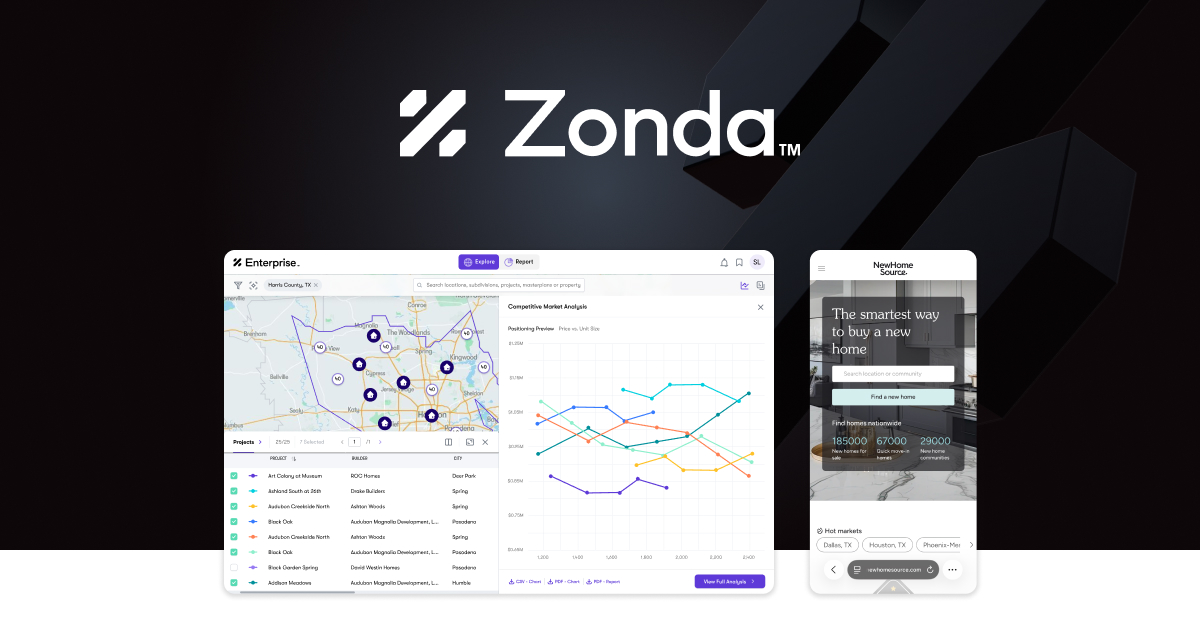
CoStar Group already knew everything about the buildings. On May 29, 2026, it moved to know everything about the land underneath them too. The Arlington, Virginia-based real estate data giant announced an $800 million all-cash agreement to acquire Zonda, the dominant intelligence platform for North American homebuilding, in a deal that gives CoStar ownership of the most granular new-construction dataset in existence: lot-level data covering land development, construction activity, builder operations, community launches, and new-home sales across thousands of communities. For a company that has spent four decades turning real estate opacity into information advantage, the acquisition of Zonda is not simply a product extension. It is the closing chapter of a decades-long effort to map every corner of the property industry.
The Machine That Knows What Gets Built
At the center of the Zonda deal is a proprietary database with no real equivalent. Where most real estate data firms track what has already been sold or listed, Zonda tracks what is being planned, permitted, constructed, and marketed. Its lot-level records cover new home communities across the United States and Canada, capturing data on land acquisition, construction status, builder pricing, absorption rates, and community launches. More than 500 housing metrics flow through the platform. The majority of Zonda's revenue is subscription-based, with a net customer retention rate of 104 percent, meaning existing customers spend more year over year. Zonda counts more than 3,000 customers including many of the largest residential builders, developers, lenders, and building product manufacturers in North America. These are not passive data consumers. They use Zonda every day to make land bids, allocate capital, set pricing, and project sales timelines.
That workflow dependency is critical to understanding the deal. CoStar's strategy has always been to become so embedded in an industry's daily operations that departing would be operationally unthinkable. In commercial real estate, the CoStar Suite reached that status years ago. With Zonda, CoStar acquires an equivalent chokehold on the residential construction supply chain, positioned upstream of the MLS, upstream of listing portals, and upstream of every consumer who eventually searches for a new home on Homes.com or NewHomeSource.
Andy Florance, who founded CoStar in 1986 and has led the company for nearly four decades, described Zonda as holding "one of the most valuable proprietary datasets in new home real estate." What he left understated is the strategic timing. According to Census data cited by CoStar in the announcement, the annual value of new residential construction in the United States approaches one trillion dollars. That is, as CoStar noted, materially larger than the annual rent rolls of the institutional apartment and office sectors the company has already successfully monetized.
A Roll-Up Comes to Market
Zonda did not emerge from a single founder's vision. It was assembled through a series of acquisitions orchestrated by New York-based private equity firm MidOcean Partners, which brought together two complementary businesses in 2018: Hanley Wood, a B2B information services company with deep roots in the residential construction industry dating to 1976, and Meyers Research, a real-time market data and advisory firm focused on homebuilders and developers. Hanley Wood had already expanded from a media company into a data platform with its 2013 acquisition of Metrostudy, one of the most respected new-home construction datasets in the country. Meyers Research, founded in 2006 by Jeff Meyers, had built the actual technology platform that would eventually carry the Zonda name, a system used by homebuilder executives to analyze land markets and inform capital decisions. MidOcean combined these assets, rebranded the combined company as Zonda in October 2020, and continued adding capabilities through further acquisitions including satellite imagery, Canadian urban housing analytics through Urban Analytics, and consumer marketplaces.
The most consequential marketplace addition came with the integration of NewHomeSource, the largest new-home listings platform in the United States, and Livabl, its Canadian counterpart. These two consumer-facing portals now come to CoStar as part of the $800 million transaction, giving CoStar not only the builder-side intelligence but the consumer-facing marketplace for new construction. The deal is expected to close in the second half of 2026.
The Acquisition Playbook, Executed Again
CoStar's expansion has followed a recognizable logic: identify a segment of real estate where information is fragmented and undermonetized, acquire the best data asset in that segment, and convert the resulting intelligence advantage into subscription revenue. The company's track record runs from LoopNet, acquired in 2012 for $860 million to dominate commercial listings, to Apartments.com, acquired in 2014 for $585 million to lead multifamily, to STR for hospitality benchmarking, to Ten-X for commercial auctions, to OnTheMarket in the United Kingdom, to Domain in Australia. The February 2025 completion of the Matterport acquisition for $1.6 billion added a spatial data library covering more than 14 million physical spaces and 50 billion square feet across 177 countries, giving CoStar the ability to turn any building into a navigable 3D digital twin.
Each of those moves filled a gap. Zonda fills the most consequential remaining one: new residential construction. CoStar's first-quarter 2026 revenue was $897 million, up 23 percent year over year, its 60th consecutive quarter of double-digit revenue growth. The company expects full-year 2026 revenue in the range of $3.78 billion to $3.82 billion. The $800 million Zonda purchase is expected to be accretive to adjusted earnings per share in its first full year of ownership.
Investor Turbulence as Strategic Context
The Zonda announcement arrives at a moment of unusual tension in CoStar's history. In January 2026, hedge fund Third Point, led by billionaire Daniel Loeb, launched a public proxy fight against CoStar's board, characterizing the company's investment in Homes.com as a "fiasco" and demanding that the company exit residential real estate entirely. Third Point argued that CoStar had poured roughly $3 billion into Homes.com with what it characterized as negligible returns, generating only about $80 million in revenue from the venture in 2025. Hedge fund D.E. Shaw joined the criticism in February, calling CoStar's Homes.com strategy "high-risk" and "money-losing" and calling for leadership change. Third Point ultimately sold its stake in April 2026 after CoStar announced it would cut annual net investment in Homes.com by 35 percent, to $550 million, with continued reductions planned through 2030.
The Zonda acquisition, announced six weeks after Third Point's exit, reframes the company's residential ambitions in a different register. Rather than defending a consumer portal in a competitive market dominated by Zillow, Realtor.com, and Redfin, CoStar is purchasing something those competitors cannot match: the proprietary data layer that sits below every new home before it ever appears on a listing portal. The deal does not answer every critique of Homes.com. But it demonstrates that Florance's residential strategy was never solely about winning a portal war. It was about owning the information infrastructure for every segment of residential real estate, including the segment that produces the housing supply itself.
From Dirt Lot to Closing Table
The phrase CoStar uses internally to describe the Zonda combination is "the full lifecycle of new home development." That is not marketing language. It describes an actual capability that no competitor currently possesses. When a builder's land team evaluates a raw parcel in a suburban growth corridor, Zonda's database informs the decision: what comparable communities are selling nearby, what absorption rates suggest about pricing, what permit activity signals about future competition. When that same builder breaks ground, Zonda tracks the construction schedule. When it opens sales, Zonda's marketing tools manage buyer leads. When a consumer eventually discovers the community through NewHomeSource or Livabl, that is also Zonda. Now that entire chain sits inside CoStar.
The addition of Matterport strengthens what happens at the consumer end of this chain. CoStar has indicated that Zonda's Envision visualization and digital merchandising platform will be paired with Matterport's spatial technology to create richer digital experiences for new construction marketing. Buyers will be able to move through a 3D model of an unbuilt home, selecting finishes and viewing configurations before the foundation is poured. That product combination is genuinely new in the market, and it is only possible because CoStar now controls the technology on both sides: the builder's sales toolkit and the spatial visualization engine.
Concentration and Its Consequences
For the homebuilding and commercial real estate industries, the Zonda acquisition accelerates a trend that has been building for a decade: the consolidation of real estate data into fewer and fewer hands. CoStar's brands already attract 131 million average monthly unique visitors. Its CoStar Suite dominates commercial research. Apartments.com leads multifamily. Homes.com is growing in residential resale. With Zonda, the company now adds the dominant new-construction data platform, the largest new-home consumer marketplace, and builder workflow software used daily by thousands of firms.
That concentration has competitive implications that will play out over years. Lenders who use Zonda's data for underwriting decisions and builders who rely on its forecasts for land acquisition will continue to do so, but they will do so as customers of a company that also operates the marketplace where their homes are marketed. CoStar has consistently argued that its model serves all participants by improving information quality. Critics of data consolidation would note that when one company controls data at every stage of a market, the distinction between information provider and market infrastructure begins to blur.
A Declaration of Position
Andy Florance built CoStar on a simple premise: that real estate operates on information asymmetry, and that whoever eliminates the asymmetry collects the value. He began in commercial real estate because it was the most opaque, the most dependent on relationships, and therefore the most rewarding to illuminate. Four decades later, his company has methodically illuminated every other major segment: apartments, hospitality, residential resale, 3D visualization, and now the construction pipeline that creates the housing stock itself.
What distinguishes the Zonda acquisition from the others is the directionality it represents. Every prior acquisition brought CoStar into a market that already existed. Zonda brings CoStar into the market before the market exists, tracking demand, supply, and construction activity at a stage when the homes being counted have not yet been built. For an industry that has spent decades wrestling with housing undersupply, that kind of forward-looking visibility has structural importance that transcends any single transaction. CoStar is not merely tracking real estate anymore. It is tracking the conditions under which real estate will exist. That shift in scope is the actual story behind the $800 million.