A Columbia PhD Is Building Elves, and a Game Studio Wants One in the Flesh
AheadForm turned a robot face into a venture-backed supply business in barely two years, selling the one part of the humanoid that most robot makers forgot to build.
By Carry and Conquer Publications
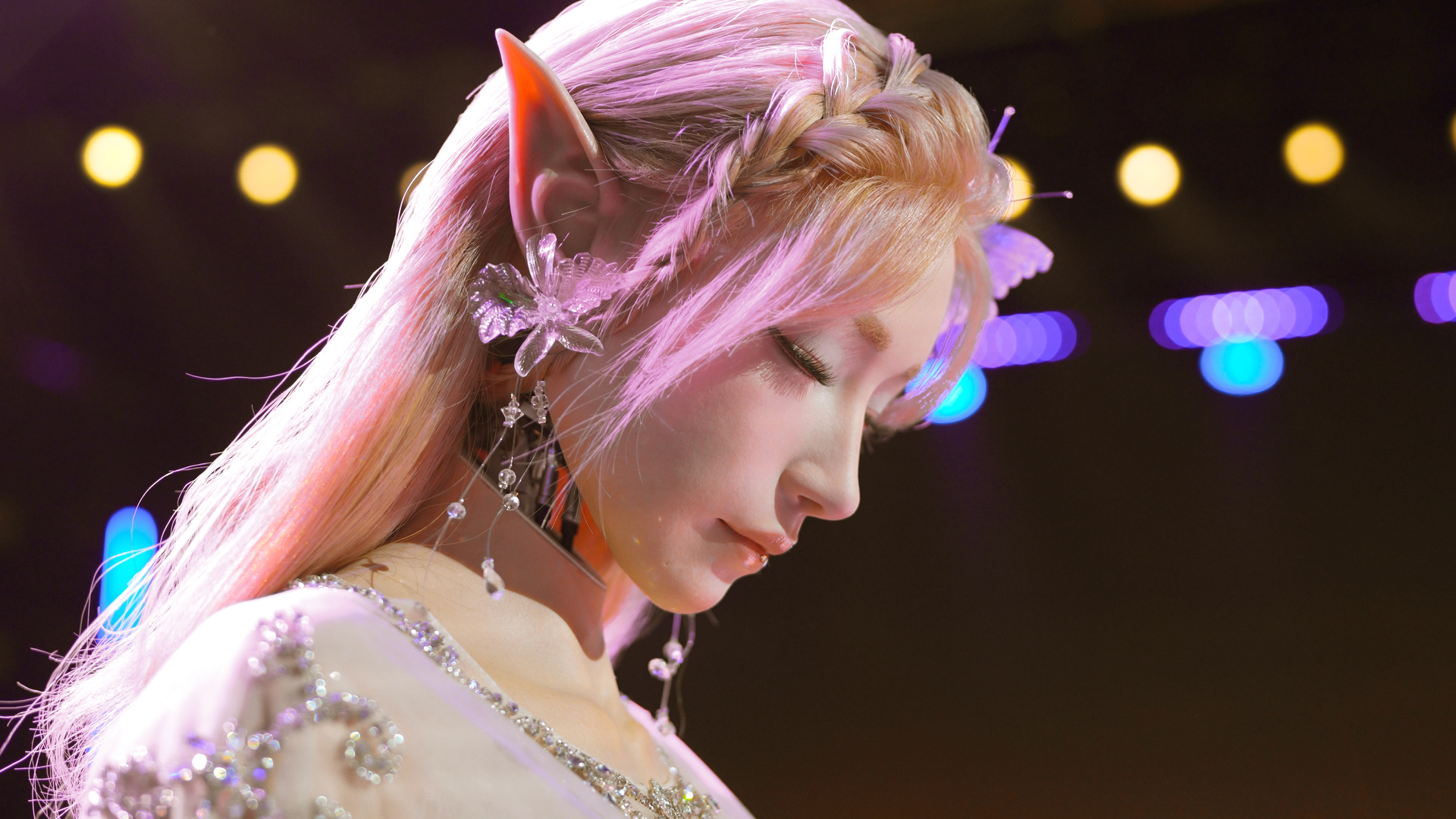
On a stage at Shanghai's INCLUSION Conference on the Bund in September 2026, a pink-haired android stood beside a human cosplayer styled to match, a staging choice that put the boundary between person and machine on public display. The android was Elf Xuan 2.0, the newest creation of AheadForm, a startup founded in 2024 by Yuhang Hu while he was still finishing a robotics PhD at Columbia University. Months earlier the same character had sung a love ballad, written by Hu himself, to an audience made entirely of robots at AgiBot's Lunar New Year gala. Humanoid robotics has spent years chasing legs, hands and warehouse payloads, and Hu has built a company on the opposite bet: that the face is where the money is.
From Emo to an Elf
The technical lineage starts in Hod Lipson's Creative Machines Lab at Columbia, where Hu was lead author on a March 2024 paper in Science Robotics describing Emo, a robot head with 26 actuators beneath a blue silicone face. Nobody scripted its expressions. Emo was placed in front of a camera and allowed to move at random until it learned which motor commands produced which facial shapes, much as a person learns by pulling faces in a mirror. A second model then watched hundreds of videos of human faces and learned to read the first flicker of an approaching smile. The result: Emo could anticipate a smile roughly 839 milliseconds before a person made it and begin smiling at the same moment, which matters because a reaction that arrives late reads as fake.
Hu, born in 1997 and raised in Quanzhou on China's southeast coast, launched AheadForm in June 2024 with a mission statement that doubles as its name: give artificial intelligence a head. He later followed Emo with work on lip synchronization, a robot face whose silicone lips could form shapes covering 24 consonants and 16 vowels. Lips are a notorious trap for android makers, because audiences forgive a stiff arm far sooner than a mouth that drifts out of sync with the voice.
The commercial products retain that DNA. AheadForm sells four families. The Origin series, including the male M1 and female F1, are deliberately neutral, biomimetic faces for desktop and display use; the M1 was shown with up to 25 micro motors and RGB cameras embedded in the pupils. The Elf series, led by Xuan and Iridium, trades photorealism for a stylized, pointed-eared look that company watchers say also sidesteps the uncanny valley, since a viewer's brain registers that an elf is not a person and relaxes. The Mecha series covers mechanical, IP-friendly designs, including a head styled after the robot from the film Chappie. And the Mimetic series promises one-to-one likenesses of specific people, down to a cloned voice.
The hardware claims are specific. Reporting on the Elf line cites more than 30 degrees of freedom in the face alone, driven by compact brushless micro-motors under layered silicone skin that the company says is reproduced to submillimeter accuracy, with tiny surface vessels included for realism. A 2026 upgrade has been reported at 42 independent facial motors. Elf Xuan 2.0, unveiled ahead of the World Robot Conference in Beijing in August 2026, adds an articulated upper body with expanded arm movement, and coverage describes AheadForm as inching toward bipedal locomotion rather than promising it.
The Game Studio That Went First
The clearest proof of demand came from entertainment. In September 2025, Nishuihan, NetEase's martial-arts mobile game, partnered with AheadForm to present Elf Xuan wearing an in-game costume, an early sign that a virtual wardrobe could be worn by a physical performer. Three months later the studio went further. The partners produced what Chinese media called the country's first game-character bionic robot: Fang Chengyi, a character from the game, built on the Origin M1 platform and shown to fans at the CP32 pre convention in Hangzhou in December 2025.
According to 36Kr, the Fang Chengyi face has 30 movable muscle units and can perform 12 micro-expressions. Binocular cameras track where visitors stand, and a thermostat holds the skin surface near 36.5 degrees Celsius, roughly human body temperature. Each unit is closer to a commissioned sculpture than a catalog item: the face structure, skin, hairstyle, voice and personality are all tuned to a single character.
That customization is both the product and the problem. A game studio gets a physical performer that can greet fans at conventions, and a brand gets a mascot that answers questions. AheadForm gets a showcase that costs a great deal of engineering time to repeat, which explains why its latest funding was earmarked in part for a standardized production line.
The Head Supplier Thesis
Strip away the elf ears and the strategy is a component play. Most humanoid makers, including AgiBot and Unitree, concentrate on bodies, joints, hands and motion control, and few of them have a convincing face. 36Kr's analysis puts it plainly: AheadForm could standardize its heads so other manufacturers bolt them onto their own bodies. AgiBot backed that logic early, investing at the angel stage and then featuring Xuan at its gala.
The same logic extends to the IP economy. Games have popular non-player characters, museums have historical figures, theme parks have film characters and brands have virtual spokespeople. All of them currently live on screens or inside costumes worn by human actors. A face that can hold eye contact, speak in sync and carry a licensed character into a flagship store is a different product from a general-purpose humanoid, and it competes in a far less crowded field. Pricing reflects that. Custom units reportedly run from about 50,000 dollars to more than 150,000 dollars, which sits in the range of the best-known rival, Engineered Arts of Britain, whose Ameca robot sells only by quotation. Third-party estimates for Ameca generally start near 100,000 dollars and climb much higher, but the company publishes no list price.
AheadForm is also trying rental, with Elf Xuan and a desktop F1 lite model listed on a Chinese robot-leasing platform, a route that lowers the entry price for event organizers who need a performer for a weekend rather than a decade.
A Financing Machine
Capital has followed the thesis with unusual speed. Hu has acknowledged that more than 100 investors turned down his face-first pitch in the year before one of his early rounds. Then the cap table filled. Seed money came from the MiraclePlus incubator and angel investors, and AgiBot invested at the angel stage. Shunwei Capital led a later round, with China Merchants Venture, Shenzhen Capital Group and AgiBot following on, and Ant Group led a round of more than 100 million yuan, with Jinqiu Fund joining. In April 2026 the company announced a Series A1 of several hundred million yuan, co-led by Huakong Fund and an unnamed major internet company. In July came an A2 of several hundred million yuan, in which Shunwei made an oversubscribed follow-on investment. 36Kr counts it as AheadForm's seventh round since founding.
Data providers disagree on the totals. Dealroom lists the two 2026 rounds at about 14 million and 28 million dollars, with an implied valuation near 110 million dollars after the latest, while PitchBook shows 28.5 million dollars raised across 31 investors. Forbes describes backers including Ant Group, 5Y Capital and JD.com. Because AheadForm discloses little itself, every figure here should be read as reported rather than confirmed.
What the Face Has to Prove
The skeptics have a case. 36Kr notes that more than a year after its viral Emo-style video, AheadForm's core products remain heads and upper bodies, and that pricing, customer counts, order volumes and delivered units are not fully disclosed. A million likes prove people will watch, the outlet argues, not that they will repurchase. A screen showing an animated avatar can chat and explain exhibits for a fraction of the cost, and factory robots that lift boxes have no use for lifelike lips.
The market has also shown how fickle enthusiasm for hyper-realism can be. When UBTech launched its ultra-bionic U1 series, a reported 13,000 orders sent the stock sharply higher, only for it to fall about 24 percent across six consecutive sessions. Investors liked the headline more than the unit economics.
Hu's answer is a long-horizon one. He has said bubbles exist, but that a company which sticks to its niche should outlast them, and he has argued that for at least the next five years the value of humanoids lies in service and emotional support rather than industrial output. If that proves true, AheadForm's wager is simple. The firms that sell the body will fight over price. The firm that sells the face, and the right to put a beloved character behind it, can charge for the part that people actually remember.