$28 Million for Two Billion-Dollar Brands: The Collapse of CareerBuilder + Monster
How Apollo Global Management's asset-harvest strategy, a debt-laden Hail Mary merger, and a decade of competitive inaction turned two internet icons into a $57 million liquidation.
By Carry and Conquer Publications
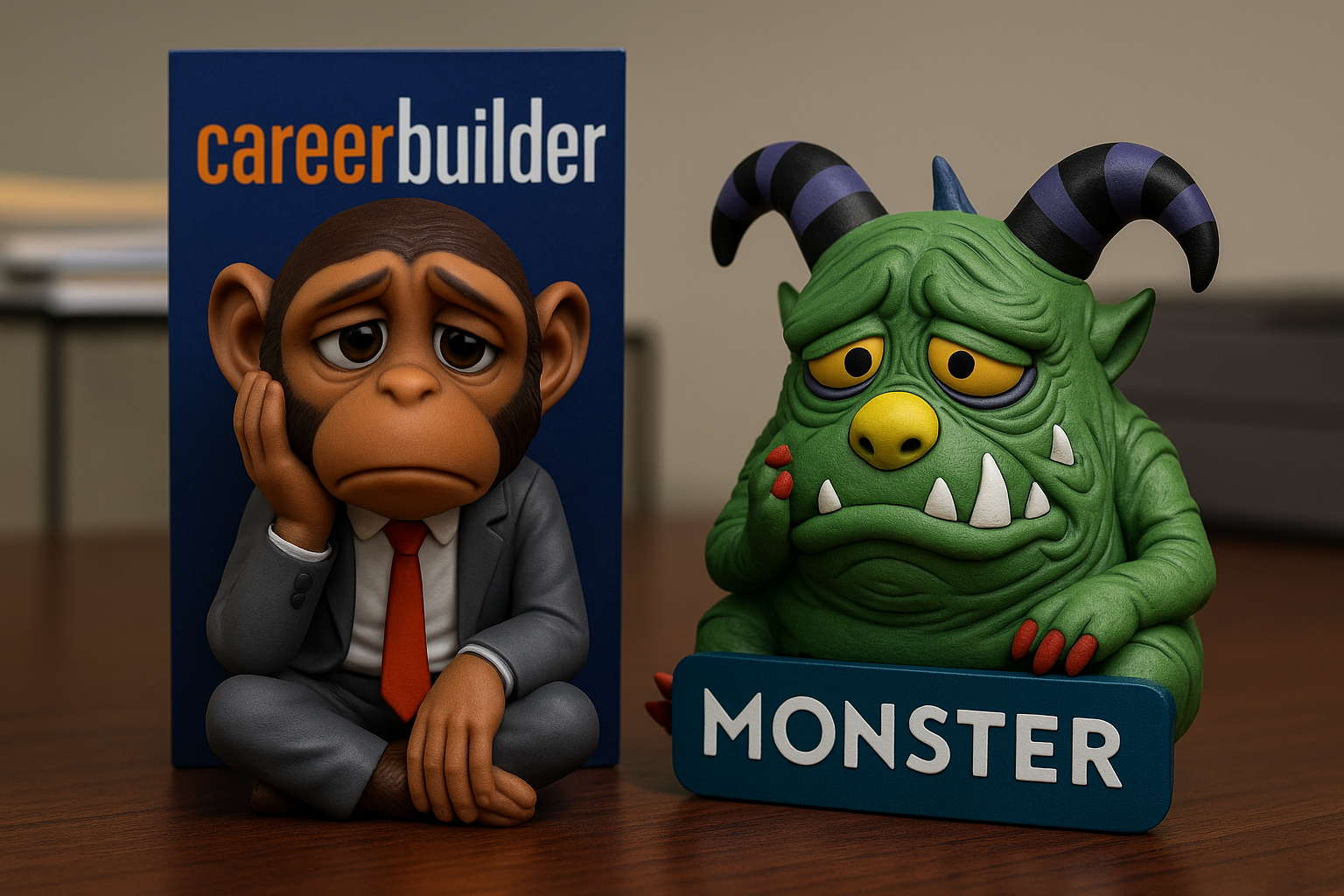
Nine months. That is how long it took for the merger of CareerBuilder and Monster - once the two most recognizable job boards in the world - to travel from closing announcement to Chapter 11 bankruptcy filing. The joint venture, operating as Zen JV LLC and backed by Apollo Global Management and Randstad NV, filed for bankruptcy protection in Delaware on June 24, 2025, with $2.2 million in cash on hand and liabilities estimated at up to $500 million. In July 2025, its core job board assets sold at auction for $28.4 million - a figure that captures, in one number, what thirty years of brand equity and institutional inertia can be worth when a business model has been obsolete for a decade but no one in the ownership chain was willing to say so.
Two Brands That Defined an Era
Monster.com launched in 1994. CareerBuilder followed in 1995. Together they helped invent the category of online job search, pulling classified advertising out of newspapers and building an internet-native model for connecting employers and candidates at scale. Monster was so dominant in its early years that it routinely bought Super Bowl commercials - its 1999 "When I Grow Up" ad, in which children sarcastically described wanting meaningless careers, became one of the most remembered spots of the dot-com era. At its March 2000 peak, Monster's market capitalization touched $8.5 billion.
CareerBuilder had the largest market share among US online job boards by 2008. Both platforms were genuine infrastructure businesses in the early internet economy - the places where a large portion of all white-collar hiring happened.
The institutional ownership history tells the story of the decline. Randstad NV, the Dutch staffing conglomerate, acquired Monster in 2016 for $429 million - a price that represented roughly a 95% discount from its 2000 peak valuation. Apollo Global Management acquired CareerBuilder in 2017 for approximately $500 million, along with the Ontario Teachers' Pension Plan Board. From those two acquisition dates forward, both companies were in the hands of owners who, by the financial logic of their respective mandates, had limited appetite for the kind of patient platform investment that rebuilding a technology product against entrenched competitors requires.
How Indeed and LinkedIn Won Without a Fight
The story of why CareerBuilder and Monster lost is not primarily a story of bad management, though there was plenty of that. It is a story of business model obsolescence that was visible years before either company acknowledged it.
Indeed, founded in 2004, introduced a freemium aggregator model that fundamentally undercut the subscription pricing on which CareerBuilder and Monster depended. Rather than charging employers $279 to $349 per month for a job posting, Indeed indexed listings from across the web for free and charged only for sponsored placement on a pay-per-click basis. For employers, the economics were immediate and obvious. For the legacy boards, allowing Indeed to crawl and distribute their listings was - as industry observers have noted since - one of the most consequential competitive missteps in the history of internet business. A cease-and-desist in the mid-2000s might have altered the outcome. Instead, both CareerBuilder and Monster facilitated the aggregator model that eventually killed them.
LinkedIn, meanwhile, quietly built the professional social network that turned passive candidate sourcing into a direct-to-recruiter product. By the time both legacy boards recognized the threat, LinkedIn had already accumulated hundreds of millions of professional profiles and had been acquired by Microsoft for $26.2 billion in 2016. At the time of that acquisition, Monster was sold to Randstad for $429 million.
The Apollo Play and the Stripped Asset Base
Apollo's ownership of CareerBuilder followed a pattern familiar to observers of private equity's approach to legacy tech assets. The firm sold off Broadbean, the UK-based programmatic recruitment technology it had acquired with CareerBuilder. It sold TextKernel, the AI-powered talent matching platform. It divested EMSI, the labor market analytics business. Each sale returned capital. What remained after the asset harvest was the hollowed-out core: the CareerBuilder brand, the candidate database, and a job board business that was generating roughly $82 million in revenue in 2023 before collapsing 40% to $49.2 million in 2024, according to Moody's data reported by Bloomberg.
Industry insiders at the AIM Group, which tracks recruitment marketplaces, estimate that Apollo may have recouped as much as seven times its initial investment through the combined asset sales and operational profits before the business deteriorated. That framing is important for understanding the bankruptcy: from Apollo's perspective, the $28.4 million fire-sale price on the rump job board assets was not a catastrophic loss. It was a residual recovery on an investment that had already been substantially harvested. For the hundreds of employees who received two weeks of severance regardless of tenure, and for the vendors owed millions they will not recover, the calculus was different.
The Merger That Changed Nothing
The September 2024 combination of CareerBuilder and Monster into Zen JV LLC was announced in language that bore no relationship to the actual condition of either business. Management described the merger as bringing together two trusted brands with best-in-class solutions to create a stronger job board. Industry analysts were less charitable. Job Board Doctor, one of the more credible trade publications covering the sector, described it as two dumpster fires merging into a larger one. The combined entity would rank 20th globally among online job advertising platforms by traffic - behind Indeed, LinkedIn, ZipRecruiter, and a long list of niche competitors.
The new entity entered the merger carrying $392.5 million in debt. Revenue was already in freefall. The Zen JV structure, as bankruptcy filings subsequently revealed, was designed to legally insulate Apollo and Randstad from the operating entity's liabilities - a separation that protected the private equity sponsors while leaving vendors, creditors, and employees exposed. By Q3 2024, within weeks of the merger closing, vendors were reporting that CareerBuilder had stopped paying invoices. Thirty-day payment terms stretched to 45, then 90 days. Programmatic advertising partners - including Google, which was owed more than $14 million - began pulling traffic. The company that had just announced a merger for strength was hemorrhaging the very partners who drove its revenue.
The Auction and the Aftermath
CareerBuilder + Monster filed for Chapter 11 on June 24, 2025 with $2.2 million in cash, $20 million in debtor-in-possession financing from JMB Capital Partners, and three pre-arranged stalking-horse bids. The initial bid for the core job board business was $7 million. At auction, Bold Holdings - operator of ResumeBuilder.com and related career sites - won with a final bid of $28.4 million. Military.com and FastWeb.com sold to Valnet for $27 million. Monster Government Services went to Valsoft for $13 million. Total recoveries across all divisions: approximately $57 million against liabilities that the company itself estimated at up to $500 million. Unsecured creditors were told to expect nothing.
Bold retained approximately 350 employees and the brand names. Whether it can extract value from the Monster and CareerBuilder databases and brand recognition in a market now dominated by AI-powered hiring tools - LinkedIn Recruiter, Indeed Smart Sourcing, and a rapidly expanding roster of purpose-built AI agents - remains an open question. The new owner operates in a very different environment than the one that made those brand names valuable.
The Private Equity Lesson the Market Has Not Fully Absorbed
The CareerBuilder + Monster collapse is not primarily a story about job boards or about the particular strategic failures of two legacy platforms. It is a story about what happens when private equity applies a harvest strategy to a technology business that requires sustained platform investment to remain competitive - and about the structural incentives that make that outcome nearly inevitable.
Apollo's mandate, like that of all private equity funds, is to generate returns for limited partners within a defined time horizon. The best way to generate returns from a declining-revenue software business is to monetize its existing assets - the databases, the technology components, the ancillary products - and return capital to investors. That is precisely what Apollo did, and by the firm's own internal measure, it likely worked. What it also did was accelerate the terminal decline of the operating business, eliminate any possibility of the investment in product development that might have kept CareerBuilder competitive, and ultimately leave a hollowed-out shell that, when merged with an equally hollowed-out Monster, could not survive even a single year as a combined entity.
For investors evaluating PE-backed legacy technology turnarounds, the Zen JV bankruptcy offers a template of what to avoid: two declining-revenue assets combined under a debt-laden holdco with no product differentiation, no path to competitive parity with free-to-post aggregators, and an ownership structure explicitly designed to protect the sponsors from the downside. The $28 million recovery on two brands that were collectively worth over $9 billion at their peak is the answer to the question of what that structure produces for everyone else.